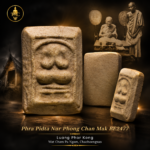
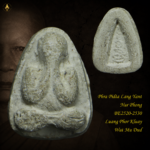
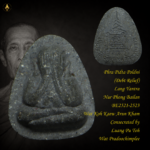
Phra Pidta Nur Phong Chan Mak BE2477 Luang Phor Khong (Lp Khong) Wat Sam Phan Ngam, Chacheongsao
| Type | Phra Pidta |
| Monk | Luang Phor Khong |
| Temple | Wat Sam Phan Ngam |
| B.E. Year | 2477 |
| Material | Phong Chan Mak |
| SKU | TAC-0095 |
Authentic Phra Pidta by Luang Phor Khong, Wat Sam Phan Ngam BE 2477. Phong Chan Mak nuea. Pre-war Chachoengsao piece. Available from TAC, Singapore.
What is the Phra Pidta by Luang Phor Khong from Wat Sam Phan Ngam, BE 2477?
The Phra Pidta Luang Phor Khong is a sacred powder amulet pressed in BE 2477 (1934) at Wat Sam Phan Ngam, Chachoengsao Province. Its nuea — the phong (sacred powder) base — is Phong Chan Mak, ground from betel nut, giving the piece its characteristic brown-to-reddish-brown tone and compact granular surface.
Who was Luang Phor Khong, and why does this piece carry weight?
Luang Phor Khong Suwanno was born around BE 2377 (1834) in Phra Tabong, the Khmer region of what is now Battambang, Cambodia. He ordained as a novice at fifteen, then studied Pali scripture and advanced Khmer occult sciences under established Khmer meditation masters — a lineage that shaped his approach to amulet-making for the rest of his life.
He served as principal abbot of Wat Sam Phan Ngam in Amphoe Sanam Chai Khet, and he passed around BE 2485 (1942) at an estimated age of 108. That longevity and his Khmer-rooted training are exactly what collectors point to when explaining the standing of anything he produced. His known sacred objects span BE 2483 commemorative coins in silver, alpaca and copper variants, yantra shirts, and takrut (rolled metal scroll) — the Phra Pidta from BE 2477 predates all of those.
A rare sepia photograph by the Eiam Huang studio, estimated between BE 2477 and 2480, shows him seated during a consecration rite at roughly 100–103 years old. It is one of the few visual records placing him in active ritual at the period this piece was made.
The nuea and what makes this pim distinctive
Phong Chan Mak — phong derived primarily from ground betel nut, likely blended with ancient powders and herbal compounds — is the defining nuea here. Betel nut is organic and perishable, which is part of why surviving examples from this era are limited. The compact texture with natural granule visibility is what you are looking at when you authenticate the material; pieces pressed from this muan sarn have a density and colour range that does not read the same as later synthetic or lime-based powders.
The form is classic Phra Pidta — the meditating figure with both hands covering the face, the iconographic posture associated with withdrawal from sensory distraction. Back design varies across surviving pieces: some are plain, others carry hand-inscribed yant (sacred inscriptions) or coded markings. The amulet is small, sized for personal wear.
Consecration was personal — Luang Phor Khong blessed the batch through prolonged chanting, meditation, and protective spell invocation. There may have been additional communal pluk sek (consecration ceremony) sessions involving Khmer masters or his disciples, though precise records of a formal phutthaphisek gathering for this run have not been documented. His two notable disciples, Chao Phraya Abhai Bhubejhr and Luang Pho Mi of Wat Sam Phan Ngam, were both connected to his broader spiritual circle.
Within the Thai Buddhist amulet tradition, Phong Chan Mak pieces from the early Rattanakosin period are among the more fragile categories — age, organic composition, and limited original production numbers all constrain supply.
What collectors look for when authenticating this piece
No certificate is listed for this piece, so authentication rests on physical inspection against known reference examples. Key points to assess:
- Nuea colour: brown to reddish-brown consistent with a betel nut phong base — not pale, not uniform
- Surface granularity: natural visible granule structure, compact but not smooth or recast-looking
- Age patina appropriate to a piece pressed in 1934 — nearly 90 years of wear and oxidation
- Pim (mould) lines and figure proportion consistent with documented Wat Sam Phan Ngam examples from this period
- Back face: check whether yant markings, if present, match known hand-inscribed patterns attributed to this temple and period
Because no certification accompanies this piece, comparison against niyom (collector-standard reference) examples and consultation with specialists familiar with early Chachoengsao material is the practical route for buyers doing due diligence.
We acquired this Phra Pidta Luang Phor Khong in Phong Chan Mak nuea from BE 2477 — one of the earlier Phra Pidta of this material type from eastern Thailand, and a piece that reflects Luang Phor Khong's documented Khmer occult lineage. For collectors focused on early Thai-Khmer sacred-powder work, the combination of the monk's age, lineage, and the organic nuea makes this a reference-grade piece worth documenting carefully before it moves on.
Attributes reflect Thai Buddhist devotional tradition and are not measurable claims.