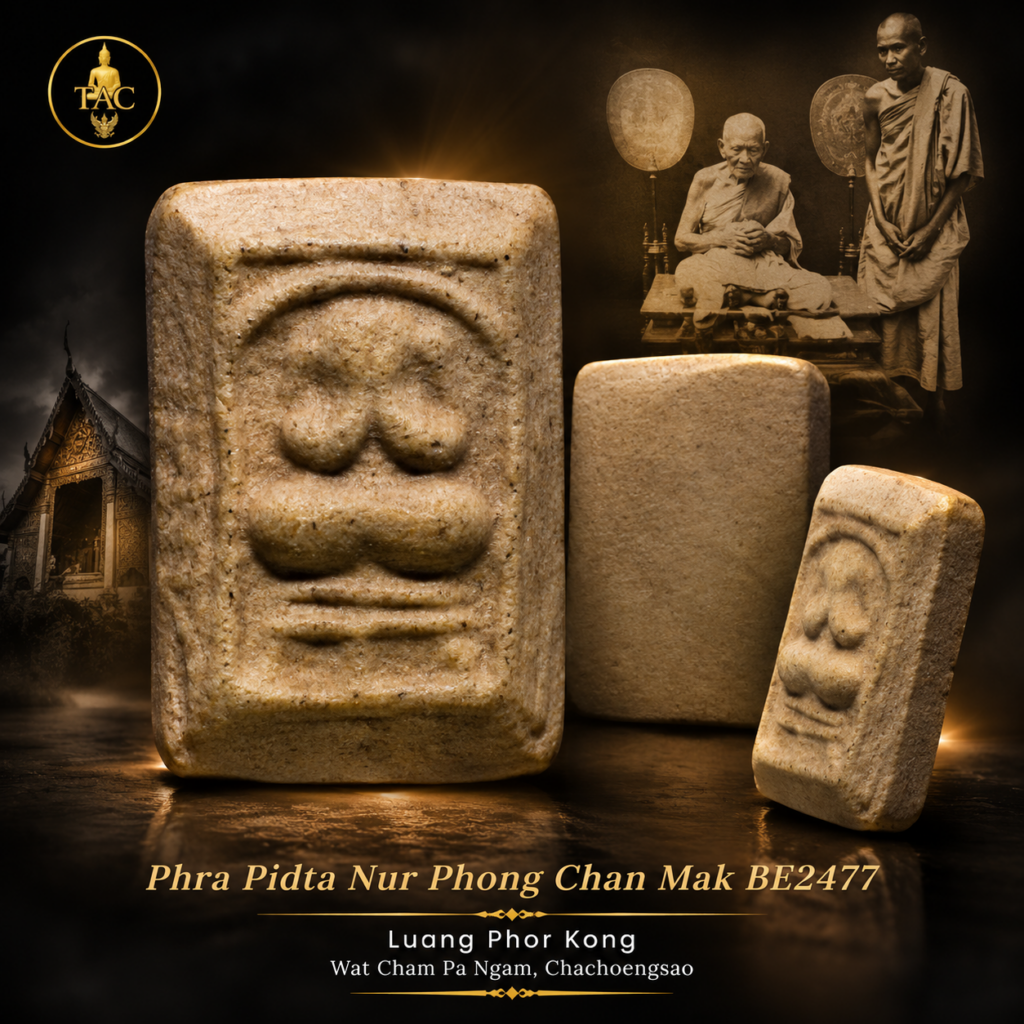
Phra Pidta Nur Phong Chan Mak BE2477 Luang Phor Kong Wat Cham Pa Ngam, Chachoengsao
| Type | Phra Pidta |
| Monk | Luang Phor Kong |
| Temple | Wat Cham Pa Ngam |
| B.E. Year | 2477 |
| Material | Nur Phong Chan Mak |
| Condition | Very Good |
| SKU | TAC-PhraPidta-LpKong-001 |
Phra Pidta Luang Phor Kong, Wat Cham Pa Ngam, Chachoengsao, BE 2477. Pressed in Nur Phong Chan Mak. A rare pre-war classical era piece handled by TAC Singapore.
What is the Phra Pidta Luang Phor Kong from Wat Cham Pa Ngam, and why do collectors seek out the BE 2477 batch?
This Phra Pidta Luang Phor Kong was produced at Wat Cham Pa Ngam, Chachoengsao in BE 2477 (1934 CE), pressed in Nur Phong Chan Mak — a betel-nut ash powder base considered among the more spiritually dense traditional nuea (materials) of the pre-war period. It is a classical-era piece by any measure, made when Thailand’s amulet tradition was still largely monk-driven rather than committee-issued.
Luang Phor Kong and the tradition behind this piece
Luang Phor Kong of Wat Cham Pa Ngam was active in Chachoengsao province during the early-to-mid Rattanakosin period — a time when monks in the Eastern provinces were producing pieces whose muan sarn (the blend of sacred powders and consecrated materials) reflected personal practice and temple lineage rather than commercial scale. His Phra Pidta works are not widely publicised, which is exactly why collectors who know the province tend to watch for them.
Chachoengsao sits in the lower Central Plains, a province with its own network of forest monks and wat whose pre-war output rarely circulated far beyond the region. Pieces from this era and this area surface infrequently, and when they do the pim (mould form) tends to be distinct enough that experienced eyes can place them without needing a certificate to begin the conversation. That said, collectors are encouraged to cross-reference with known reference examples before making any attribution call.
For context on what a pre-war Phra Pidta blessing ceremony would have looked like, the broader Thai Buddhist amulet tradition article on Wikipedia gives a useful overview of how pluk sek (consecration ceremonies) were conducted and how monks’ reputations shaped the value placed on their batches.
Nur Phong Chan Mak — what this nuea tells you about the piece
Phong Chan Mak is a powder derived from betel-nut preparations, historically used in temple ritual contexts and incorporated into sacred muan sarn blends. As a base material for Phra Pidta amulets, it produces a surface that ages distinctively — absorbing handling patina over decades in a way that mass-produced powder mixes do not replicate cleanly. A piece pressed in BE 2477 and reaching you today should carry almost ninety years of natural aging in its surface texture and tone.
When examining this nuea, the density and colour consistency of the pressed powder is worth checking closely. Pre-war phong-based pieces from Chachoengsao should show natural compaction and a patina that sits within the material, not on top of it. Surface cracking that follows the press lines rather than cutting across them is another indicator collectors look for in genuinely aged phong pieces.
What to look for when authenticating this piece
Without a certificate accompanying this batch, authentication rests on physical study of the pim and nuea. Key reference points include:
- The pim form — proportion, depth of relief, and how the closed-eye Pidta figure sits within the frame
- Surface patina consistent with Phong Chan Mak aged over eight-plus decades — colour, density, and how the material has settled at the edges
- Any yant (sacred inscription) on the reverse, its incision depth and style relative to known examples from this monk and period
- Overall weight and feel — pre-war pressed-powder pieces have a characteristic density that differs from later production
Collectors comparing this to other pre-war Phra Pidta in phong-based nuea from the same era — such as the Phra Pidta Kru BE 2459 consecrated by Luang Pu Eiam — will find useful reference points for how powder-pressed Pidta of this vintage should present, even where the pim and monk differ. For phong nuea with yant reverse, the Phra Pidta Lang Yant by Luang Phor Kluay also offers a useful surface-texture comparison, though it is a later batch.
This is a pre-war Phra Pidta in Phong Chan Mak from Luang Phor Kong of Wat Cham Pa Ngam, Chachoengsao, dated BE 2477 — close to ninety years old and from a province whose early output rarely gets the attention it deserves. There is no accompanying certificate with this batch, so we recommend collectors examine the pim and nuea carefully against known reference pieces; we are happy to assist with comparisons from our records. A genuine piece of this age and nuea in solid condition is the kind of item that tends to disappear quietly into a serious collection.
Attributes reflect Thai Buddhist devotional tradition and are not measurable claims.


