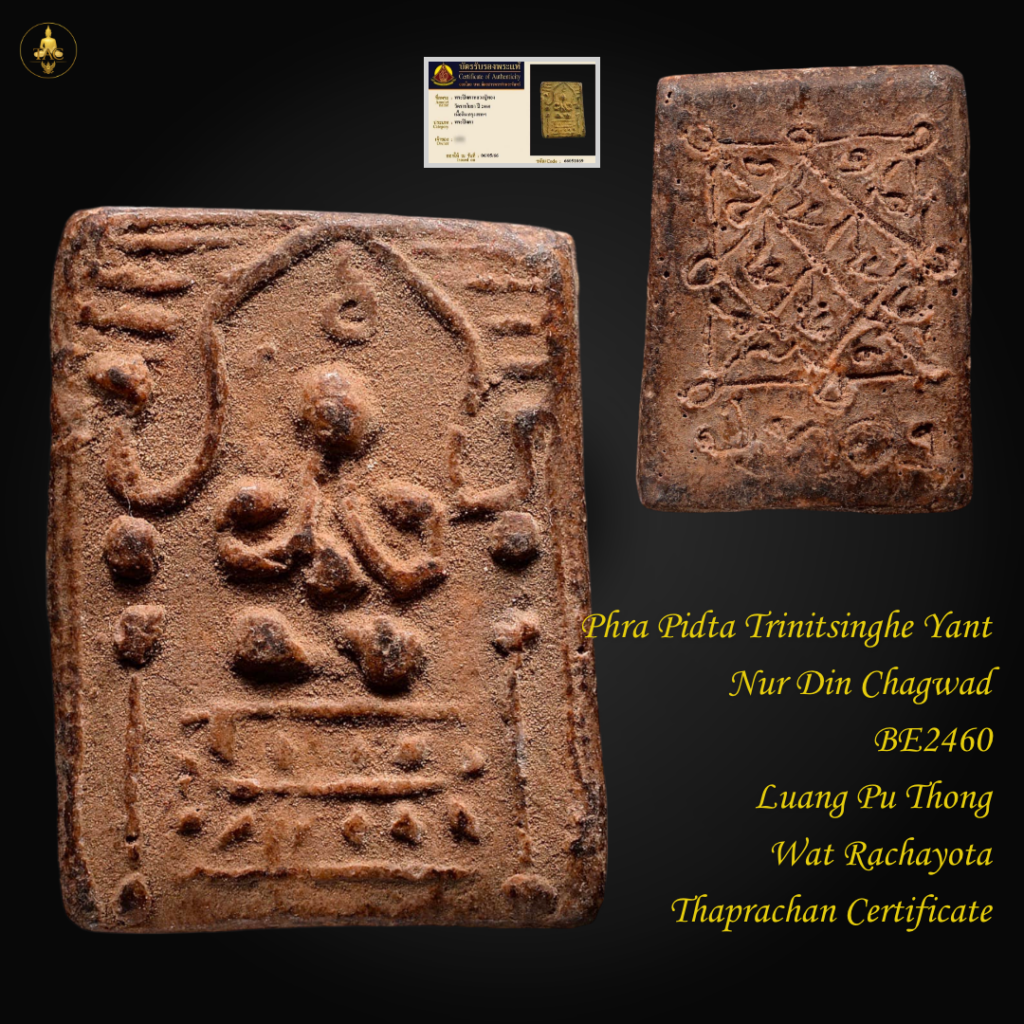
Phra Pidta Trinitsinghe Yant Nur Din Chagwad BE2460 Luang Pu Thong Wat Rachayota
| Type | Phra Pidta |
| Monk | Luang Pu Thong (Lp Thong) Wat Rachayota |
| Temple | Wat Rachayota |
| B.E. Year | 2460 |
| Material | Nur Din Chagwad |
| Condition | Good |
| Certificate | Thaprachan |
| SKU | TAC-0138 |
Phra Pidta Trinitsinghe Yant Nur Din Chagwad BE2460 Luang Pu Thong Wat Rachayota with Thaprachan certificate
The Phra Pidta Luang Pu Thongdam (Lp Thongdam) Wat Tha Thong, Uttaradit is among the most historically consequential closed-eye Buddha amulets held by serious collectors across Singapore and the wider Southeast Asian region, revered primarily for its powerful properties of protection and the blocking of misfortune from the devotee’s life.
Cast in Buddhist Era 2460, this Phra Pidta predates many of the most celebrated amulet series in the Thai tradition, placing it firmly within an era when sacred craftsmanship was inseparable from monastic discipline and deep meditative attainment. The amulet’s age alone marks it as a rare primary-generation piece worthy of careful study and preservation.
Luang Pu Thongdam (Lp Thongdam) Wat Tha Thong, Uttaradit was a venerated forest-tradition monk whose spiritual reputation extended well beyond his home province of Uttaradit. His amulets were produced in limited quantity, consecrated through rigorous ceremonial practice, and distributed primarily to devoted followers rather than for broad commercial circulation.
The combination of Luang Pu Thongdam’s established spiritual authority, the antiquity of the BE 2460 series, and the refined Trinitsinghe Yant sacred geometric design pressed into the clay surface gives this piece an identity that resonates deeply with collectors who value both religious heritage and material rarity.
Phra Pidta and Wat Rachayota Heritage
Wat Rachayota carries a distinguished place within Thailand’s network of historically significant Buddhist temples, serving as the ritual and spiritual ground upon which this Phra Pidta series was consecrated. The temple’s lineage and its associations with accomplished monks of the early twentieth century lend considerable weight to any amulet bearing its provenance.
The consecration of amulets at Wat Rachayota followed protocols rooted in the broader Thai Buddhist amulet tradition, in which senior monks, sacred texts, and carefully prepared materials converge through extended ceremony to imbue a physical object with protective spiritual energy. This process was not undertaken lightly, and pieces produced under such conditions are regarded by the collector community as qualitatively distinct from later, more commercially oriented productions.
For collectors evaluating provenance, the Wat Rachayota origin provides a traceable institutional context that supports both the spiritual authenticity and the documentary history of the piece. Amulets linked to this temple and to BE 2460 remain scarce in the open market.
Din Chagwad Phra Pidta — Composition and Craftsmanship
Din Chagwad is a sacred earth-based clay medium traditionally gathered from sites of recognised spiritual potency, often riverbanks, temple grounds, or locations associated with meditating masters. Its composition is considered inherently receptive to the consecration process, making it a preferred base material for high-grade votive tablets and closed-eye Buddha figures.
The Phra Pidta Luang Pu Thongdam (Lp Thongdam) Wat Tha Thong, Uttaradit in Din Chagwad carries the distinctive Trinitsinghe Yant — a sacred geometric inscription pressed or incised into the surface of the tablet. This yantra encodes protective formulas drawn from the Pali canonical tradition and amplifies the amulet’s core function of sealing negative influences away from the bearer.
Pieces produced in Din Chagwad from this era display a characteristic surface texture and density that experienced collectors learn to recognise through direct handling. The clay hardens over decades into a compact, stable matrix, and authentic examples from BE 2460 will show age patina and mineral integration consistent with over a century of natural preservation.
Spiritual Benefits of Phra Pidta by Luang Pu Thongdam (Lp Thongdam) Wat Tha Thong, Uttaradit
The Phra Pidta form — depicting the Buddha with hands covering the eyes — is doctrinally associated with the sealing off of harm, obstacles, and negative karmic influences. Devotees who wear or enshrine the Phra Pidta Luang Pu Thongdam (Lp Thongdam) Wat Tha Thong, Uttaradit regard it as a constant spiritual guardian across professional, personal, and financial spheres of life.
- Protection from harm and misfortune: The closed-eye posture symbolically blocks negative forces, creating a spiritual barrier around the devotee in daily life and during travel.
- Enhancement of personal fortune and wealth accumulation: The Phra Pidta tradition holds strong associations with Metta Maha Lap, drawing favourable conditions and financial opportunity toward the bearer.
- Shielding against malicious intentions and spiritual disturbances: The Trinitsinghe Yant on this specific series is understood to reinforce the amulet’s protective field against both physical and non-physical sources of disruption.
Phra Pidta BE 2460 — Authentication and Collector Value
The original listing references a Thaprachan certificate associated with this Phra Pidta, indicating that the piece has passed through the authentication process conducted at Tha Prachan, Bangkok’s principal amulet market and one of Thailand’s most respected centres for expert amulet appraisal. Thaprachan certification is widely recognised across collector communities in Singapore, Malaysia, Thailand, and Greater China as a credible indicator of authenticity.
Amulets from BE 2460 occupy a genuinely early stratum of the twentieth-century Thai amulet canon. The passage of over a century since consecration means that surviving examples in stable condition are encountered infrequently, and those with documented temple provenance from Wat Rachayota and monastic association with Luang Pu Thongdam (Lp Thongdam) Wat Tha Thong, Uttaradit represent a particularly narrow subset of the available market.
Collector interest in pre-World War II Thai amulets has grown steadily across the TAC markets of Singapore, Malaysia, Hong Kong, Taiwan, and China, driven by increasing awareness of early monastic lineages and the finite supply of authenticated centenary-era pieces. This demand trajectory has reinforced the long-term value positioning of the BE 2460 series.