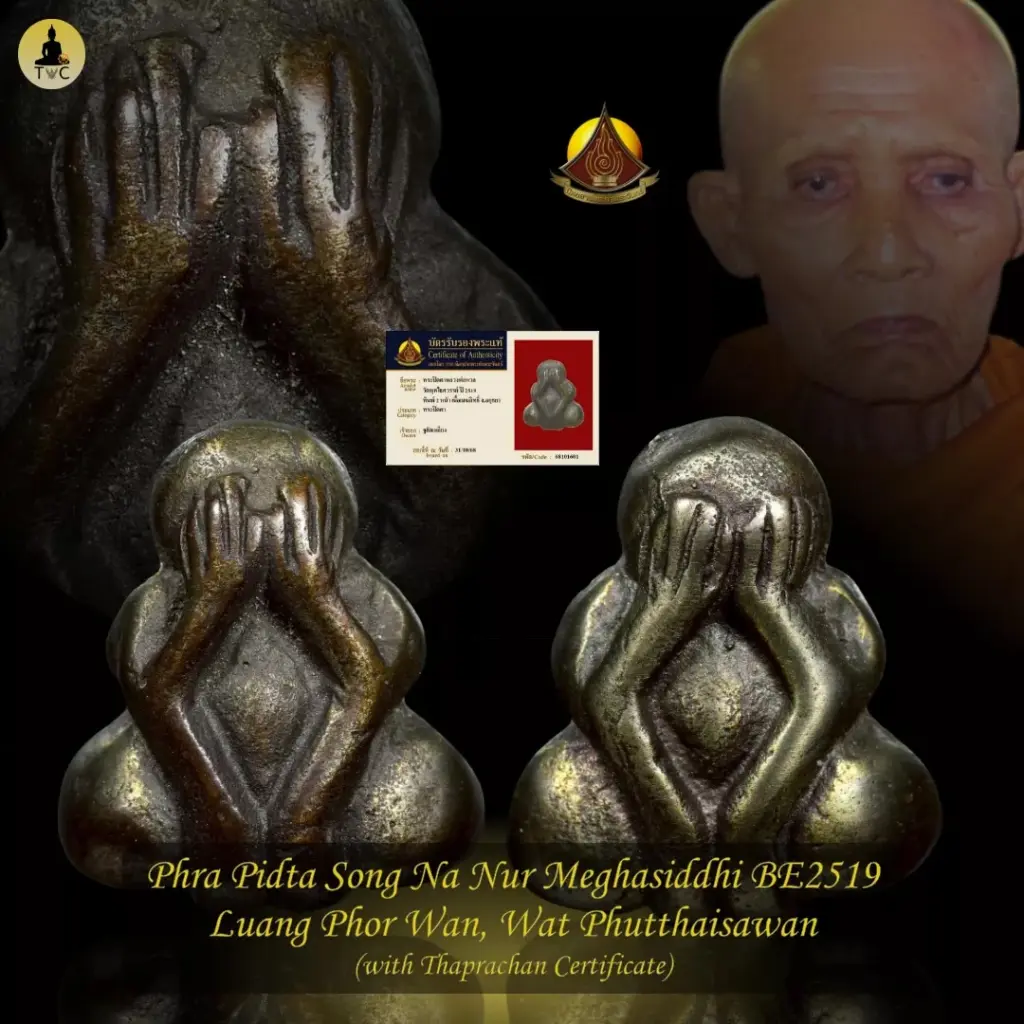
Phra Pidta Song Na Nur Meghasiddhi BE2519 Luang Phor Wan, Wat Phutthaisawan
| Type | Phra Pidta |
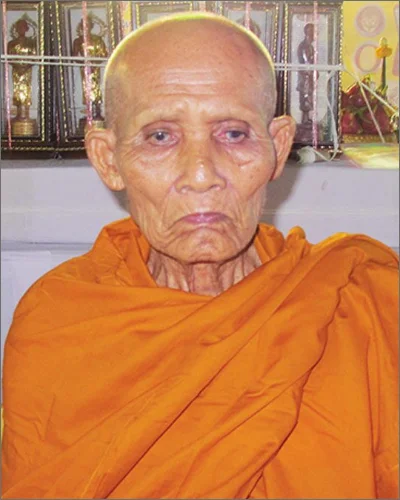
| Monk | Luang Phor Wan (Lp Wan) Wat Phutthaisawan |
| Temple | Wat Phutthaisawan |
| B.E. Year | 2519 |
| Material | Meghasiddhi |
| SKU | TAC-0546 |
Authentic Phra Pidta Song Na by Luang Phor Wan (Lp Wan) Wat Phutthaisawan, BE2519, pressed in Meghasiddhi nuea. Singapore dealer, TAC since 2015.
What is the Phra Pidta Song Na by Luang Phor Wan (Lp Wan) Wat Phutthaisawan, BE2519?
The Phra Pidta Luang Phor Wan (Lp Wan) Wat Phutthaisawan in the Song Na (two-faced) form is a BE2519 (1976 CE) piece pressed in Meghasiddhi nuea — a dark metallic material class associated with protective alloy energy in Thai belief — and consecrated at Wat Phutthaisawan under Luang Phor Wan (Lp Wan) Wat Phutthaisawan.
The Song Na Form and Why Collectors Pay Attention to It
Phra Pidta — literally “closing the eyes” (ปิดตา) — depicts a Buddha figure with both hands covering the face, turning inward. Within the broader Thai Buddhist amulet tradition, this posture signals inner mastery rather than withdrawal: staying composed when provoked, staying protected when circumstances shift.
Song Na (สองหน้า) means two-faced — not in the colloquial sense, but literally: a front face and a back face, both rendered in the Pidta posture. Collectors read this as protection working in both directions, covering seen and unseen threats simultaneously. For anyone in business, negotiations, or leadership, that dual coverage is precisely the appeal.
BE2519 sits at a point where old-school craftsmanship was still the standard. Pieces from that era carry a material character — surface density, edge softening, organic tonal depth — that later reproductions consistently fail to match convincingly. That gap is part of what drives collector interest in this period.
Meghasiddhi Nuea: What the Material Tells You
Meghasiddhi (เนื้อเมฆสิทธิ์) translates loosely as “cloud-metal” or “mystical alloy.” In practice, Thai collectors use the term for a specific class of dark metallic nuea (material/substance) that presents with a layered surface sheen and a visually dense, compact feel. The tone tends toward deep grey-black with subtle variation across the surface — not uniform, not harsh.
For this Song Na piece, the authentication study focuses on four points:
- Surface continuity: genuine ageing reads as calm and organic — no harsh etching, no suspiciously uniform patina.
- Edge behaviour: old Meghasiddhi pieces soften at the edges over decades; new-cut sharpness is a flag.
- Two-face symmetry: front and back should be balanced in thickness and curvature — warping or uneven pressing indicates problems.
- Mould integrity: the key posture proportions — hand positioning, body mass, base line — should read consistently across both faces without distortion.
The side and edge angles often reveal more than the face. Thickness consistency, mould-line behaviour, and surface continuity without tool marks are the details that separate a solid piece from a problematic one. This listing includes front, back, both side angles, and a coin-scale reference for proportion — the kind of photo set serious collectors expect before committing.
Collector Standing and What Sets Value on a BE2519 Song Na
Well-preserved Song Na Pidta pieces from BE2519 are held as long-term study pieces as much as wearable amulets. The dual-face pim (mould) is harder to execute cleanly than a single-face pressing, and pieces where both faces have aged gracefully and symmetrically are genuinely scarcer than the single-face equivalents from the same period.
Value on a BE2519 piece like this is driven by material condition, mould clarity on both faces, provenance support, and how well the piece photographs — because photo-based verification is now the standard for collectors across Singapore, Malaysia, and the Chinese-speaking markets. A piece encased in a waterproof casing with full photographic documentation sits in a stronger position than one without.
Luang Phor Wan (Lp Wan) Wat Phutthaisawan is the attribution here, with Wat Phutthaisawan as the issuing temple. For collectors who track lineage, that combination grounds the piece within a specific tradition and gives the authentication study a clear reference point to work from.
We acquired this BE2519 Song Na Pidta in Meghasiddhi as a study-worthy example of Luang Phor Wan's work from Wat Phutthaisawan — a named master, named temple combination that gives collectors a clear reference point for authentication. The two-faced format is less common than standard single-face Pidta from this period, which adds to its interest for collectors building a reference collection.
Attributes reflect Thai Buddhist devotional tradition and are not measurable claims.