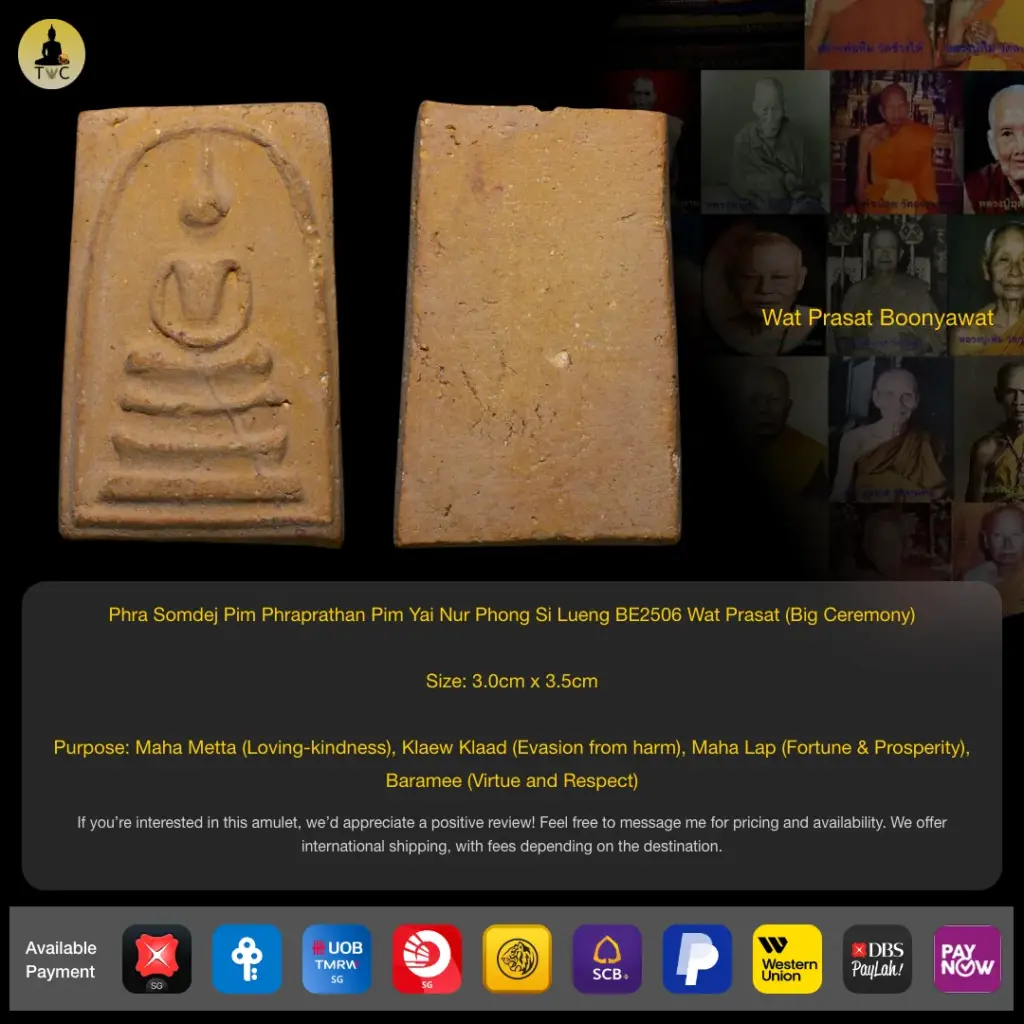
Phra Somdej Pim Phraprathan Pim Yai Nur Phong Si Lueng BE2506 Wat Prasat (Big Ceremony)
| Type | Phra Somdej |
| Temple | Wat Prasat |
| B.E. Year | 2506 |
| Material | Phong Si Lueng |
| SKU | TAC-0289 |
Authentic Phra Somdej Pim Phraprathan Pim Yai, Wat Prasat BE 2506. Phong Si Lueng nuea, consecrated by 200+ monks. Available from TAC, Singapore.
What is the Phra Somdej Pim Phraprathan Pim Yai from Wat Prasat BE 2506?
The Phra Somdej Pim Phraprathan Pim Yai is a large-mould sacred powder amulet pressed from Phong Si Lueng — a pale yellow phong (sacred powder blend) — at Wat Prasat in Bangkok during BE 2506 (1963). It was consecrated across two separate mass ceremonies attended by over 200 monks from across Thailand, making it one of the most extensively blessed pieces of its era.
Why the BE 2506 Wat Prasat ceremony stands apart
Wat Prasat undertook a major renovation in BE 2506, and the amulets were commissioned specifically to fund that restoration. What set this batch apart was not the pim alone — it was the scale of the pluk sek (consecration ceremony) behind it. Two separate sessions were held: the first ran from 6–9 March 1963, three days and three nights; the second from 13–16 November 1963, four days and four nights. Together they are recognised by collectors as among the most significant consecration rites since the 25th Buddhist Century celebrations.
The roster of attending monks is what serious collectors point to first. Participants included Luang Pu Tim of Wat Lahanrai, Luang Phor Toh of Wat Pradoochimplee, Luang Phor Pae of Wat Pikunthong, Luang Phor Guay of Wat Kositaram, Luang Phor Doo of Wat Sakae, Luang Phor Mui of Wat Don Rai, Luang Phor Nak of Wat Rakhang, Luang Phor Ngern of Wat Don Yai Hom, and Luang Phor Klai of Wat Suankhan. Names like these carry weight in any collection — this was not a routine temple edition.
What goes into the nuea and what the pim looks like
The nuea (material/substance) here is Phong Si Lueng, which gives the pressed tablet its characteristic pale yellow tone. The muan sarn (sacred powder blend) is not a simple mix. It incorporates crushed fragments of old Phra Somdej amulets from Wat Bang Khun Prom and Wat Rakang — pieces originally associated with Somdej Phra Buddhachan Toh — alongside holy powders from Wat Paknam’s Phra Phong tradition, sacred soil from important Buddhist sites, and herbal elements and waxes used in traditional Thai consecration work. The Thai Buddhist amulet tradition places considerable importance on the lineage of source materials, and this batch draws from some of the most respected sources in the country.
The pim (mould collectors authenticate against) for this edition is Pim Yai — the large mould. It shows the Buddha image seated on a three-tiered base, enclosed within an arched frame. Dimensions run approximately 4.0 cm high by 2.5 cm wide by 0.5 cm thick. The reverse may be plain or carry a faint temple mark depending on the individual piece.
What collectors look for and how this piece is certified
Authentication starts with the nuea. Genuine Phong Si Lueng examples carry an even, pale yellow body with a texture consistent with the powder blend described above — no uniform machine finish, no artificially bright surface. The pim details matter too: the proportions of the seated Buddha, the arch, and the tiered base should match documented reference pieces for this edition.
- Check the nuea colour: genuine Phong Si Lueng reads as a soft, natural pale yellow — not white, not deep gold
- Examine the pim sharpness: Pim Yai examples from this run show defined but not over-sharp mould lines consistent with hand-pressed production
- Reverse detail: confirm whether the piece shows a plain back or a faint Wat Prasat temple mark, and cross-reference against catalogue documentation
- Condition: age-appropriate surface character (micro-fissures, natural toning) consistent with over 60 years since pressing
No certificate issuer is noted for this piece. Collectors sourcing this edition should verify against established amulet catalogue references and, where possible, seek assessment from a recognised Thai amulet grading house before transacting at higher price points.
We at TAC are offering this Phra Somdej from the well-documented Wat Prasat BE 2506 batch — a run that collectors in Thailand and across the region track specifically because of the two grand consecration ceremonies held that year and the calibre of monks who participated. The Phong Si Lueng nuea, incorporating muan sarn traceable to Somdej Toh's original pieces, gives this batch a material lineage that few post-war editions can match.
Attributes reflect Thai Buddhist devotional tradition and are not measurable claims.