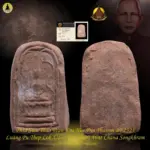
Phra Sum Thawan Kru BE2325 Luang Pu Thep Lok Udon, Wat Chana Songkhram
| Type | Phra Somdej |
| Monk | Luang Pu Thep Lok Udon (Lp Thap) or Phra Uttara Thera, Wat Chana Songkhram |
| Temple | Wat Chanasongkram |
| B.E. Year | 2325 |
| SKU | TAC-0586 |
Authentic Phra Somdej by Luang Pu Thep Lok Udon (Lp Thap) or Phra Uttara Thera, Wat Chana Songkhram, BE 2325. Nur Din nuea, Samakom certified.
What is the Phra Somdej by Luang Pu Thep Lok Udon (Lp Thap) or Phra Uttara Thera, Wat Chana Songkhram?
The Phra Somdej Luang Pu Thep Lok Udon (Lp Thap) or Phra Uttara Thera, Wat Chana Songkhram is an early Rattanakosin earthen-matrix amulet pressed in BE 2325 (1782 CE) at Wat Chanasongkram, Bangkok. The nuea is Nur Din — temple earth blended with bailan scripture ash — consecrated through Putthapisek empowerment at the temple. Samakom certification has been noted for this specimen.
BE 2325 — What the date tells a collector
BE 2325 corresponds to 1782 CE, the founding year of the Rattanakosin kingdom. Amulets pressed at that moment sit at the very start of Bangkok’s Buddhist court culture, when royal monasteries were being established and their protective rites formalised. Wat Chanasongkram — whose name translates roughly as “Victory in Battle” — was tied directly to early Rattanakosin military and Mon Buddhist networks, which shaped both its wicha (esoteric method) and the plain, functional character of the pieces it produced.
Luang Pu Thep Lok Udon (Lp Thap) or Phra Uttara Thera, Wat Chana Songkhram presided over the temple’s disciplined chant cycles — katha sequences oriented toward protection and calm rather than ornament. That discipline shows in the amulet itself: sober relief, soft contours, balanced frame, practical wearing size. Nothing is there for display. The proportions are deliberate.
For collectors tracking the Thai Buddhist amulet tradition, a securely dated BE 2325 piece from a royal monastery is a primary historical reference, not just a devotional object.
Nur Din nuea — how this piece was made
Nur Din means “earthen matrix.” The blend here combines temple soil with bailan scripture ash — the residue of palm-leaf manuscripts — producing a porous body with faint mineral flecks throughout. Early Bangkok examples from this temple typically show gentle pink-red specks and traces consistent with kiln-adjacent curing rather than open firing.
The pim (mould collectors authenticate against) reflects early Rattanakosin restraint: the relief is calm, the iconography spare, the edges compact. Press lines from the original mould remain legible, and age-coherent wear appears on the high points of the face. Scripture-ash stratification is visible on close inspection — this is one of the primary material markers the piece is assessed against.
Consecration followed the Putthapisek (phutthaphisek) format, conducted within the temple’s own protective lineage rather than a large committee ceremony. The empowerment emphasis was katha-based: extended chant cycles aligned with the temple’s wicha for obstacle avoidance and daily protection.
Authentication and what collectors examine
Authenticated examples of the Phra Somdej Luang Pu Thep Lok Udon (Lp Thap) or Phra Uttara Thera, Wat Chana Songkhram are assessed as collector-grade scarce. The original content notes Samakom certification for this specimen, with documentation accompanying the piece.
When examining the amulet, collectors focus on:
- Coherent earthen patina consistent with the Nur Din nuea and its age
- Scripture-ash flecks and mineral inclusions visible in the body
- Period press grain and natural press lines from the early Rattanakosin pim
- Age-coherent surface wear concentrated on the high-relief points
- Stylistic proportionality — balanced frame, sober iconography, practical size — matching documented early Bangkok examples
Samakom certification supports provenance. Independent expert assessment remains advisable alongside any certification, as is standard practice in the collector community.
This BE 2325 Nur Din piece from Wat Chanasongkram sits right at the start of the Rattanakosin era — that alone makes it a serious reference item, not just a devotional carry. We at TAC note that Samakom certification accompanies this specimen, which gives it a documented provenance layer that many early Bangkok pieces simply lack.
Attributes reflect Thai Buddhist devotional tradition and are not measurable claims.