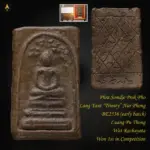
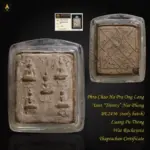
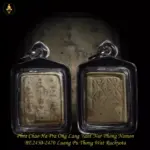
Phra Somdej Khang Yant Lang Yant “Trinity” BE2436 Luang Pu Thong Wat Rachayota
| Type | Phra Somdej |
| Monk | Luang Pu Thongdam (Lp Thongdam) Wat Tha Thong, Uttaradit |
| Temple | Wat Rachayota |
| B.E. Year | 2436 |
| Condition | Good |
| Certificate | Competition |
| Competition | Won 3RD placing |
| SKU | TAC-0104 |
Authentic Phra Somdej by Luang Pu Thongdam (Lp Thongdam) Wat Tha Thong, Uttaradit, Wat Rachayota BE 2436. Mixed Nur Phong and Nur Din.
What is the Phra Somdej Khang Yant Lang Yant “Trinity” by Luang Pu Thongdam (Lp Thongdam) Wat Tha Thong, Uttaradit?
The Phra Somdej Luang Pu Thongdam (Lp Thongdam) Wat Tha Thong, Uttaradit — specifically the Khang Yant Lang Yant “Trinity” pim — was created circa BE 2436 (1893 CE) at Wat Rachayota, Bangkok. Pressed from a mixed nuea of Nur Phong (holy powder) and Nur Din (consecrated temple clay), it earned 3rd place in a national Thai amulet competition, placing it firmly in the certified collector tier.
Who Was Luang Pu Thongdam and Why Does BE 2436 Matter?
Luang Pu Thongdam (Lp Thongdam) Wat Tha Thong, Uttaradit was known for his calm, methodical approach to wicha (sacred craft) — in particular the precise geometry of yant (sacred inscription) work. His discipline balanced samadhi (meditative concentration) with karuna (compassion), and both qualities are said to be reflected in the careful hand-pressing of each batch he produced.
BE 2436 sits squarely in the post–Somdej Toh era, when Bangkok masters were working hard to preserve the original sacred powder recipes of Wat Rakang. Luang Pu Thongdam was among those who maintained that lineage with real rigour. His batches from this period are early-period pieces by any collector’s measure — and early-period Wat Rachayota material in certifiable condition does not surface often.
The Trinity pim design is deliberate: the triple yant on the reverse represents the Three Jewels of Buddhism — Buddha, Dhamma, Sangha — while the obverse carries a seated Buddha in standard Somdej meditation posture. The thematic continuity between Wat Rachayota and the Wat Rakang school shows clearly in this layout.
Wat Rachayota, the Muan Sarn, and How This Piece Was Made
Wat Rachayota stands as one of the historic Bangkok temples connected to the early Rattanakosin Buddhist reform movement. Its position within the broader Thai Buddhist amulet tradition traces directly to the Somdej Wat Rakang school — the lineage every serious Somdej collector eventually traces back to.
The nuea (material/substance) here is a blend: Nur Phong, comprising phong (sacred powder blend) that includes Phong Itthijay and Phong Patamang from scriptural ash and powdered herbs, combined with Nur Din — specifically Din Saktawarn, a fine consecrated temple clay added for structural stability. The result is the matte, stratified surface visible on genuine examples, one that develops a natural patina rather than flaking or crumbling.
Consecration followed a multi-day phutthaphisek (consecration ceremony) with chanting by masters from the Wat Rachayota and Wat Rakang lineage. This wasn’t a single-session blessing. The extended ceremony is part of what collectors and competition judges assess when evaluating early Wat Rachayota pieces.
What Collectors Look For — and How This One Is Certified
Early powder amulets from Wat Rachayota are inherently fragile. The fine Nur Phong and Nur Din blend that gives the surface its aged character also makes pristine examples rare. When looking at this pim, the points that matter are the crispness of the threefold yant impression on the reverse, the natural powder stratification visible on the body, and the hand-press marks consistent with period production.
- Clear threefold yant marks on the reverse — the defining feature of the Trinity pim
- Frontal seated Buddha in meditation posture on the obverse, consistent with Somdej form
- Natural matte surface showing powder stratification and clay layering, not added lacquer
- Competition certificate: 3rd place award in a national Somdej category event
That competition certificate matters practically, not just as a trophy. Thai amulet competition panels evaluate originality, material authenticity, and pim consistency against documented reference pieces. A 3rd-place national result on a late-19th-century Wat Rachayota piece is a meaningful authentication data point for any collector building a serious Somdej collection.
We at TAC are presenting this Phra Somdej Luang Pu Thongdam (Lp Thongdam) Wat Tha Thong, Uttaradit — the Trinity pim from Wat Rachayota, BE 2436 — as a documented late-19th-century piece with national competition certification at 3rd place, which gives serious collectors a concrete authentication reference point beyond dealer word alone. Early Wat Rachayota material in certifiable condition is genuinely uncommon, and the competition result ties this directly into the documented Somdej Toh lineage that underpins long-term collector interest in this category.
Attributes reflect Thai Buddhist devotional tradition and are not measurable claims.