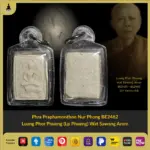
Phra Somdej Than Bau Nur Phong Namon BE2500-2521 Luang Phor Saneh Wat Sawang Arom Uthai Thani
| Type | Phra Somdej Than Bau |
| Monk | Luang Phor Saneh (Lp Saneh) Wat Sawang Arom, Sawang Arom District, Uthai Thani |
| Temple | Wat Sawang Arom |
| B.E. Year | 2500-2521 |
| Material | Nur Phong Namon |
| Condition | Very Good |
| SKU | TAC-PhraSomdejThanBau-LpSaneh-001 |
Authentic Phra Somdej Than Bau by Luang Phor Saneh (Lp Saneh) Wat Sawang Arom, Sawang Arom District, Uthai Thani. Nur Phong Namon, BE 2500–2521. No certificate.
What is the Phra Somdej Than Bau by Luang Phor Saneh (Lp Saneh) Wat Sawang Arom, Sawang Arom District, Uthai Thani?
The Phra Somdej Than Bau Luang Phor Saneh (Lp Saneh) Wat Sawang Arom, Sawang Arom District, Uthai Thani is an authentic Thai amulet pressed from Nur Phong Namon — sacred holy powder — and consecrated at Wat Sawang Arom across a production span running from BE 2500 to BE 2521. No certificate accompanies this piece.
Luang Phor Saneh and what two decades of consecration means for a collector
Luang Phor Saneh (Lp Saneh) Wat Sawang Arom, Sawang Arom District, Uthai Thani built his reputation through disciplined monastic practice and an exacting approach to amulet consecration. Devotees who knew him regard his accumulated merit as the foundation behind every piece he blessed. That standing is what collectors in Singapore, Malaysia, and Greater China are really paying for when they acquire one of his works.
The production window here — BE 2500 through BE 2521 — spans more than twenty years. That is not unusual for a productive monk, but it does mean pieces from across that range can show period-specific differences in pressing weight, surface tone, and phong (powder) density. Experienced collectors treat those variations as dating evidence, not as flaws.
The nuea: what Phong Namon is and how to read the surface
Nur Phong Namon — nuea meaning the material substance, phong meaning sacred powder — is the foundational material of this amulet. The powder blend is prepared through extended ceremonial process under the presiding monk’s supervision, then pressed into the Phra Somdej Than Bau pim (the mould collectors authenticate against). The result is a fine, compact tablet with a surface texture that experienced hands recognise immediately.
What distinguishes Phong Namon to an authentication eye is the consistency of density across the face and the way the pressed detail holds its edge. Pieces produced under Luang Phor Saneh’s watch at Wat Sawang Arom are noted for clarity of impression. Surface crazing or minor settling is normal for material of this age and is part of what confirms a genuine period piece rather than a later reproduction.
The broader Thai Buddhist amulet tradition places the sanctity of both monk and temple at the centre of any assessment. For this piece, those two factors converge: Luang Phor Saneh consecrating at his own temple, Wat Sawang Arom, across a sustained and documented period.
What collectors look for — and the certificate situation
There is no certificate with this piece. That is a straightforward fact, not a problem unique to this amulet — a large proportion of Thai amulets pressed before the mid-BE 2500s predate the formal certification systems that later emerged. Authentication here rests on material evidence and dealer provenance rather than paperwork.
- Phong texture and density: Authentic Phong Namon has a fine, uniform grain. Coarse or chalky surfaces warrant closer scrutiny.
- Pim sharpness: Check that the pressed Phra Somdej image retains clear definition without signs of a recast.
- Period ageing: Consistent surface patina across the tablet — not localised or artificially applied.
- Dealer provenance: In the absence of a certificate, the source matters. Acquire from a dealer who can speak to where the piece came from.
Collectors across the region associate this amulet with the metta (loving-kindness) and klaew klaad (evasion of danger) qualities traditionally linked to the Phra Somdej lineage. Protection from misfortune and support for interpersonal harmony are the qualities most commonly cited by long-term wearers. These are beliefs held within Thai Buddhist tradition — passed down through generations of devotees at Wat Sawang Arom and beyond.
We at TAC acquired this Phra Somdej Than Bau Luang Phor Saneh (Lp Saneh) Wat Sawang Arom, Sawang Arom District, Uthai Thani as part of our ongoing focus on documented monastic lineages from the central and northern provinces. The Phong Namon nuea on a genuine example from this period has a character that is straightforward to assess once you have handled a few — No certificate accompanies this amulet, which is typical for works of this era, and collectors who understand the material will find that the piece speaks for itself.
Attributes reflect Thai Buddhist devotional tradition and are not measurable claims.