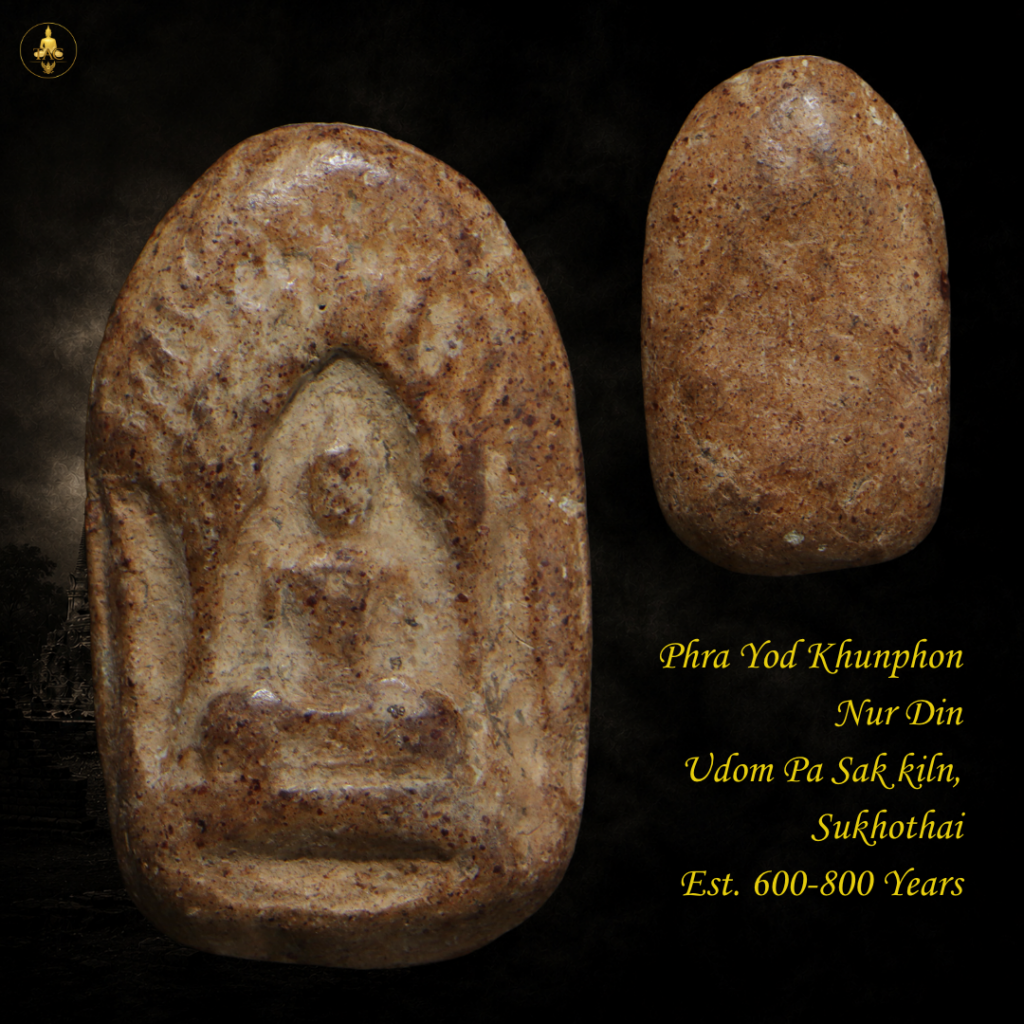
Phra Yod Khunphon Nur Din Udom Pa Sak kiln, Sukhothai Est. 600-800 Years
| Type | Phra-Yod Khunphon |
| Temple | Sukhothai |
| B.E. Year | 1600-1800 |
| Material | Nur Din |
| Condition | Good |
| SKU | TAC-PhraYodKhunphon--001 |
Authentic Phra Yod Khunphon from Udom Pa Sak kiln, Sukhothai, BE1600–1800. Nur Din clay. A legendary ancient Thai amulet available from Singapore dealer.
What is the Phra Yod Khunphon Amulet from Udom Pa Sak Kiln, Sukhothai?
The Phra Yod Khunphon from the Udom Pa Sak kiln, Sukhothai is an ancient clay amulet dated to approximately BE1600–1800, crafted from Nur Din (sacred earth clay) and unearthed from a legendary kiln site in Si Satchanalai, Sukhothai Province. It is regarded by collectors as one of the most historically significant classical-era Thai amulets in existence.
The Udom Pa Sak kiln site was, for many decades, known only as an obscure ruin — little more than crumbling walls and scattered laterite bricks buried within a bamboo forest south of the old city of Si Satchanalai. Few newer collectors today are even aware of its existence, which makes the Phra Yod Khunphon from this kiln all the more remarkable as a collector’s piece.
The amulets discovered at this site belong to a period stretching across two centuries of Sukhothai-era Buddhist craftsmanship. Their survival to the present day is a testament to the durability of Nur Din clay and the reverence with which they were originally created and enshrined.
Phra Yod Khunphon and the Udom Pa Sak Kiln, Sukhothai Heritage
The Udom Pa Sak kiln, Sukhothai site faces southeast, aligning with the same axial orientation as many of Si Satchanalai’s most revered religious monuments — including Wat Phra Si Maha That, Wat Chedi Chet Thao, Wat Chang Lom, Wat Nang Phaya, Wat Suan Kaeo Uthayan Yai, Wat Suan Kaeo Uthayan Noi, and Wat Khao Phanom Phleng. This shared orientation suggests the site was a deliberate and significant part of the city’s sacred landscape.
Historical analysis indicates the original structure comprised a seven-room vihara with a Manila-style roof, housing a stucco Buddha image in the Maravijaya (subduing Mara) posture, with a monastic seat positioned to the right of the main image. Behind the vihara stood a central stupa group — a main stupa with a square base in the shape of a lotus bud or rice-sheaf — surrounded by eight corner and cardinal-direction stupas, each with a 3-metre square base, and approximately 29 further smaller stupas with 1-metre square bases.
The site was later restored by the National Parks Division of the Fine Arts Department around 1987. Its significance within the Thai Buddhist amulet tradition had already been firmly established more than a decade earlier, when the amulet hoard was first discovered.
Nur Din Phra Yod Khunphon — Composition and Craftsmanship
Nur Din, or sacred earth clay, is the primary material of the Phra Yod Khunphon from Udom Pa Sak kiln, Sukhothai. In classical Sukhothai-era amulet production, Nur Din was sourced from spiritually auspicious locations — riverbanks near sacred sites, temple grounds, and forest hermitages — before being refined and pressed into moulds by skilled artisans under the guidance of learned monks.
The resulting pieces are dense, compact, and often display a characteristic surface texture that expert collectors use as one of the primary indicators of age and authenticity. The clay composition, combined with centuries of natural mineral absorption within the burial environment, gives each Phra Yod Khunphon a unique patina that cannot be replicated by modern reproduction.
The amulet hoard at Udom Pa Sak kiln was discovered accidentally around 1976 when a tractor was used to level the surrounding area. Illegal excavation continued into 1977, and the types recovered included Nang Khaen On, Phra Ruang seated (similar to those at Wat Phra Chetuphon), Phra Ruang standing, and Phra Nak Prok with a high base — alongside the Phra Yod Khunphon itself. This diversity of forms within a single hoard underscores the site’s importance as a major centre of sacred amulet production.
Spiritual Benefits of Phra Yod Khunphon from Udom Pa Sak Kiln
Collectors and devotees across Singapore, Malaysia, Thailand, and Greater China have long associated the Phra Yod Khunphon with powerful classical-era blessings. The amulet is traditionally venerated for its protective and auspicious qualities, rooted in the Buddhist merit accumulated at the Udom Pa Sak site over centuries of religious practice.
Devotees regard the Phra Yod Khunphon as particularly beneficial for those seeking spiritual grounding, personal protection, and the accumulation of positive merit — qualities that classical Sukhothai-era Buddha amulets of this type are known to embody in Thai collector tradition.
- Protective Blessing: Traditionally venerated for its capacity to shield the wearer from harm and misfortune, in keeping with classical Sukhothai Buddhist belief.
- Spiritual Growth: Collectors associate this amulet with deepening one’s practice, merit accumulation, and spiritual clarity rooted in the Maravijaya Buddha iconography it reflects.
- Authority & Leadership: The Phra Yod Khunphon is regarded by devotees as an amulet that supports personal authority, commanding presence, and respectful recognition from others.
Phra Yod Khunphon BE1600–1800 — Authentication and Collector Value
Authenticating a Phra Yod Khunphon from the Udom Pa Sak kiln, Sukhothai requires careful examination of surface patina, clay composition, mould characteristics, and burial mineral deposits consistent with centuries of interment. Because the site was subjected to illegal excavation between 1976 and 1977, provenance documentation and expert appraisal are especially important for pieces entering the collector market.
The Nur Din Phra Yod Khunphon from this kiln has become increasingly scarce as collectors and institutions recognise its historical significance. Pieces in well-preserved condition, retaining clear mould definition and original surface patina, command premium interest among serious collectors in Singapore, Hong Kong, Taiwan, and China.
The rarity of this amulet is compounded by the fact that the site was eventually restored and brought under the protection of the Fine Arts Department around 1987, effectively closing off any further recovery. What exists in the collector market today represents the entirety of what was recovered — making each authenticated Phra Yod Khunphon a genuinely finite and irreplaceable artefact of Sukhothai Buddhist heritage.
Among the ancient kiln-site amulets we handle at TAC, the Phra Yod Khunphon from Udom Pa Sak stands apart precisely because of how obscure its origin remains — even within serious collector circles, few have encountered a piece traceable to this bamboo-forest site in Si Satchanalai, and that rarity alone warrants careful attention. Dating to the BE 1600–1800 period, this Nur Din clay example represents six to eight centuries of survival, and the integrity of the clay body tells its own story about the conditions of its enshrinement. We present this piece without certificate, as is appropriate for genuine Sukhothai-era artifacts of this age, and we encourage prospective collectors to evaluate it on its material and stylistic merits within the well-documented heritage of the Udom Pa Sak kiln tradition.
Attributes reflect Thai Buddhist devotional tradition and are not measurable claims.
![[SOLD] Phra Yod Khunphon Mueang Sri Thep Kru (Wat Thutangkaram), Phetchabun Province, Est. 1,000 Years](https://tac-media.sgp1.digitaloceanspaces.com/2026/03/phra-yod-khunphon-mueang-sri-thep-kru-wat-thutangkaram-phetchabun-province-est-1-000-years-150x150.webp)