How to worship Kuman Thong?
How to worship Kuman Thong? Discover the sacred rituals, traditional mantras, and time-honoured customs behind one of Thai Buddhism's most fascinating spirit-child traditions.
What is How to Worship Kuman Thong?
How to worship Kuman Thong is a set of rituals, prayers, and daily customs rooted in Thai Buddhist and animist tradition, governing how devotees invite, honour, and communicate with a Kuman Thong — a consecrated spirit-child figure believed to bring good fortune, protection, and prosperity to a household. The practice draws on centuries of Thai Buddhist folk belief and involves specific incantations, offerings, and placement rules observed by devotees across Thailand and Southeast Asia.
For many families in Thailand, a Kuman Thong is far more than a decorative object. Devotees regard it as a living spiritual ward — a child spirit that must be fed, spoken to, named, and treated with genuine affection if it is to fulfil its protective and auspicious role in the home.
Understanding how to worship Kuman Thong properly means entering a rich world of Thai folk religion, where Buddhist scripture, animist spirit-belief, and the intimate language of parent and child all intertwine in a single daily practice.
Origins and Historical Background of How to Worship Kuman Thong
The Kuman Thong tradition is one of the most distinctive strands within Thai Buddhist folk religion, blending Theravada Buddhist devotion with older animist beliefs about wandering child spirits.
The name itself speaks to the nature of the figure: kuman means “young male child” in the Pali-inflected Thai of traditional religion, while thong means “golden” — together evoking a radiant, otherworldly child whose spiritual energy can be harnessed for the benefit of those who care for it. The female counterpart, Kumaree, follows the same ritual logic.
Across Thai Buddhist history, certain monks became especially renowned for their ability to consecrate Kuman Thong figures with genuine spiritual power. Among the most celebrated lineages is that associated with Wat Sam Ngam in Nakhon Pathom Province, where Luang Pho Phra Khru Phawana Sangworakun — popularly known as Luang Pho Te Kongthong — and Luang Pu Yaem developed a body of incantations and blessing rites that remain authoritative reference points for practitioners today.
The Story of How to Worship Kuman Thong: Key Figures and Events
The living tradition of how to worship Kuman Thong is not a single historical event but an accumulated body of ritual knowledge passed from master monks to lay devotees across generations, with Wat Sam Ngam in Nakhon Pathom serving as one of its most respected custodial centres.
When a devotee brings a Kuman Thong into a home for the first time, the ritual sequence is carefully prescribed. The process unfolds in clearly defined stages, each with its own words, materials, and spiritual logic.
- Step 1 — Seeking permission from the land spirits: Before the Kuman Thong crosses the threshold, the devotee lights 12 or 16 incense sticks outdoors within the property’s boundary and addresses the guardian spirits of the land directly, giving their own name, house number, and a formal request for the spirits to open the way for the Kuman Thong to enter and leave freely.
- Step 2 — Introducing the Kuman Thong: Using 5 or 16 incense sticks placed before the figure, the devotee introduces themselves by name, gives the Kuman Thong a name, and states the purposes for which it is being raised — finding wealth, guarding the home, and bringing good fortune. The devotee also introduces the Kuman Thong to every other person in the household.
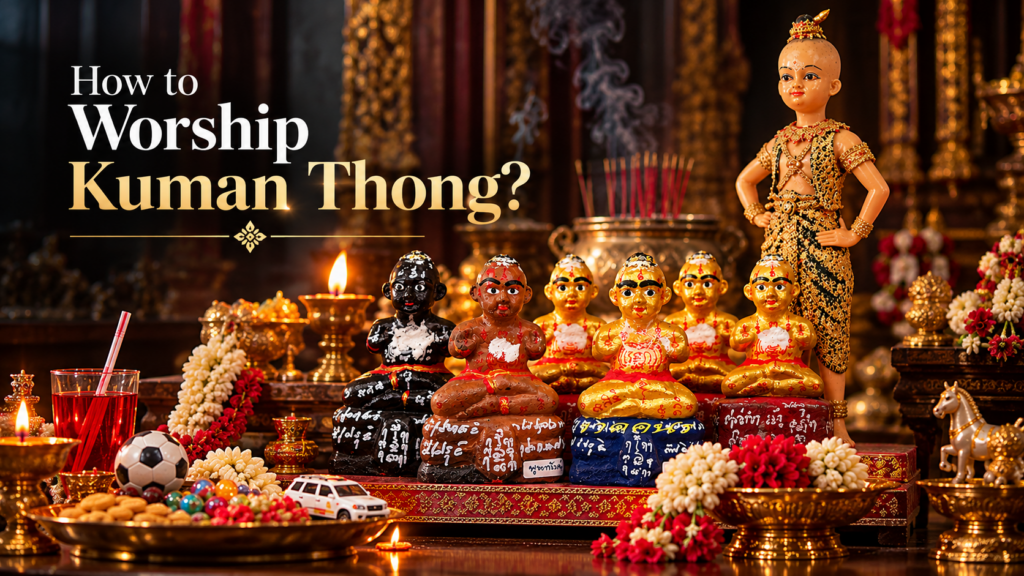
- Step 3 — Preparing a separate altar: The Kuman Thong must have its own dedicated space, placed at a lower level than Buddha images and other deities but not so low as to touch the floor.
- Step 4 — Daily offerings: Plain water must be present on the altar every single day without exception. Regular offerings include red syrup, orange syrup, green syrup, milk, bananas, other fruits, and various sweet breads — but never raw or savoury food.
- Step 5 — Toys and special rewards: Toys and special prizes are offered when a specific request has been fulfilled, mirroring the way a parent rewards a child for good behaviour, not indiscriminately.
- Step 6 — Nightly mantra recitation: Every night before sleep, the devotee recites the prescribed prayer from the Wat Sam Ngam lineage.
- Step 7 — Merit-making: Whenever the devotee performs meritorious deeds, the accumulated merit is dedicated to the Kuman Thong, believed to strengthen its power and accelerate the fulfilment of requests.
The tradition emphasises relationship over transaction. Devotees are instructed to talk to the Kuman Thong daily, to invite it along whenever leaving the house, and to inform it upon returning home — treating it precisely as one would treat a beloved child placed in one’s care.
Cultural and Spiritual Significance of How to Worship Kuman Thong
The ritual framework surrounding how to worship Kuman Thong expresses a distinctly Thai understanding of the relationship between the living, the spiritual world, and the obligations that bind them together.
Central to the practice is the concept of reciprocal vow-keeping. Devotees are counselled to make requests that are realistic and specific — stating clearly how much money is needed and by when — and, crucially, to fulfil any promise made to the Kuman Thong promptly once a wish is granted. The tradition cautions plainly: asking is easy, but forgetting a vow is a serious breach of trust.
The prohibitions surrounding placement and ritual reflect both animist cosmology and Buddhist respect for hierarchy. Facing the figure westward is forbidden, as the west is traditionally associated with death in Thai Buddhist cosmology. Placing it under stairs or at the foot of a bed — locations symbolically low, overlooked, or disrespectful — is equally prohibited. The instruction to use an odd or specific number of incense sticks (never a single stick alone, and often 5, 12, or 16 sticks depending on the occasion) reflects Thai ritual numerology deeply embedded in Buddhist and Brahmanical traditions.
The mantras associated with the Wat Sam Ngam lineage further illuminate the tradition’s spiritual architecture. The nightly incantation asks that good fortune flow from all eight directions without ceasing, invoking the accumulated merit of countless past lives. Additional incantations — including those to awaken the spirit child, to summon it, and to increase its power — draw on Pali, Sanskrit-derived, and local Thai sacred syllables, weaving together the full spectrum of Thai Buddhist esoteric practice.
Legacy of How to Worship Kuman Thong in Thai Buddhist Tradition
The tradition of how to worship Kuman Thong remains vibrantly alive across Thailand and among Thai Buddhist communities throughout Southeast Asia and Greater China, continuing to attract both long-standing devotees and those newly curious about its rituals.
The Wat Sam Ngam lineage, with its formally transmitted incantations attributed to Luang Pho Te Kongthong and Luang Pu Yaem, is widely cited as an authoritative source for correct practice. The mantras from this lineage — including the power-increasing incantation “Namapatha Namo Buddhaya Cha Pha Ka Sa Chijeruni Na O Ae Mo O Ae Phut O Ae Tha O Ae Ya O Ae Ma A U Buddha Sangmi Itikumaro Prasiddhime” — continue to be recited by devotees who follow the Nakhon Pathom tradition faithfully.
If you also worship other protective spirits or amulets in your home — including Thao Wet Suwannarat or Chuchok — the tradition advises that you light incense and formally ask those figures to open the way for the Kuman Thong as well, maintaining harmony among all the spiritual presences under your roof.
For those wishing to understand Kuman Thong within the broader context of Thai mythology and folk religion, it represents one of the most intimate expressions of Thai Buddhist culture — a tradition in which the domestic and the sacred are never truly separate, and in which care, commitment, and daily ritual shape the spiritual life of an entire household.
Frequently asked questions
There are six core prohibitions in the Kuman Thong tradition. Devotees must never light only a single incense stick; must never face the figure towards the west; must never place it under the stairs; must never position it at their feet or at the foot of a bed; must never curse or speak ill of the Kuman Thong; and must never make a vow and then forget to fulfil it. These rules are rooted in Thai Buddhist cosmology and the ethics of reciprocal spiritual obligation, and are considered essential to maintaining a harmonious relationship with the spirit child.
The most widely cited source for Kuman Thong mantras in the Thai tradition is Wat Sam Ngam, located in Nakhon Pathom Province in central Thailand. The incantations associated with this temple are attributed to two revered monks: Luang Pho Phra Khru Phawana Sangworakun, known familiarly as Luang Pho Te Kongthong, and Luang Pu Yaem. Their transmitted lineage includes nightly recitation prayers, power-increasing mantras, and specific incantations for awakening the spirit child, summoning it, and blessing offerings of sweets, red syrup, food, and toys. These texts remain the authoritative reference for practitioners following the Nakhon Pathom tradition.
The how to worship Kuman Thong tradition endures because it speaks directly to universal human concerns — prosperity, protection, family wellbeing, and the desire for a reliable spiritual ally — through the intimately relatable framework of raising a child. The practice encodes important Thai Buddhist values: reciprocity, mindfulness of obligation, generosity through merit-making, and daily devotion expressed in small, consistent acts. Across Thailand, Singapore, Malaysia, and Chinese-speaking communities throughout Asia, the tradition continues to evolve while its core ritual logic — treat the spirit child with love and keep your promises — remains unchanged.