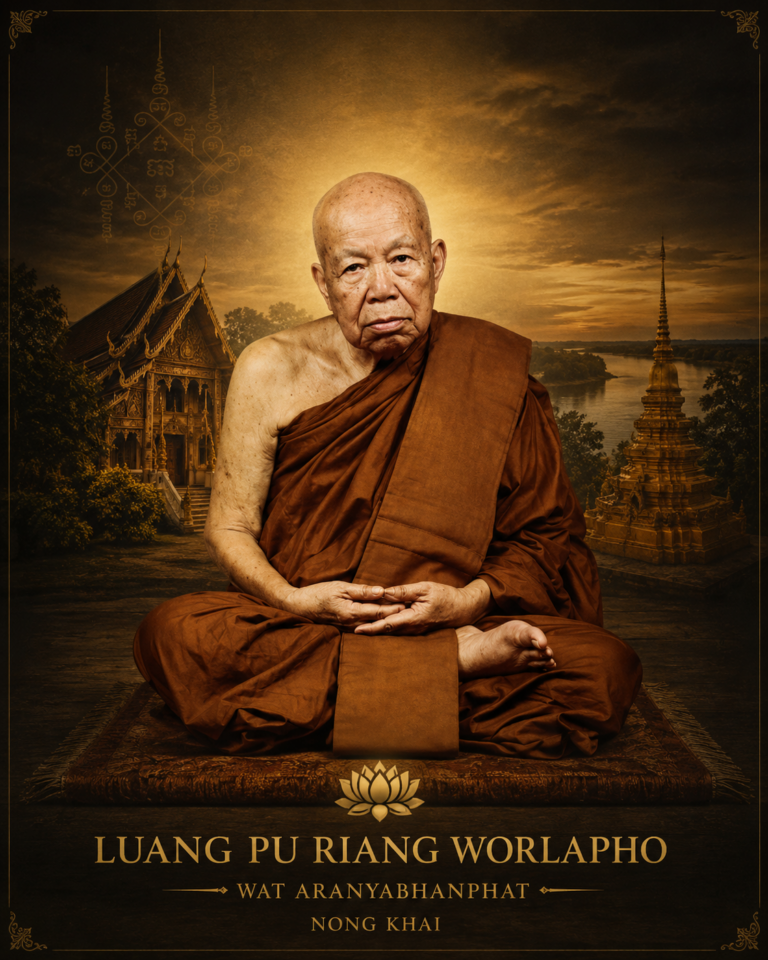
Luang Pu Riang Worlapho
Who Was Luang Pu Riang Worlapho? Luang Pu Riang Worlapho (หลวงปู่เรียง วรลาโภ) was a revered forest meditation monk born on 8 January BE 2455 (AD 1912) in Nong Khai Province, and later became a principal figure at Wat Aranyabhanphat (วัดอรัญญบรรพต) in Si Chiang Mai. He was widely known for his disciplined practice in the Kammathana ... Read more ↓
Biography
Who Was Luang Pu Riang Worlapho?
Luang Pu Riang Worlapho (หลวงปู่เรียง วรลาโภ) was a revered forest meditation monk born on 8 January BE 2455 (AD 1912) in Nong Khai Province, and later became a principal figure at Wat Aranyabhanphat (วัดอรัญญบรรพต) in Si Chiang Mai. He was widely known for his disciplined practice in the Kammathana (forest meditation) tradition and his deep emphasis on mindfulness and insight meditation. In Thai amulet culture, he is most respected for his lineage connection to great masters such as Ajahn Mun Bhuridatto and for embodying the transition from Samatha (tranquility) to Vipassana (insight), which shaped the spiritual foundation behind his consecrated objects.
Early Life and Ordination
Luang Pu Riang Worlapho was born as Riang Chai Khan in Ban Mo village, Si Chiang Mai District, Nong Khai Province, into a humble farming family. His father, Pha, and mother, Pimpa, raised him in a simple rural environment where diligence and discipline were part of daily life. From a young age, he showed a natural inclination toward spiritual reflection, often contemplating the nature of life beyond worldly pursuits.
At the age of 20, driven by a deep sense that ordinary life lacked lasting meaning, he sought permission from his parents to enter the monkhood. He was ordained at Wat Ban Hong Thong in Tha Bo District under Phra Khru Wapidithawat as his preceptor, with Phra Ajarn Phrom guiding him in monastic discipline. Shortly after his ordination in BE 2475 (AD 1932), he returned to Wat Pho Chai in his hometown, where he began formal study and practice. His early training focused on memorisation and internal recitation of the Anussati 10 (ten recollections), which gradually stabilised his mind and cultivated a deep sense of inner calm.
Spiritual Development and Practice
Luang Pu Riang’s spiritual journey was deeply rooted in the Kammathana (กรรมฐาน) forest tradition, which emphasises direct meditation practice over textual study. His early development centred on Samatha (สมถะ), or tranquility meditation, where he trained his mind to achieve stillness through continuous mindfulness in all postures.
A pivotal influence came when he studied teachings by Phra Ajarn Sing Khantayagamo, particularly the Satipatthana 4 (สติปัฏฐาน 4), or Four Foundations of Mindfulness. Through contemplation of the body’s 32 parts, he developed insight into anatta (non-self), recognising that the body is merely a temporary aggregation of elements without a permanent essence.
Despite his progress, Luang Pu Riang faced internal conflict between continuing the monastic path and returning to lay life. In a decisive moment, he made a firm vow during meditation, refusing to rise until clarity was attained. This marked a turning point in his commitment to the Dhamma.
His journey led him to study under respected masters such as Phra Ajarn Ku Thammadinno and Ajarn Boonma Thitapemo. Most significantly, in BE 2481 (AD 1938), he met Ajahn Mun Bhuridatto (หลวงปู่มั่น ภูริทัตโต), whose teachings transformed his practice. Ajahn Mun advised him not to cling to the peace of meditation but to develop Vipassana (วิปัสสนา), or insight, through deep investigation of reality. This guidance shifted Luang Pu Riang’s path toward true wisdom, aligning his practice with the Four Noble Truths.
Major Amulet Consecrations and Ceremonies
Specific records of Luang Pu Riang Worlapho’s amulet consecrations, including detailed batch names, BE years, and material compositions, are not widely documented in English sources. In Thai amulet culture, he is generally associated with traditional forms such as roop muean (realistic monk images), rian (commemorative coins), and classic phim amulets produced within temple contexts.
Collectors typically note that amulets attributed to Luang Pu Riang carry significance not from mass production records, but from his direct lineage in the forest meditation tradition and his close association with Ajahn Mun’s teachings. More detailed documentation of specific batches is usually preserved in Thai-language temple archives or oral transmission among dedicated collectors.
Legacy and Temple Significance
Luang Pu Riang Worlapho’s legacy is closely tied to Wat Aranyabhanphat in Nong Khai, where he spent much of his later life teaching and guiding practitioners. The temple itself reflects the principles of the forest tradition, emphasising simplicity, discipline, and meditation practice.
Within Thai Buddhist culture, he is remembered not only as a meditation master but also as a teacher who bridged the gap between tranquility and insight. His teachings continue to influence practitioners who seek a balanced path—one that does not cling to calmness alone but progresses toward deeper understanding.
Today, devotees and collectors revere him for his uncompromising dedication to the Dhamma. His presence is still felt through temple rituals, remembrance ceremonies, and the continued respect shown by disciples who preserve his teachings. In the collector community, his name carries the weight of authenticity rooted in practice rather than reputation alone.
Frequently Asked Questions About Luang Pu Riang Worlapho Amulets
What amulets did Luang Pu Riang Worlapho create?
Luang Pu Riang Worlapho is generally associated with traditional Thai amulet types such as roop muean (monk image amulets), rian (medallions), and classic phim styles. Detailed records of specific BE year batches are not widely documented in English sources, and most information is preserved in Thai temple archives or among experienced collectors.
Which Luang Pu Riang Worlapho amulet is considered the most powerful?
Collector consensus tends to value amulets that are directly linked to his early forest practice period or those consecrated during his time at Wat Aranyabhanphat. Rather than focusing on a single “most powerful” piece, collectors typically prioritise items with clear provenance and connection to his lineage under Ajahn Mun Bhuridatto, as these reflect the depth of his meditative attainment.
How do I authenticate a Luang Pu Riang Worlapho amulet?
Authentication relies on careful examination of mold details, material composition, and aging characteristics consistent with the era. Collectors often compare known reference pieces and consult certification bodies such as G-Pra (การันตีพระ) or Samakom (สมาคมพระเครื่อง). Provenance, including temple origin and documentation, plays a critical role in establishing authenticity.
What is Wat Aranyabhanphat known for in Thai amulet history?
Wat Aranyabhanphat (วัดอรัญญบรรพต) in Nong Khai is known as a meditation-focused temple within the forest tradition. It is associated with disciplined practice rather than large-scale amulet production, and its significance lies in its connection to respected meditation monks like Luang Pu Riang Worlapho.
What is the value and price range of Luang Pu Riang Worlapho amulets?
In the Singapore collector market, prices vary depending on type, condition, and provenance. Entry-level pieces may start from a few hundred SGD, while rarer or well-documented examples can reach into the thousands. Certified items with clear lineage documentation typically command higher value.
Are there fake Luang Pu Riang Worlapho amulets in circulation?
As with many respected monks, there are reproductions and misattributed pieces in circulation. Collectors should be cautious of overly new-looking items, inconsistent materials, and unclear origins. Verification through reputable dealers and certification bodies remains essential to ensure authenticity.
Amulets by Luang Pu Riang Worlapho Available at Thai Amulets Collection
Collectors interested in exploring authentic pieces associated with Luang Pu Riang Worlapho can view available items through Thai Amulets Collection. Due to the limited documentation of specific batches, each piece is evaluated based on material, condition, and provenance.
Further Insights into the Teachings of Luang Pu Riang Worlapho
What core Dhamma principle did Luang Pu Riang Worlapho emphasise most?
Luang Pu Riang Worlapho consistently emphasised the understanding of defilements—known in Thai as kilesa (กิเลส)—as the root cause of suffering. He taught that just as weeds naturally grow and overtake a field, the human mind is constantly overtaken by greed, anger, and delusion if left unattended. This teaching reflects a fundamental Buddhist principle: suffering does not arise externally, but from internal accumulation. In Thai amulet culture, collectors often interpret this as a reminder that the true “power” of any sacred object lies in the practitioner’s own discipline and mindfulness, not the object itself.
How did Luang Pu Riang Worlapho describe mindfulness in daily life?
He used a simple but powerful analogy—mindfulness is like a driver holding a steering wheel. This reflects the concept of sati (สติ), or awareness, which must constantly guide one’s actions, speech, and thoughts. Rather than suppressing emotions, he taught that one must recognise them immediately as they arise. In collector understanding, this teaching aligns with the belief that amulets serve as reminders of awareness, helping the wearer return to mindfulness in moments of emotional disturbance.
Why is the balance between Samatha and Vipassana important in his teachings?
Luang Pu Riang’s own journey illustrates the importance of balancing Samatha (สมถะ), or calm concentration, with Vipassana (วิปัสสนา), or insight. Initially, he developed deep tranquility but realised, after guidance from Ajahn Mun, that calmness alone does not lead to liberation. Insight into impermanence, suffering, and non-self must follow. In Thai Buddhist tradition, this balance is considered essential, and collectors often regard monks who embody both aspects as possessing deeper spiritual attainment, which in turn influences the perceived significance of their amulets.
How did Luang Pu Riang Worlapho approach the concept of suffering?
He taught that suffering—dukkha (ทุกข์)—is not something to be avoided but understood. By observing the five aggregates (khandha, ขันธ์) as impermanent and constantly changing, one begins to see that attachment itself is the source of distress. When this understanding deepens, the mind naturally lets go. In collector interpretation, this teaching reinforces the idea that spiritual objects are not tools to escape suffering, but symbols that guide the practitioner toward deeper realisation.
What role did determination play in his spiritual path?
Determination, or adhiṭṭhāna (อธิษฐาน), played a critical role in Luang Pu Riang’s development. His decisive vow to remain in meditation until clarity arose marked a turning point in his life. This moment reflects the seriousness required in the monastic path. Among devotees, such stories are often seen as evidence of strong spiritual resolve, which contributes to the respect and reverence associated with the monk’s legacy.
How do collectors view monks from the forest tradition like Luang Pu Riang?
In Thai amulet culture, monks from the forest tradition—Kammathana (กรรมฐาน)—are often regarded with a high level of respect due to their emphasis on direct practice and renunciation. Collectors typically associate such monks with authenticity and spiritual depth rather than ceremonial prominence. As a result, amulets linked to these monks are appreciated for their connection to genuine meditative attainment rather than large-scale temple production.
What is the significance of his connection to Ajahn Mun Bhuridatto?
Ajahn Mun Bhuridatto is widely recognised as one of the most influential meditation masters in modern Thai Buddhism. Luang Pu Riang’s direct encounter with him represents a crucial lineage connection. In collector perspective, lineage—สายวิชา (sai wicha)—is an important factor when evaluating spiritual heritage. A monk trained under or influenced by Ajahn Mun is often regarded as part of a highly respected tradition, which enhances both historical and cultural significance.
Why is Luang Pu Riang Worlapho still respected today?
His continued respect comes from his life example rather than recorded achievements alone. He demonstrated discipline, humility, and dedication to the Dhamma throughout his life. Even without extensive documented amulet batches, his influence remains strong among practitioners and collectors who value authenticity. In Thai Buddhist culture, such monks are remembered not for what they created materially, but for the clarity and guidance they left behind.