Who is “Nang Kwak”? Why has she become a sacred figure believed to bring good fortune and wealth?
Discover Nang Kwak — the sacred Thai fortune goddess rooted in Buddhist history. Learn her origins, iconography, worship rituals, and collector value. Trusted by Singapore amulet collectors.
Who Is Nang Kwak, and Why Has She Become a Sacred Figure Believed to Bring Good Fortune and Wealth?
Nang Kwak is a sacred Thai goddess of prosperity whose origins trace back over 2,500 years to a real woman named Supavadee (also written Supavati), a merchant’s daughter from the city of Machchikasanda in northern India who received blessings from two Arahants during the time of the Buddha. Collectors in Singapore and across Southeast Asia regard authentic Nang Kwak statues and amulets as among the most culturally significant sacred objects in the Thai Buddhist tradition.
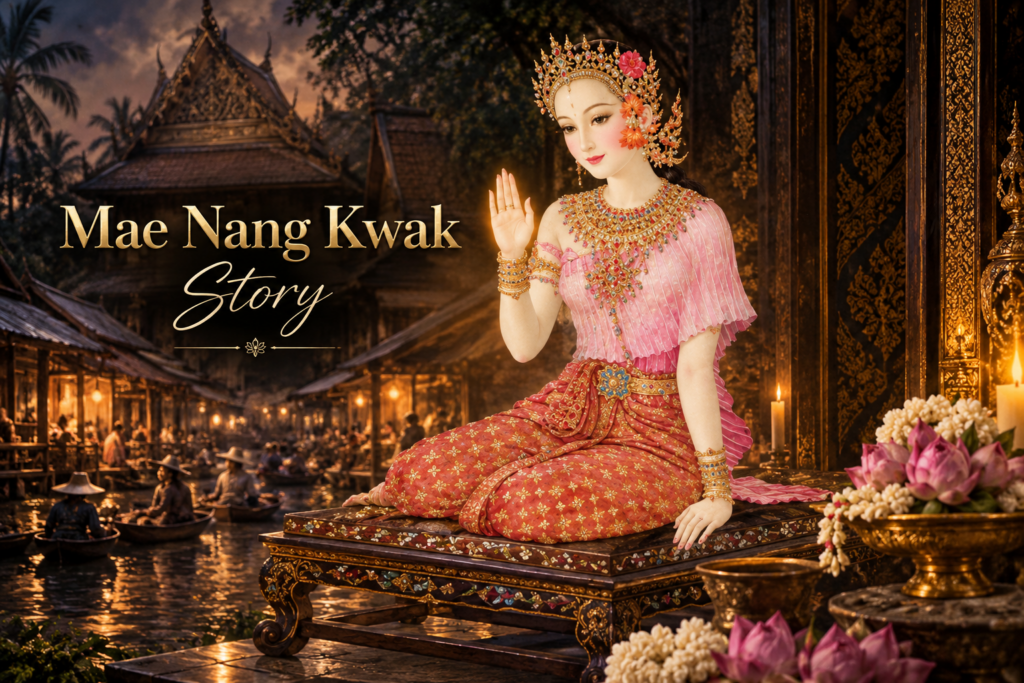
Before the 1990s, Nang Kwak was already one of the most widely venerated sacred figures in Thai culture for attracting commercial prosperity. Her image — a kneeling woman in red traditional Thai dress with her right hand raised in a beckoning gesture — became a fixture in shops, restaurants, and market stalls across Thailand and the broader Thai-speaking world.
The story of Nang Kwak is inseparable from the broader Thai Buddhist amulet tradition, which holds that merit accumulated through devotion and right conduct can manifest as tangible blessings of wealth, health, and protection. Her legend demonstrates that Buddhism does not forbid the honest pursuit of prosperity — a theological point the Buddha himself never contradicted.
Origins and Historical Context of Nang Kwak as a Sacred Figure of Good Fortune and Wealth
The origins of Nang Kwak’s legend lie in the Buddhist scriptures of the Theravada tradition, set in the rural northern regions of ancient India during the lifetime of the Gautama Buddha, more than 2,500 years ago.
Supavadee was born to a Brahmin family: her father was named Sujit Brahmin and her mother was named Sumontha. They lived in the city of Machchikasanda, not far from the city of Savatthi, earning their livelihood as traveling merchants whose income was barely enough to make ends meet.
While accompanying her family on a merchant journey and driving their cart through the countryside, Supavadee — who had already heard of the virtues of the Buddha’s disciples — prayed earnestly that she and her family would meet the Arahant Venerable Kassapa along the way. Her wish was fulfilled: the family met and listened to the sermons of the Venerable Kassapa, and from that moment they became followers of the Buddha.
Before the family departed, the Venerable Kassapa bestowed a powerful blessing upon Supavadee, declaring: “May all your wishes come true, and may your business prosper and flourish, accumulating abundant wealth, money, and gold.” This blessing marks the foundational moment from which Nang Kwak’s association with commercial prosperity derives.
Key Events and Sacred Significance of Nang Kwak as a Wealth-Beckoning Deity
The second pivotal encounter in Supavadee’s story involves the Arahant Phra Siwali, one of the Buddha’s first disciples and among the most celebrated figures in Theravada Buddhism for directly bestowing good fortune upon devotees.
Phra Siwali’s biography is extraordinary: according to the Buddhist scriptures, he remained in his mother’s womb for 7 years, 7 months, and 7 days before his birth. The number 7 is regarded as a highly auspicious number in Buddhism, and his prolonged gestation was interpreted as evidence of immense accumulated merit. He was born endowed with exceptional fortune, always encountering auspicious circumstances throughout his life.
When Supavadee accompanied her father on another trading journey, the family had the fortune to encounter Phra Siwali. He, too, listened to Supavadee’s devotion and bestowed blessings upon the family in the same manner as Phra Kassapa, further amplifying their commercial success. Following these two Arahant blessings, Supavadee’s family experienced continuous trade prosperity and amassed vast wealth.
Her father came to believe that Supavadee herself was a vessel of good fortune and regularly brought her along to assist in his business dealings. After her death, the villagers erected an image of Supavadee in her honour, praying before it for prosperous business and success. This devotional practice spread from India into mainland Southeast Asia and eventually became deeply embedded in Thai Buddhist culture, known today as the worship of Nang Kwak.
Nang Kwak and Her Impact on Thai Amulet History and Collector Value
Nang Kwak’s legend represents one of the clearest intersections of Thai Buddhist tradition and the pursuit of worldly prosperity, making her images and amulets a cornerstone category in Thai amulet history for collectors across Singapore, Malaysia, China, Taiwan, and Hong Kong.
The Theravada Buddhist theological framework underpinning Nang Kwak’s legend is significant: the Buddha never equated profit with ignorance, and even the precepts and blessings of Theravada Buddhism emphasise well-being and wealth as integral parts of a prosperous and peaceful life for lay followers. This doctrinal position has allowed the veneration of wealth-associated figures like Nang Kwak and Phra Siwali to flourish within orthodox Thai Buddhist practice.
For collectors in Singapore seeking an authentic Thai amulet connected to the Nang Kwak tradition, the market spans hand-cast resin and bronze statues, pressed-powder amulet medallions, and framed devotional prints — each category commanding different collector values depending on the craftsmanship, the temple or master who consecrated it, and the age of the piece. The intersection of Buddhist legend, iconographic precision, and ceremonial consecration is what separates a decorative item from a genuinely collectible sacred object within the Thai Buddhist tradition.
Nang Kwak Worship Practices — A Collector Guide for Singapore and Southeast Asia
For collectors and devotees in Singapore, Malaysia, and Greater China who wish to properly venerate a Nang Kwak figure, traditional Thai Buddhist practice prescribes specific offerings, ritual intervals, and invocations that have been transmitted alongside the figure’s legend. Understanding these practices is also useful for authenticating whether a vendor’s description of a figure’s provenance aligns with established Thai Buddhist tradition.
The worship of Nang Kwak traditionally serves multiple purposes: attracting good fortune and luck, cultivating favour with superiors in professional contexts, and promoting business success when the figure is placed in a shop or restaurant. Devotees traditionally offer red syrup, green syrup, plain water, snacks or fruit, and flower garlands on Buddhist holy days, with plain water maintained on the altar at all times. The incense protocol specifies 5 sticks when making a specific request, and 12 or 16 sticks when first introducing the figure into a new space to inform local spirits and open the pathways for Nang Kwak’s energy to flow freely. Devotees are also instructed never to offer savoury food — only sweets or fruit — and to fulfil any vow made in exchange for a granted wish, as breaking such a promise is considered to nullify the figure’s protective presence.
Frequently asked questions
Nang Kwak's legend originates in Theravada Buddhist scripture and is based on a real historical figure named Supavadee (also spelled Supavati), the daughter of Sujit Brahmin and his wife Sumontha, who lived in the city of Machchikasanda near Savatthi in ancient northern India. Her family earned their living as traveling merchants with modest means. During their journeys, Supavadee and her family received direct blessings from two Arahants — Venerable Kassapa and Venerable Phra Siwali — whose blessings caused the family's trade to flourish and their wealth to grow substantially. After Supavadee's death, villagers erected an image in her honour and prayed before it for commercial prosperity, a practice that eventually spread throughout mainland Southeast Asia and became central to Thai Buddhist culture. Her story predates the Rattanakosin period but became widely popularised in Thailand and among overseas Thai communities before the 1990s.
An authentic Nang Kwak figure is identifiable by precise iconographic features: the right hand must be raised in the beckoning gesture (distinguishing her from Nang Mai, whose right hand rests on the lap), the figure must be dressed in traditional Thai attire predominantly in red with gold ornaments on the head, neck, upper arms, and wrists, and the posture must be a kneeling goddess-like pose. Collectors in Singapore and Southeast Asia should note that mass-produced decorative replicas frequently omit these details or use incorrect colours. Value in the collector market is determined by a combination of iconographic accuracy, the material used (bronze, pressed powder, or resin), the reputation and certification of the temple or master who performed the consecration ceremony, and the provenance documentation accompanying the piece. Experienced dealers familiar with Thai amulet history can identify period-appropriate craftsmanship markers that distinguish collectible pieces from modern reproductions.
Nang Kwak is regarded by devotees as a goddess of auspiciousness, good fortune, and protection — a figure who actively beckons wealth, customers, and positive energy into the spaces where she is venerated. Her theological significance within Thai Buddhist tradition lies in her demonstration that the honest pursuit of prosperity is not contrary to Buddhist principles, as the Buddha himself never equated profit with spiritual ignorance. The blessings she received from the Arahants Phra Kassapa and Phra Siwali — himself famous for remaining in his mother's womb for 7 years, 7 months, and 7 days, a figure of immense accumulated merit — are considered to have been transmitted through her image to all who venerate it. Proper worship includes maintaining plain water on the altar at all times, making offerings of sweets and fruit (never savoury food) on Buddhist holy days, and reciting the traditional invocation calling upon Nang Kwak to beckon money, gold, customers, fame, and prosperity. This tradition is observed by Thai communities and collectors across Singapore, Malaysia, Thailand, China, Taiwan, and Hong Kong who venerate authentic Nang Kwak figures as living sacred objects rather than decorative items.