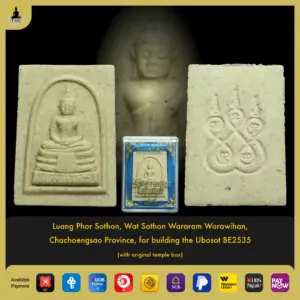
 Luang Phor Sothon, Wat Sothon Wararam Worawihan, Chachoengsao Province, for building the Ubosot BE2535 (with original temple box)
S$10
S$18save S$8 (44%)
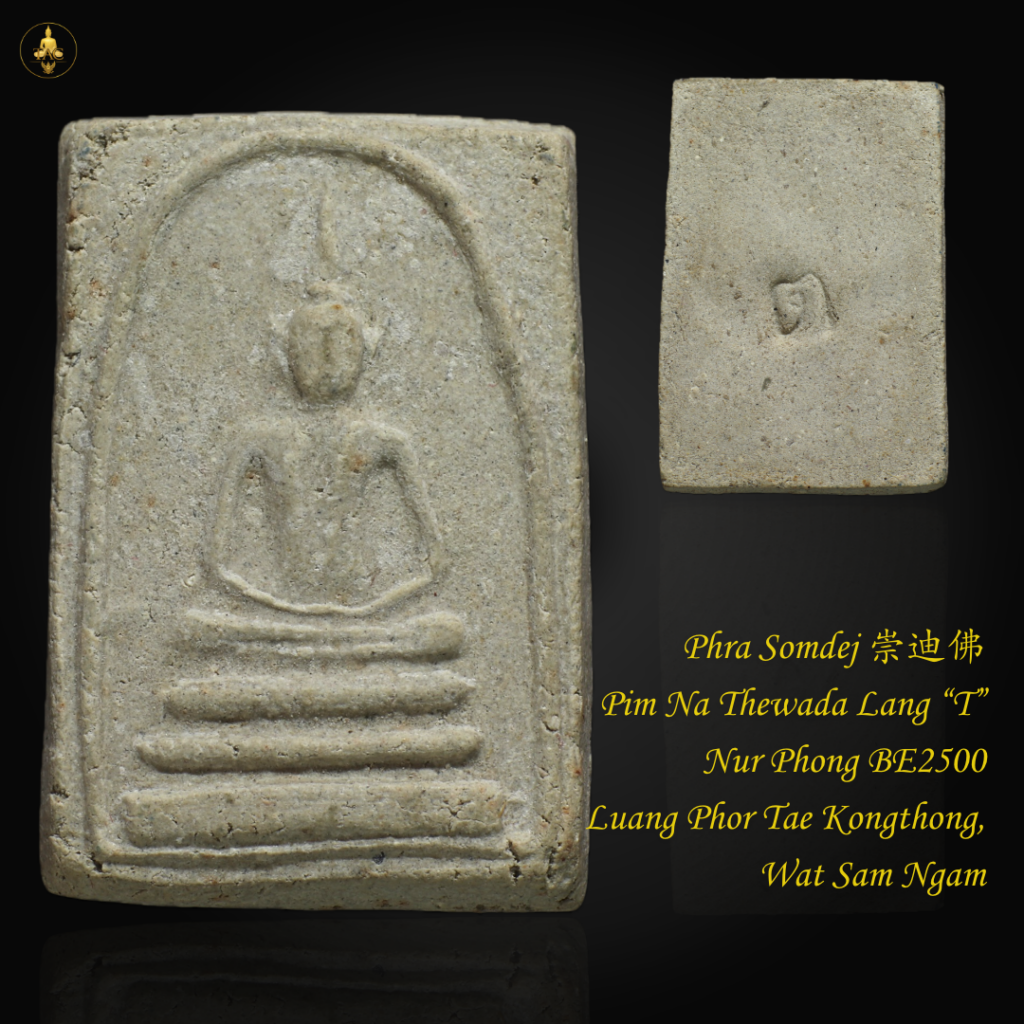
| Type | Phra Somdej |
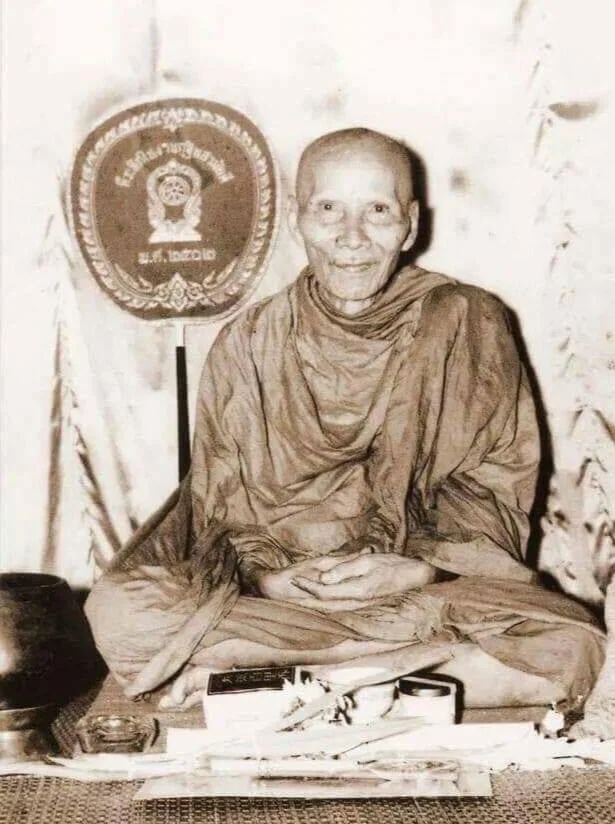
| Monk | Luang Phor Tae (Lp Tae) Wat Sam Ngam |
| Temple | Wat Sam Ngam |
| B.E. Year | 2500 |
| Condition | Very Good |
| SKU | TAC-0571 |
Luang Phor Sothon, Wat Sothon Wararam Worawihan, Chachoengsao Province, for building the Ubosot BE2535 (with original temple box)
 Phra Luang Pu Thuad (Lp Thuad) Nur Wahn BE2550 Wat Kongkha Liap (Tha Sak), Nakhon Si Thammarat (425 Years Anniversary, 9 Days & 9 Grand Ceremonies)
 Phra Pang Umbat (Wednesday Buddha) BE2512 Luang Phor Tae (Lp Tae) Khongthong Wat Sam Ngam
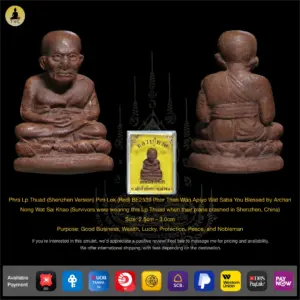 Phra Lp Thuad 龙婆托 (Shenzhen Version) Pim Lek (RED) BE2539 Phor Than Wan Apiyo Wat Saba You Blessed by Archan Nong Wat Sai Khao
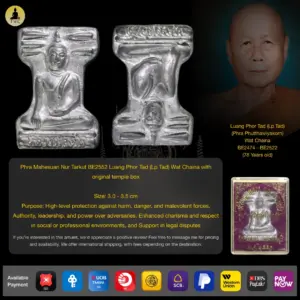 Phra Mahesuan Nur Tarkut BE2552 Luang Phor Tad (Lp Tad) Wat Chaina with original temple box
Each adds this amulet plus the offer at the bundle price — ready at checkout, or mention it when you enquire on WhatsApp.
Authentic Phra Somdej Luang Phor Tae (Lp Tae) Wat Sam Ngam, Pim Na Thewada Lang "T" BE2500. Rare sacred powder blend. No certificate. Singapore dealer TAC.
The Phra Somdej Luang Phor Tae (Lp Tae) Wat Sam Ngam Pim Na Thewada Lang “T” is a sacred powder amulet pressed in BE 2500 (1957) to mark the 2,500th anniversary of Buddhism. Made from a documented blend of rare phong (sacred powders) including Dvaravati relic powder and Somdej Bang Khun Phrom material, it was consecrated at Wat Sam Ngam through a full phutthaphisek ceremony.
BE 2500 was not an ordinary production year. Luang Phor Tae spent years before this date deliberately gathering phong from sources that were difficult to access even then — among them broken Somdej fragments and crypt powder gifted by Phra Khru Amorn Khanachan (Seng), former abbot of Wat Mai Amataros. That level of forward planning tells you this batch was something he considered a milestone, not routine output.
That same year he produced other significant editions — the Suan Tao bell and 3rd generation coins — but the Lang T Somdej earned the broadest respect among serious practitioners and collectors. It sat at the centre of what BE 2500 meant for Luang Phor Tae (Lp Tae) Wat Sam Ngam‘s legacy.
The pressing itself was a joint effort. Luang Phor Tae worked alongside Luang Phor Suea, and monks, novices, and lay devotees all took part in the physical pressing under his supervision. People present at the time described a sacred fragrance settling over the temple during the moulding — something devotees took as a sign the amulets carried potency before formal consecration had even begun.
The muan sarn (sacred powder blend) pressed into each piece draws from three distinct sources. First, material from Somdej Bang Khun Phrom — broken amulets and phong donated by Phra Khru Amorn Khanachan (Seng), including powder drawn from the BE 2500 crypt and earlier Somdej fragments. Second, Na Phathamang Powder: sacred scripts written and erased repeatedly across nine cycles, each cycle re-blessed by Luang Phor Tae to concentrate the accumulated intention into the material. Third, ground powder from Dvaravati-period Buddha fragments — ancient relics sourced from Mueang Tum and the area around Wat Sam Ngam itself — pressed directly into the mix.
That third component matters to collectors. Genuine Dvaravati relic material is not something you can substitute or approximate, and its presence connects this piece to the broader Thai Buddhist amulet tradition at a depth that later editions rarely reach. The nine-cycle processing of the Na Phathamang Powder is equally specific — it reflects a method tied to Luang Phor Tae’s personal practice rather than standard production technique.
The phutthaphisek (consecration ceremony) brought in senior monks to join Luang Phor Tae. Extended chanting, deep meditation, and formal ritual invocations were performed across the full Lang T batch. The scale of the ceremony matched the significance of what the batch represented.
This piece is offered without a third-party certificate. That is a fact worth stating plainly. In the context of the Lang T edition, experienced collectors tend to rely on direct physical examination against known niyom (collector-standard reference pieces) and on documented provenance rather than on certification alone. The pim (mould) characteristics of the Pim Na Thewada are well-documented in collector references, and those details are where authentication starts.
Collector demand for this edition has held across Singapore, Malaysia, Thailand, China, Taiwan, and Hong Kong. The combination of documented sacred composition, the inter-lineage collaboration behind the pressing, and the historical weight of the BE 2500 milestone keeps it in steady circulation among serious buyers.
This BE 2500 Phra Somdej Lang "T" holds a significant place in Thai amulet history precisely because of its context: created to mark the 2,500th anniversary of Buddhism, it represents one of Luang Phor Tae's most consequential editions, produced under the joint supervision of both LP Tae and LP Suea at Wat Sam Ngam — a collaborative consecration that serious collectors recognise as adding weight to the batch's ceremonial pedigree. At TAC, we regard pieces from this specific Lang "T" pressing as important reference points for any collector building a focused LP Tae collection, given how broadly respected this edition remains among seasoned practitioners across the region. While this piece carries no certificate, authentication for well-documented LP Tae BE 2500 editions relies on die characteristics and material composition that experienced eyes can assess — we are happy to discuss the specifics with serious enquirers.
Attributes reflect Thai Buddhist devotional tradition and are not measurable claims.