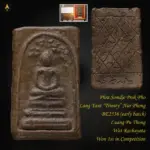
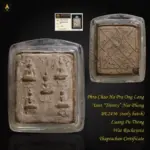
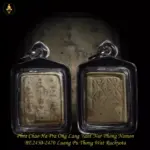
Phra Somdej Pim Lep Mer Kru Nur Phong Din Wat Bungpayasurin BE2431 Luang Pu Thong Wat Rachayota
| Type | Phra Somdej |
| Monk | Luang Pu Thong (Lp Thong) Wat Rachayota |
| Temple | Wat Bungpayasurin |
| B.E. Year | 2431 |
| Material | Phong Din |
| Condition | Good |
| Certificate | Competition |
| Competition | Won 1ST placing |
| SKU | TAC-0705 |
Authentic Phra Somdej Luang Pu Thong (Lp Thong) Wat Rachayota, Wat Bungpayasurin BE 2431. Nuea Phong Din, Pim Lep Mue Kru. Competition certified.
What is the Phra Somdej Luang Pu Thong (Lp Thong) Wat Rachayota from Wat Bungpayasurin, BE 2431?
The Phra Somdej Luang Pu Thong (Lp Thong) Wat Rachayota is an old kru Somdej pressed in nuea Phong Din (powder-and-earth body) from Wat Bungpayasurin, dated BE 2431. Cast in the pim (mould) known as Pim Lep Mue Kru, it carries a Competition certificate and sits within one of the recognised old Bangkok kru study fields.
The temple, the year, and why BE 2431 matters to collectors
Wat Bungpayasurin — recorded also as Wat Phraya Suren or Wat Bung Phraya Suren — was established during the reign of King Rama V by Phraya Suren Ratchasena (Phueng Singhaseni) and Khunying Boonmee. The temple received its Wisungkhamsima, the royal boundary consecration that formally constitutes a temple, in BE 2431. That date anchors the Somdej pieces collectors study under the “kru Wat Bung Phraya Suren” label to the founding moment of the temple itself.
Within the broader Thai Buddhist amulet tradition, kru pieces are those recovered from a temple’s stupa, ground caches, or sealed spaces — surfaces that preserved the amulets across decades. The Wat Bungpayasurin kru is a recognised old Bangkok field. Collectors compare pieces by pim profile, powder texture, age tone, and the settling behaviour of the rear plane. Pim Lep Mue Kru is one of the standard models in that reference set, named for the characteristic hand-and-nail impression language pressed into the mould.
Luang Pu Thong and the lineage behind this piece
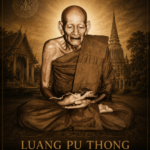
Luang Pu Thong (Lp Thong) Wat Rachayota is recorded in Bangkok district history as a monk of exceptional longevity — born BE 2363, ordained BE 2384, and living to 117 years. He became the first abbot of Wat Rachayota, the temple built by the same Phraya Suren Ratchasena family line connected to Wat Bungpayasurin. That overlap is exactly why his name appears alongside this kru field in collector references.
His training followed old-school wicha (esoteric scriptural discipline), and collectors who study the serious old-era Somdej circles note that he is repeatedly referenced in connection with the shared teacher lineages of that period. The connection is lineage, not coincidence. A portion of the temple’s Somdej was distributed to devotees; another portion remained within temple grounds and later surfaced as the kru field studied today.
Nuea Phong Din: what the material tells you and what to look for
Nuea Phong Din (เนื้อผงดิน) is a Somdej body built from sacred powder blended with earth and clay components. Over decades, pieces in this nuea develop a calm, matte surface — not the harder, denser feel of pure phong blends, but something that settles with visible micro-porosity and a natural tonal depth. That aged surface behaviour is one of the primary authentication cues for kru Somdej of this type.
When studying a piece, collectors focus on a consistent set of reference points:
- Pim profile: the Pim Lep Mue Kru silhouette reads immediately distinct from the temple’s other Somdej forms — proportions and mould impression depth are both reference-matched.
- Surface tone: look for even, settled colour across the face, base edge, and rear plane — no uneven brightening or artificial patina.
- Powder feel: old Phong Din compacts with age; the press should feel firm without the brittleness of later or inferior blends.
- Competition certificate: this piece carries a Competition-level certificate, which collectors use as a cross-reference when comparing model proportions and old-work consistency against known standards.
For care: keep the piece dry, away from oils and chemicals, and stored where humidity is stable. The original powder skin is fragile and irreplaceable. Retain front, back, and side photographs alongside the certificate as one complete provenance set.
What collectors associate this piece with, and how value is read
Phra Somdej is traditionally carried as a foundation amulet — associated in Thai devotional practice with a settled mind, calm presence, and protection through sustained faith. Collectors describe kru Somdej from old Bangkok fields in particular as carrying a grounded, quiet quality: suited to daily wear, steady across different life circumstances. The Thai terms most often attached are metta (เมตตา, loving-kindness and harmonious relationships), khum khrong (คุ้มครอง, protection), and nun duang (หนุนดวง, baseline support for good fortune).
These are beliefs held within the tradition — not outcomes anyone can guarantee. What a collector can read objectively is the documentation: this piece comes with both a standard amulet certificate and competition placing, making it a study-grade reference item as much as a devotional one. For collectors who build Somdej kru collections systematically, that documentation set — certificate images, multi-angle photographs, competition record — is the difference between a piece you can confidently show and one you cannot.
We at TAC are offering this Phra Somdej Pim Lep Mue Kru from the recognised Wat Bungpayasurin kru field, dated BE 2431 and connected to the lineage of Luang Pu Thong (Lp Thong) Wat Rachayota — one of the senior old-era monks whose name recurs across serious Bangkok Somdej study references. The Competition certificate included with this piece gives collectors a concrete reference point for pim identity and old-work consistency.
Attributes reflect Thai Buddhist devotional tradition and are not measurable claims.