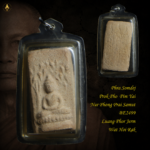
Phra Somdej Prok Pho Nur Din BE2475 Luang Phor Thongkham Wat Chao Chet Nai, Ayutthaya
| Monk | Luang Phor Thongkham (Lp Thongkhram), Wat Chao Chet Nai , Ayutthaya |
| Temple | Wat Chao Chet Nai |
| B.E. Year | 2475 |
| Material | Din |
| SKU | TAC-0681 |
Authentic Phra Somdej Prok Pho Nur Din BE2475 Luang Phor Thongkham Wat Chao Chet Nai, Ayutthaya by Luang Phor Thongkham (Lp Thongkhram), Wat Chao Chet Nai…
What is the Phra Somdej Prok Pho Nur Din BE2475 Luang Phor Thongkham Wat Chao Chet Nai, Ayutthaya by Luang Phor Thongkham (Lp Thongkhram), Wat Chao Chet Nai, Ayutthaya?
The Phra Somdej Prok Pho Nur Din BE2475 Luang Phor Thongkham Wat Chao Chet Nai, Ayutthaya by Luang Phor Thongkham (Lp Thongkhram), Wat Chao Chet Nai, Ayutthaya is a din (fired clay) amulet pressed in BE 2475 at Wat Chao Chet Nai, Ayutthaya. It depicts the Buddha seated beneath a seven-headed Naga canopy — the Prok Pho posture — and was consecrated personally by Luang Phor Thongkham Tisso.
Luang Phor Thongkham and Wat Chao Chet Nai in BE 2475
BE 2475 corresponds to 1932 CE — a period when monastic communities across Ayutthaya were still the primary custodians of sacred knowledge and local amulet traditions. Luang Phor Thongkham (Lp Thongkhram), Wat Chao Chet Nai, Ayutthaya was a central figure at Wat Chao Chet Nai during this era — guiding the lay community, sustaining the temple’s spiritual programs, and preserving the wicha (sacred knowledge) passed down through earlier Ayutthaya masters.
The batch was created not as a commercial run but as a spiritual anchor for local devotees and pilgrims. That provincial, community-first intent is part of why original pieces rarely surface today. The original batch size was modest to begin with, and well-developed examples seldom leave private collections.
Understanding this context matters to collectors because it sets this piece apart from the large centrally distributed Phra Somdej editions of Bangkok temples. This came from a specific master, a specific temple, a specific moment in Ayutthaya’s monastic life. That specificity is exactly what the Thai Buddhist amulet tradition prizes most in older provincial pieces.
Nuea Din, the Pim, and How It Was Made
The nuea (material/substance) here is din — ancient fired clay — giving the piece its characteristic earthy tones from pale beige through to a deeper brown, depending on individual example and age. Luang Phor Thongkham’s formulation is said to have incorporated sacred earth, pollens, and ashes worked together with his disciples before pressing. The result is a dense, slightly rough surface quite different from the smooth pressed-powder Somdej types most collectors handle first.
The pim (mould collectors authenticate against) shows the Prok Pho design: Buddha in meditation, sheltered beneath the raised hood of a seven-headed Naga. The pronounced hood line and the seated posture are the primary pim reference points. Some examples carry an embossed Singha (lion) on the reverse, reflecting mould variations within the BE 2475 production. The pressing marks and clay thickness visible on the side profile are further authentication references serious collectors note.
Consecration followed traditional Ayutthaya practice. Luang Phor Thongkham — known for his depth in samadhi (meditative concentration) — led focused recitation of Pali sutras and applied Prok Pho yant (sacred inscription) workings to charge the clay. The pluk sek (consecration ceremony) was conducted at Wat Chao Chet Nai, not distributed across multiple venues, which collectors regard as a mark of concentrated, undiluted blessing.
What Collectors Look For — and the Authentication Picture
Pieces approaching ninety years old in din will show natural ageing: surface micro-cracking consistent with old fired clay, settled patina in the recessed areas of the Naga hood, and an overall colour that has deepened from use and time. Artificially aged fakes tend to show uniform surface discolouration without the depth variations you see on genuine old din.
- Check the Naga hood lines against known reference pim — the proportions and the number of hood segments are fixed by the original mould.
- On examples with the Singha reverse, the embossing should be crisp at the relief edges but worn on the high points consistent with age and handling.
- Clay tone should vary naturally across the surface; uniform colour is a flag worth investigating further.
- Pressing marks on the side profile should feel organic, not mechanically regular.
No certificate is listed for this piece at time of writing. Collectors pursuing certification should consult established Thai amulet committees with experience in Ayutthaya provincial masters. Age, condition, and clear pim correspondence are the primary value drivers here. Pieces in good preservation with the Singha reverse intact tend to attract stronger collector interest given how rarely they appear.
This is a din piece from BE 2475 — nearly ninety years old — pressed by Luang Phor Thongkham Tisso at Wat Chao Chet Nai, Ayutthaya, a provincial master whose batch sizes were modest and whose work rarely appears outside private collections. Collectors value this piece for its age, its clear pim identity within Ayutthaya's provincial tradition, and the focused consecration attributed to a master known for serious samadhi practice — factors that distinguish it from more widely distributed central Thai Somdej editions.
Attributes reflect Thai Buddhist devotional tradition and are not measurable claims.