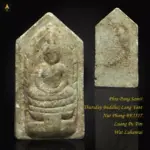
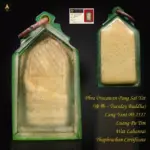
Rian Luang Pu Thuad Nur Thong Daeng BE2505 Wat Kae, Ayutthaya consecrated by Archan Tim Wat Changhai
| Monk | Luang Pu Thuad |
| Temple | Wat Changhai |
| B.E. Year | 2505 |
| Material | Thong Daeng |
| SKU | TAC-0587 |
Authentic Rian Luang Pu Thuad Nur Thong Daeng BE2505 Wat Kae, Ayutthaya consecrated by Archan Tim Wat Changhai by Luang Pu Thuad. Copper. No cert. SGD 338.
What is the Rian Luang Pu Thuad Nur Thong Daeng BE2505 Wat Kae, Ayutthaya consecrated by Archan Tim Wat Changhai by Luang Pu Thuad?
The Rian Luang Pu Thuad Nur Thong Daeng BE2505 Wat Kae, Ayutthaya consecrated by Archan Tim Wat Changhai by Luang Pu Thuad is a copper-alloy coin amulet issued in BE2505 (CE1962) at Wat Kae, Ayutthaya, with consecration attributed to Archan Tim of Wat Changhai — one of the most important ritual figures in the modern Luang Pu Thuad devotional revival.
An Early Cross-Regional Issue and Why Collectors Pay Attention
BE2505 sits close to the formative years of the modern Luang Pu Thuad revival. At that point, large-scale commemorative production had not yet overtaken the field, and many issues still carried the character of a living lineage in active expansion. A rian (coin amulet) issued from Wat Kae in Ayutthaya — deep in central Thailand — is documentary evidence that the current had already moved well beyond Pattani and the southern provinces where Wat Changhai remained the principal reference point.
Archan Tim’s role in this story is specific. Collectors do not treat him simply as a temple abbot; his ritual authority is read as the channel through which the early modern Luang Pu Thuad blessing current was transmitted. When a listing places an issue within his consecration network, that is a meaningful provenance signal. It locates the piece near the transmission line that shaped how Luang Pu Thuad came to be associated nationwide with khlad klaew (safe escape from danger) and steady protection.
For a broader view of how coin amulets fit within Thai devotional practice, the Thai Buddhist amulet tradition article offers useful context on regional production and consecration practice.
The Nuea and What the Copper Surface Tells You
The nuea (material/substance) here is nur thong daeng — a copper-based alloy widely used for Thai coin amulets through the mid-20th century. Collectors do not look for bright, freshly polished surfaces on pieces of this age. What matters is the opposite: stable oxidation, natural darkening in the recessed fields, and a surface that reflects genuine long-term handling rather than recent intervention.
On an early Luang Pu Thuad rian, the copper does real work. It supports legibility of the face and robe lines while also holding the evidence collectors rely on for period study. An over-cleaned surface destroys that evidence. Honest ageing preserves it. The pim (mould collectors authenticate against) on this type favours restraint — calm posture, clear robe definition, purposeful relief — rather than elaborate ornamental detail, and that simplicity makes surface condition easier to read and assess.
- Warm copper tone with darker aged areas consistent with early BE2500s medallions
- Natural oxidation in recessed fields is the key surface honesty indicator
- Reverse inscriptions serve as period identifiers; collectors check alignment and depth against known reference pieces
- Strike sharpness, edge integrity, and relief preservation are the core authentication points for this type
What Collectors Look For and How This Piece Is Assessed
The value of a BE2505 Wat Kae issue is built from several factors working together: timing, lineage association, material character, and regional significance. This is not a piece that competes on decorative complexity. It competes on documentary clarity — how precisely it can be placed within the Luang Pu Thuad transmission story, and how honestly the physical evidence supports that placement.
Collectors typically assess strike sharpness, edge condition, and whether the copper surface shows natural maturity. Artificial brightening, heavy cleaning, or re-lacquering all reduce study value. The listing carries no certificate notation for this piece. That places additional weight on careful physical assessment and cross-reference against established reference material for this run and pim type.
Regional significance adds another layer. Ayutthaya is not a southern province. A Luang Pu Thuad medallion issued there in BE2505 shows how far and how early the devotional current had already reached. For collectors tracking the spread of the tradition, that geography is part of the record.
This BE2505 Wat Kae issue is one of the earlier cross-regional Luang Pu Thuad medallions we carry at TAC — the Ayutthaya temple attribution combined with the Archan Tim consecration network reference makes it a genuinely specific piece for collectors tracking the early transmission story. For a collector focused on the formative BE2500–2510 Luang Pu Thuad period, the combination of early timing, lineage proximity, and honest nur thong daeng nuea is what justifies the study interest here.
Attributes reflect Thai Buddhist devotional tradition and are not measurable claims.