Luang Pu Tesk Tesrangsi – Wat Hin Mak Peng, Si Chiang Mai District, Nong Khai
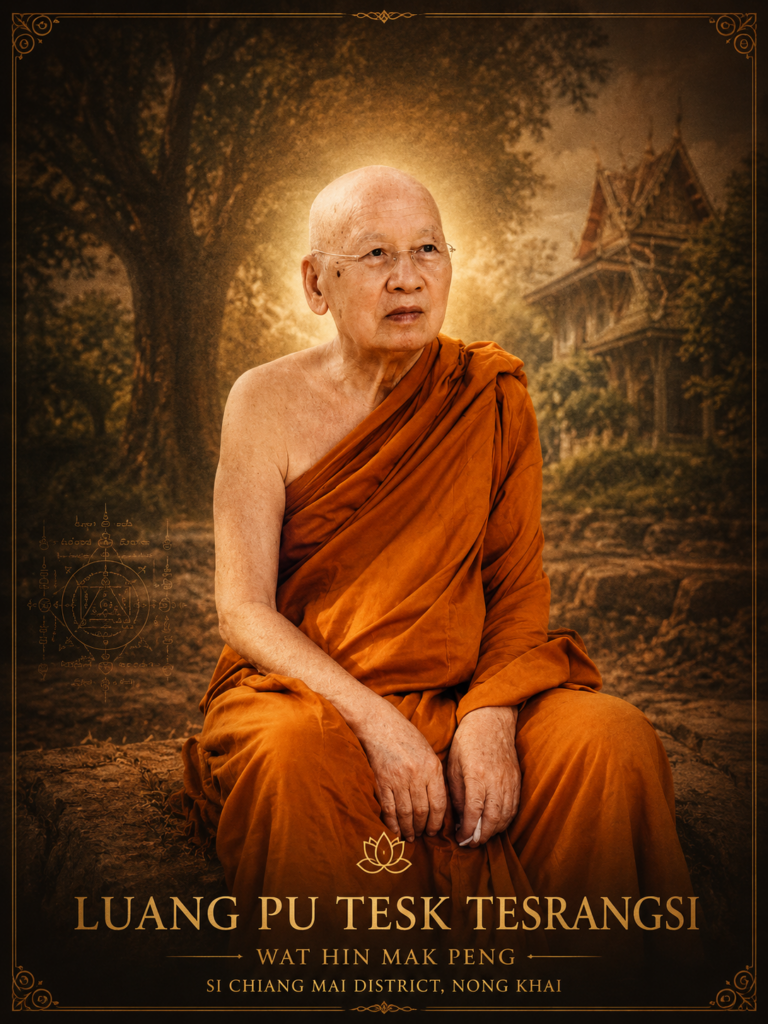
Luang Pu Tesk Tesrangsi (หลวงปู่เทสก์ เทสรังสี) was one of Thailand's most revered forest meditation masters of the twentieth century, born in BE 2445 (AD 1902) in the northeastern region of Thailand and ordained as a Buddhist monk who would dedicate his life to the rigorous practice of the Dhammayut forest tradition under the direct lineage of Luang Pu Mun Bhuridatto (หลวงปู่มั่น ภูริทัตโต). He served as the abbot of Wat Hin Mak Peng (วัดหินหมากเป้ง), a serene and highly respected forest monastery situated along the banks of the Mekong River in Si Chiang Mai District, Nong Khai Province (จังหวัดหนองคาย), a temple that has since become a celebrated pilgrimage destination for both Thai Buddhists and international practitioners. In the world of Thai amulets and sacred objects, Luang Pu Tesk Tesrangsi is most celebrated for the deeply consecrated sacred items produced under his spiritual authority at Wat Hin Mak Peng, which are treasured by collectors across Thailand, Singapore, Malaysia, China, Taiwan, and Hong Kong as objects imbued with the profound meditative power of a true forest monk of the highest attainment. Read more ↓
Biography
Who Was Luang Pu Tesk Tesrangsi – Wat Hin Mak Peng, Si Chiang Mai District, Nong Khai?
Luang Pu Tesk Tesrangsi (หลวงปู่เทสก์ เทสรังสี) was one of Thailand’s most revered forest meditation masters of the twentieth century, born in BE 2445 (AD 1902) in the northeastern region of Thailand and ordained as a Buddhist monk who would dedicate his life to the rigorous practice of the Dhammayut forest tradition under the direct lineage of Luang Pu Mun Bhuridatto (หลวงปู่มั่น ภูริทัตโต). He served as the abbot of Wat Hin Mak Peng (วัดหินหมากเป้ง), a serene and highly respected forest monastery situated along the banks of the Mekong River in Si Chiang Mai District, Nong Khai Province (จังหวัดหนองคาย), a temple that has since become a celebrated pilgrimage destination for both Thai Buddhists and international practitioners. In the world of Thai amulets and sacred objects, Luang Pu Tesk Tesrangsi is most celebrated for the deeply consecrated sacred items produced under his spiritual authority at Wat Hin Mak Peng, which are treasured by collectors across Thailand, Singapore, Malaysia, China, Taiwan, and Hong Kong as objects imbued with the profound meditative power of a true forest monk of the highest attainment.
Early Life and Ordination
Luang Pu Tesk Tesrangsi (หลวงปู่เทสก์ เทสรังสี) was born in BE 2445 (AD 1902) in the northeastern region of Thailand, in an era when the forest monk tradition was experiencing a powerful revival under the guidance of the great Ajahn Mun Bhuridatto (อาจารย์มั่น ภูริทัตโต). The precise details of his family background and his early lay life are not widely documented in English sources, though Thai-language accounts describe a young man drawn powerfully to the Dhamma from an early age, displaying the temperament and spiritual sensitivity that would later distinguish him as an exceptional meditator. He took novice ordination and subsequently received full Upasampada (อุปสัมปทา) ordination as a Bhikkhu (ภิกษุ) in the Dhammayut Nikaya (ธรรมยุตนิกาย), the reform lineage established by King Mongkut (King Rama IV) that emphasised strict Vinaya discipline and deep meditative cultivation. His early monastic years were defined by the wandering, or tudong (ธุดงค์), practice characteristic of forest monks of his era — moving through forests, mountains, and remote rural areas in search of solitary environments suited to intensive meditation practice.
Spiritual Development and Practice
The spiritual formation of Luang Pu Tesk Tesrangsi (หลวงปู่เทสก์ เทสรังสี) was shaped most profoundly by his close discipleship under Luang Pu Mun Bhuridatto (หลวงปู่มั่น ภูริทัตโต), widely regarded as the father of the Thai forest tradition and one of the most accomplished meditation masters in modern Theravada Buddhist history. Through this lineage, Luang Pu Tesk received transmission in both Samatha (สมถะ), the practice of deep mental stillness and absorption, and Vipassana (วิปัสสนา), the direct investigation of impermanence, suffering, and non-self. He was regarded by his peers and students as a monk who had attained a very high degree of inner purity and meditative realisation, a reputation that drew large numbers of practitioners, both Thai and Western, to study under him at Wat Hin Mak Peng. The monastery he established and presided over was deliberately kept simple and close to nature — built along the rocky banks of the Mekong River — reflecting the forest tradition’s emphasis on seclusion and renunciation. Luang Pu Tesk was also a prolific Dhamma teacher, producing a significant body of teachings on meditation, mindfulness, and the nature of mind that remain widely studied in Thai Buddhist communities today. His mastery of both the intellectual and experiential dimensions of the Dhamma gave him a stature that extended far beyond the provincial monastery he called home.
Major Amulet Consecrations and Ceremonies
For collectors and devotees across Southeast Asia and beyond, the sacred objects produced under the spiritual authority and blessing of Luang Pu Tesk Tesrangsi (หลวงปู่เทสก์ เทสรังสี) at Wat Hin Mak Peng (วัดหินหมากเป้ง) represent some of the most spiritually significant amulets associated with the Thai forest tradition of the twentieth century. Because Luang Pu Tesk was foremost a meditation master rather than an amulet-creating monk in the mould of urban temple abbots, the sacred objects connected to him are relatively few in number, which is precisely why collectors prize them so highly — scarcity combined with the extraordinary spiritual reputation of the monk creates significant demand among serious collectors throughout the region.
The following outlines what is understood about consecrated items associated with Luang Pu Tesk Tesrangsi, drawn from collector community knowledge and Thai-language sources:
- Phra Pidta and Monk Image Amulets — Various Batches (BE 2510s–2530s / AD 1967–1987):
- Period: Produced across multiple decades during Luang Pu Tesk’s active abbotship at Wat Hin Mak Peng.
- Materials: Typically crafted from nuea phong (นวะโลหะ — nine sacred metals alloy) and sacred powder (phong — ผง) blended with materials gathered from the forest monastery grounds, sacred herbs, and consecrated earth.
- Ceremony details: Consecrations were conducted under the direct supervision of Luang Pu Tesk himself, with extended periods of meditative blessing (เจริญพระพุทธมนต์) performed by resident monks of the Dhammayut forest lineage. Due to the forest tradition’s austere philosophy, large-scale public blessing ceremonies of the kind common in urban temples were generally avoided in favour of intensive private consecration periods.
- Collector significance: Items from these batches are regarded as phra kru (พระกรู) — sacred objects of rarity and antiquity — within the collector community. Their value lies not in elaborate ceremony but in the widely held belief that the meditative power (itthirit — อิทธิฤทธิ์) of a forest monk of Luang Pu Tesk’s attainment is deeply embedded within each piece.
- Roop Muean (รูปเหมือน) — Monk Likeness Images:
- Period: Not widely documented in English sources regarding specific BE year batches.
- Materials: Cast metal editions and sacred powder pressed images bearing the likeness of Luang Pu Tesk in seated meditation posture.
- Ceremony details: Not widely documented in English sources.
- Collector significance: Monk likeness images of revered forest masters carry enormous symbolic and spiritual weight in collector culture, representing not merely decorative or protective objects but tangible connections to a lineage of realised practitioners. Pieces with provenance directly traced to Wat Hin Mak Peng command particular respect.
- Takrut (ตะกรุด) — Sacred Scroll Amulets:
- Period: Not widely documented in English sources.
- Materials: Rolled metal scrolls inscribed with sacred Khom (ขอม) script yantra and Pali incantations, a form strongly associated with forest tradition monks who were known for their mastery of sacred inscriptions.
- Ceremony details: Not widely documented in English sources.
- Collector significance: Takrut associated with forest masters of the Luang Pu Mun lineage are among the most sought-after items in the Thai amulet market, believed to carry powerful protective properties (khlap — คลาบ) and the ability to deflect harm.
Collectors are strongly advised that given the relatively limited commercial production associated with Luang Pu Tesk Tesrangsi, authentication through reputable Thai amulet certification bodies and consultation with experienced specialists is essential before acquiring any piece attributed to this master.
Legacy and Temple Significance
The legacy of Luang Pu Tesk Tesrangsi (หลวงปู่เทสก์ เทสรังสี) within Thai Buddhism is immense and multidimensional. As one of the last direct disciples of the great Luang Pu Mun Bhuridatto (หลวงปู่มั่น ภูริทัตโต), he was a living custodian of the forest tradition’s highest teachings, and his role in transmitting this lineage to subsequent generations of monks — including Western practitioners — cannot be overstated. Wat Hin Mak Peng (วัดหินหมากเป้ง) under his abbotship became internationally recognised as a place of genuine meditative depth, attracting practitioners from across the world. Following Luang Pu Tesk’s passing, the temple has continued to function as a major pilgrimage site in Nong Khai Province (จังหวัดหนองคาย), with a revered statue and shrine dedicated to his memory receiving the veneration of thousands of devotees annually. The temple’s scenic location along the Mekong River and the tangible sense of spiritual atmosphere cultivated over decades of forest practice make it one of the most spiritually charged sites in northeastern Thailand. In the collector community, his name is spoken with the same reverence as the greatest forest masters, and any sacred object carrying his association is treated as a treasure of the highest order.