Chapter 01
Section 1: What Is a Leklai Amulet?
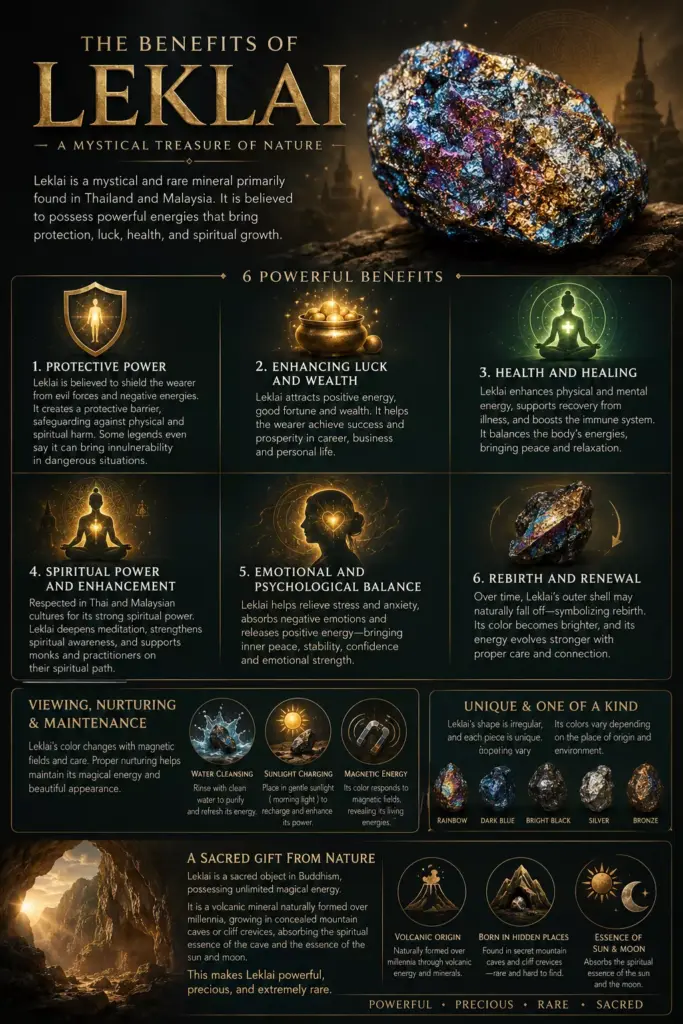
A Leklai amulet (เหล็กไหล) is a sacred object rooted in Thai Buddhist mysticism and forest monk traditions, formed from or consecrated with Taat Gaayasit (ธาตุกายสิทธิ์), a legendary elemental substance often translated as "living magical metal" or "mystical elemental relic." Historically associated with remote caves, dense forests, and mountain cliffs throughout Thailand and parts of Southeast Asia, Leklai has been venerated across multiple Buddhist Eras (BE) as a substance of alchemical and spiritual significance, predating many formalised amulet traditions. Within Thai amulet culture, the Leklai amulet's core spiritual purpose is the attainment of Spiritual Enlightenment, energetic protection, and elevated meditative awareness, making it among the most revered and debated sacred objects in the collector community today.Chapter 02
Section 2: Historical Origins and Development
The origins of Leklai (เหล็กไหล) as a sacred substance are deeply intertwined with Thailand's forest monk (Phra Tudong — พระธุดงค์) lineage and the ascetic traditions of Ruesi (ฤๅษี — hermit sages) who practised in remote wilderness areas. These wandering masters, operating across what is now northern, northeastern, and central Thailand, are credited in oral tradition with first identifying and extracting Leklai from cave formations as early as the early Rattanakosin period and arguably stretching back to Ayutthaya-era mystical practices, though precise BE dates from that period are not widely documented in English sources. By the mid-twentieth century, interest in Leklai had begun crossing from purely forest-tradition oral knowledge into the broader Thai amulet collecting community. Key developments included:- Pre-BE 2490: Oral accounts from forest monk lineages describe Leklai extraction as an exclusively esoteric practice, confined to masters with advanced mastery of Kasina meditation and ancient Wicha (วิชา — sacred knowledge).
- BE 2490–2520: Several prominent forest monks, including figures associated with northeastern Thai forest traditions, began incorporating Leklai into consecrated amulet batches, introducing the substance to lay devotees for the first time at meaningful scale.
- BE 2520–2550: Leklai specimens and amulets incorporating Leklai material began appearing in organised amulet markets in Bangkok, Chiang Mai, and eventually Singapore and Malaysia, prompting collector discourse around authenticity and lineage provenance.
- BE 2550–present: Genuine Leklai has become increasingly scarce within the collector market. The substance is now studied carefully by serious collectors examining cave origin traditions, monk lineage, and historical references before acquisition.
Chapter 03
Section 3: Symbolism and Spiritual Meaning
In Thai amulet culture, Leklai (เหล็กไหล) carries layered symbolic meaning that distinguishes it from conventionally moulded amulet types. Unlike amulets depicting Buddhist iconography such as the Buddha image (Phra Phim — พระพิมพ์) or a specific deity, Leklai derives its symbolic power from its nature as a raw elemental substance — a direct manifestation of sacred earth, cave energy, and forest monk spiritual attainment. The concept of Taat Gaayasit (ธาตุกายสิทธิ์), or "living magical metal," positions Leklai within a framework of elemental alchemy. In Thai Buddhist cosmology, the four great elements — earth, water, fire, and wind (Taat See — ธาตุสี่) — are understood as fundamental building blocks of existence. Leklai is traditionally viewed as transcending ordinary elemental categorisation, occupying a liminal space between mineral and spiritual matter, which is precisely why forest monks prized it for meditative and enlightenment-focused practices. The seven traditionally recognised colours of Leklai each carry distinct symbolic associations:- See Khiaw Bpeek Malaeng Tap (black-blue): Associated with protective power and deep meditative absorption.
- See Nam Dtaan Orn (light brown): Linked to grounding energy and earthly stability.
- See Bplueak Mangkut (magenta): Believed to carry transformative and spiritually elevating properties.
- See Ngern Yuong (silver tone): Associated with clarity, purity, and mental illumination.
- See Tong (gold): Connected to prosperity, abundance, and merit accumulation.
- See Nam Nom (creamy white): Traditionally linked to compassion, spiritual cleanliness, and Dhamma wisdom.
- See Phasom (mixed colour formations): Regarded as the rarest manifestation, symbolising the convergence of all elemental spiritual forces.
Chapter 04
Section 4: Key Variants and Styles (Pim Types)
Unlike classical Thai amulets pressed from sacred powder (เนื้อผง) into fixed moulds, Leklai does not conform to standard Pim (พิมพ์ — mould type) classifications in the conventional sense. Instead, collectors distinguish Leklai variants primarily by form category, extraction method, colour type, and mode of presentation. The principal categories recognised within the collector community are as follows:- Raw Natural Leklai (เหล็กไหลธรรมชาติ): Unprocessed pieces extracted directly from cave formations. These are considered the purest form of Leklai and command the highest collector regard. They are typically mounted in gold or silver casings for wearing or display. Shape and surface irregularities are expected and valued rather than penalised.
- Carved or Shaped Leklai (เหล็กไหลแกะสลัก): Pieces shaped by hand into small figurines, Buddha images, or geometric sacred forms. Carving is typically undertaken by master artisans under a monk's supervision, preserving the ritual sanctity of the material.
- Leklai Insert Amulets (พระผงผสมเหล็กไหล): Conventional amulets — often sacred powder (เนื้อผง), lead-tin alloy (เนื้อตะกั่วผสมดีบุก), or other metal compositions — into which fragments or shavings of Leklai have been incorporated during consecration. These pieces allow broader collector access to Leklai energy at lower price points.
- Cold-Extracted Leklai (เหล็กไหลดัดเย็น / Dtat Yen): A classification prized above hot-extracted pieces. Cold extraction requires advanced mastery of Fire Kasina meditation, where the practitioner uses focused psychic concentration alongside ceremonial chanting to draw the Leklai from its natural cave formation. The absence of heat is believed by collectors to preserve the substance's full spiritual potency.
- Hot-Extracted Leklai (Dtat Rorn): Obtained using intense heat and sacred incantations to draw the substance from embedded stone formations. While still considered sacred, hot-extracted Leklai is typically positioned below cold-extracted examples in collector hierarchy.
- Colour-Typed Leklai: As described in Section 3, the seven recognised colours — See Khiaw Bpeek Malaeng Tap, See Nam Dtaan Orn, See Bplueak Mangkut, See Ngern Yuong, See Tong, See Nam Nom, and See Phasom — each constitute a distinct variant in collector evaluation, with See Phasom (mixed colour formations) regarded as the rarest.
Chapter 05
Section 5: Materials and Their Significance
The material nature of Leklai is central to its sacred identity and distinguishes it fundamentally from other Thai amulet types. Where conventional amulets are composed of measurable ingredients — sacred powder (เนื้อผง), pressed clay (เนื้อดิน), or cast metal (เนื้อโลหะ) — Leklai occupies a unique position as a substance whose material identity is itself the subject of spiritual interpretation. The Core Substance — Taat Gaayasit (ธาตุกายสิทธิ์): The living magical metal at the heart of Leklai tradition is described in oral lineage accounts as forming over long geological periods within sacred cave environments. Collectors and traditional practitioners regard it as neither purely mineral nor purely organic, but as an elemental relic shaped by centuries of concentrated spiritual energy within its formation environment. Its connection to Spiritual Enlightenment derives from this understanding: the substance is believed to carry the accumulated meditative energy of the sacred spaces in which it formed. Cave Earth and Sacred Water (ดินถ้ำ / น้ำมนต์): In some Leklai consecration traditions, fragments or powders derived from cave earth and blessed water (Nam Mont — น้ำมนต์) from the extraction site are incorporated into accompanying amulet pieces. These materials are chosen to extend the cave's spiritual energy into a portable, wearable form. Sacred Lacquer and Resin Coatings (ยางรัก): Traditional Leklai pieces — particularly carved forms — may receive protective coatings of sacred lacquer (Yaang Rak — ยางรัก), a material with deep roots in Thai Buddhist craft traditions. This coating serves both preservation and ritual purposes, sealing the sacred energy within the object. Metals Used in Casing (โลหะมงคล): Authentic Leklai intended for wearing is typically mounted in gold (ทอง), silver (เงิน), or sanctified copper alloy (สำริด) casings. The choice of casing metal is not merely aesthetic — in Thai amulet tradition, each metal carries specific elemental and astrological associations that interact with the Leklai's own energetic properties. Integration with Sacred Powder Amulets: When Leklai material is incorporated into pressed sacred powder amulets, the powder base itself typically consists of consecrated herb powders (ผงสมุนไพรมงคล), ground sacred soil from multiple temples (ดินมงคล), and aromatic binding resins. The addition of Leklai shavings or fragments to such a base is believed to elevate the amulet's capacity to support the wearer's spiritual development and journey toward enlightenment.Chapter 06
Section 6: Spiritual Attributes and Collector Beliefs
Within Thai amulet culture, Leklai (เหล็กไหล) is associated with a distinctive set of spiritual attributes that collectors and devotees have documented through generations of oral tradition and practice. These beliefs are framed here as collector cultural understanding, not as guaranteed outcomes.What protection does a Leklai amulet provide?
In Thai amulet belief, Leklai is most strongly associated with Klaew Klaad (แคล้วคลาด — avoidance of danger) and Kong Grapan (คงกระพัน — invulnerability). Devotees traditionally believe that carrying or wearing authentic Leklai creates an energetic shield against physical harm, accidents, and malevolent spiritual forces. Beyond physical protection, collectors describe Leklai as believed to harmonise surrounding energies, reduce the influence of negative forces on the wearer's mental state, and support clarity of awareness — qualities directly connected to the amulet's association with Spiritual Enlightenment.How should a Leklai amulet be worn or displayed?
Raw or carved Leklai pieces are most traditionally worn on a cord around the neck, positioned against the chest, or mounted in a casing worn as a pendant. In Thai amulet tradition, yellow or white sacred cord (Saiyasin — สายสิญจน์) is considered appropriate for securing Leklai pieces. Collectors who prefer not to wear Leklai may display it in a dedicated sacred space (Hhong Buu Chaa — ห้องบูชา) at home, elevated above floor level and presented respectfully on an amulet stand or altar. Leklai should not be placed below the waistline in domestic display settings, in keeping with general Thai amulet reverence practices.Are there any taboos or care instructions for Leklai amulets?
Collectors and traditional practitioners observe several widely respected guidelines when caring for Leklai. The substance should not be worn into spaces considered spiritually impure, such as funeral homes or areas of moral transgression. Leklai should not be brought into contact with menstrual blood in traditional belief, a convention common across Thai amulet culture. Cleaning should be performed gently using a soft dry cloth; harsh chemicals and prolonged water immersion are avoided. Some collectors periodically re-consecrate their Leklai pieces by briefly placing them on a temple altar or by chanting appropriate Katha (คาถา — sacred verses) taught by the presiding monk. When not worn, Leklai is ideally stored in a clean cloth wrapping, separate from non-sacred objects.Chapter 07