Archan Heng Praiwan
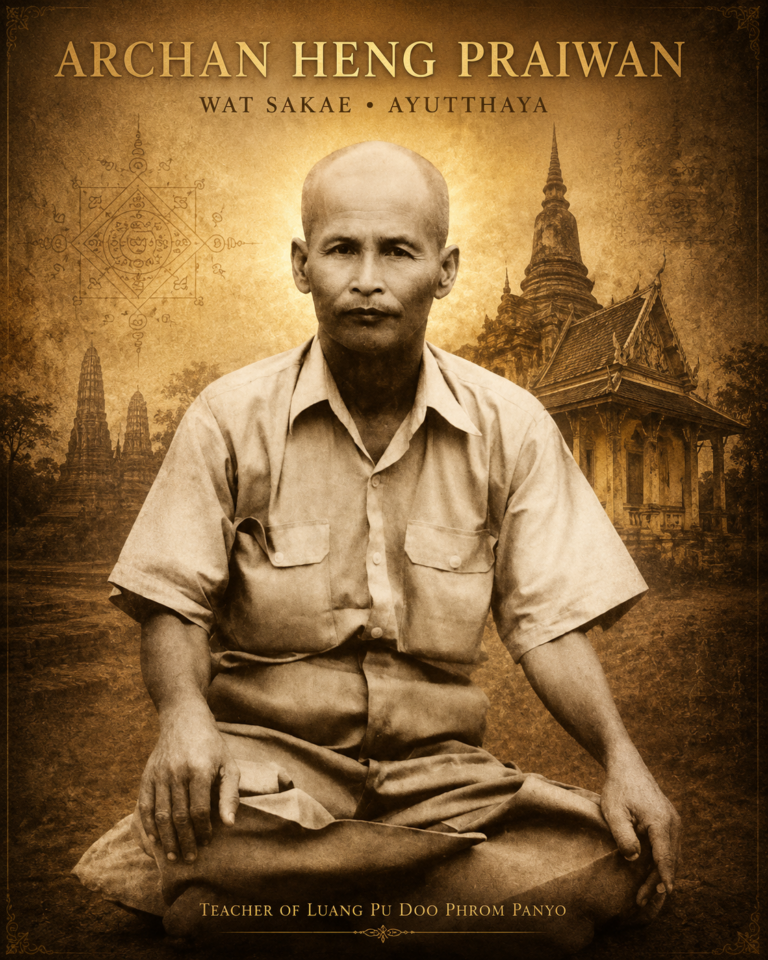
Archan Heng Praiwan (อาจารย์เฮงไพรวัลย์) was a great lay master and adept necromancer born in BE 2428 (AD 1885) in Ayutthaya Province, Thailand. Renowned across Central and Southern Thailand as a supreme Sak Yant (สักยันต์) tattoo master, sacred Takrut (ตะกรุด) maker, and keeper of ancient Wicha (วิชา) grimoires, he is most closely associated with Wat Sakae (วัดสะแก), Ayutthaya, through his deep spiritual friendship with Luang Phu Si of that temple. Read more ↓
Biography
Who Was Archan Heng Praiwan?
Archan Heng Praiwan (อาจารย์เฮงไพรวัลย์) was a great lay master and adept necromancer born in BE 2428 (AD 1885) in Ayutthaya Province, Thailand. Renowned across Central and Southern Thailand as a supreme Sak Yant (สักยันต์) tattoo master, sacred Takrut (ตะกรุด) maker, and keeper of ancient Wicha (วิชา) grimoires, he is most closely associated with Wat Sakae (วัดสะแก), Ayutthaya, through his deep spiritual friendship with Luang Phu Si of that temple.
Early Life and Ordination
Archan Heng Praiwan (อาจารย์เฮงไพรวัลย์) was born in BE 2428 (AD 1885) in Ayutthaya Province, the heartland of ancient Siamese civilisation. His father was reportedly either a police officer or a prison officer — a position of authority that afforded the family relative means. In his youth, his father sent him to Penang and Singapore to receive a formal education. However, Archan Heng did not complete his schooling. His consuming fascination with Saiyasart (ไสยศาสตร์) — the body of Thai Buddhist, Animist, and Necromantic occult practices — and the Dtamra Saiyawaet (ตำราไสยเวท) grimoires led him to abandon conventional studies entirely.
When he came of age, Archan Heng was ordained as a Buddhist monk at Wat Suwan (วัดสุวรรณ) in Ayutthaya. During his first period of monastic life, he immersed himself in the ancient magical Wicha (วิชา) contained within the grimoires of Wat Pradoo Rong Tam (วัดประตูรั้งตาม), described as perhaps the largest library of ancient magical grimoires in the country. He mastered the inscription of Khom Agkhara (ขอมอักขระ) Sanskrit spells, Kata (คาถา) incantations, and Sacred Yant (ยันต์), and became widely celebrated as a great master of Sak Yant (สักยันต์) Thai temple tattoos.
Spiritual Development and Practice
Archan Heng Praiwan’s spiritual path was one of extraordinary depth and breadth, drawing from multiple living lineages of Thai occult Buddhism. During his first ordination, he studied the Wicha Grimoire of the Dtamra Radtana Mala (ตำรารัตนมาลา) until attaining full adept mastery. He then disrobed temporarily to care for his parents — a deeply honoured act of filial piety in Thai Buddhist culture — before re-ordaining at Wat Prayatigaram (วัดพระยาทิการาม) in Ayutthaya. His Upachaya (อุปัชฌาย์) ordaining monk for this second ordination was the great Luang Phor Glan Tammachodti (หลวงพ่อกล่อมธรรมโชติ), Abbot of Wat Prayat (วัดพระยาต), from whom he spent a long period learning and mastering the full Dtamra of the Wicha of Luang Por Glan.
His quest for knowledge also drove him southward to the deep south of Thailand, where he studied the most ancient magical practices of the Southern Khao (เขา) or sorcery lineages — a tradition tracing its roots back to the Sri Vichai Era (ยุคศรีวิชัย) of ancient Siam. He further received Wicha from the famous temple of sorcery study, Wat Sam Jeen (วัดสามจีน), and from the great Luang Phu Tong (หลวงปู่ทอง) of Wat Rat Ayotaya (วัดราษฎร์อยุธยา), as well as Luang Phu Kam Wibun (หลวงปู่คำวิบูลย์). Notably, he was also the recipient of the Wicha Yant Gao Yord (ยันต์เก้ายอด) obtained from the great Luang Phor Hrun (หลวงพ่อฮ้วน). After his second period of monastic life, he disrobed and remained a lay sorcerer — an Archan (อาจารย์) — until his passing.
Major Amulet Consecrations and Ceremonies
Archan Heng Praiwan is best known among collectors and devotees for his powerful Takrut (ตะกรุด) metallic scroll spells, his sacred Sak Yant (สักยันต์) tattoos, and animist carved charms. His most celebrated pieces include the Takrut Maha Jakkapat (ตะกรุดมหาจักรพรรดิ์) — an inimitably designed metallic scroll spell considered by devotees to carry supreme protective and commanding power — and the Takrut Jappapattirach (ตะกรุดจับพระตาราช), which became so feared for its invincibility properties that those who wore one were regarded as virtually untouchable. High-class artisans were commissioned to carve his amulets, while village craftspeople produced animist charms from ivory, wood, and necromantic Ban Neng (บ้านเนิง) skullbone materials. These bone-derived pieces, along with his metallic Takrut, are considered the rarest and most sought after by serious collectors of ancient Ayutthaya occult amulets.
Among his most historically significant ceremonial events was a large-scale blessing ceremony conducted at Wat Hantra (วัดหันตรา), around BE 2476 (AD 1933), during a time of military dispute in the era of King Rama the Third. On this occasion, regiments of Thai soldiers — both officers and lower ranks — sought Archan Heng’s protective Yant in enormous numbers, all arriving on the same day. To conduct this ceremony with full efficacy, Archan Heng gathered a host of powerful monks with psychic abilities to assist in the Suad Nam Puttamont (สวดน้ำพุทธมนต์) chanting ritual and the Putta Pisek (พุทธาภิเษก) Buddha Abhiseka consecration ceremony. He was assisted in assembling these masters by his close Dhamma friend, Luang Phu Si (หลวงปู่ศรี) of Wat Sakae (วัดสะแก) — the temple of the renowned Luang Phor Doo (หลวงพ่อดู) — though Luang Phu Si could not personally attend on that occasion, being engaged with Dhamma duties at Wat Liab (วัดเลียบ). From that ceremony onward, Archan Heng always invited Luang Phu Si to attend and assist with empowerment at all subsequent blessing ceremonies.
Detailed batch records for specific amulet series — including precise BE years, batch names, and materials for each issue — are not widely documented in English sources. Researchers and serious collectors are advised to consult Thai-language temple records and specialist Thai amulet publications for complete batch documentation.
Legacy and Temple Significance
Archan Heng Praiwan passed away in BE 2502 (AD 1959) at the age of 75, leaving behind a legacy that straddles the boundary between orthodox Thai Buddhism and the deep esoteric arts. As a lay master who chose to serve the public rather than remain within the monastery walls, he represents a revered archetype in Thai spiritual culture — the Archan Sorcerer who applies sacred knowledge for the protection of devotees in the world.
His connection to Wat Sakae (วัดสะแก) in Ayutthaya — through his close spiritual friendship with Luang Phu Si — links him to one of the most celebrated amulet temples in Thailand, a temple also famous for Luang Phor Doo (หลวงพ่อดู) and the legendary Luang Phor Glam (หลวงพ่อกลม) amulet lineage. The Wicha that Archan Heng preserved and practised drew from royal decree: the Wicha Saiyasart grimoire texts of Wat Pradoo Roeng Tam (วัดประตูร้องทาม) were originally ordered inscribed by King Naresuan Maharach (สมเด็จพระนเรศวรมหาราช), with inscriptions completed between BE 2133–2148 (AD 1590–1605). Today, collectors and devotees across Thailand and Southeast Asia continue to seek out Archan Heng’s surviving Takrut and carved amulets as prized heirlooms of ancient Ayutthayan occult mastery.