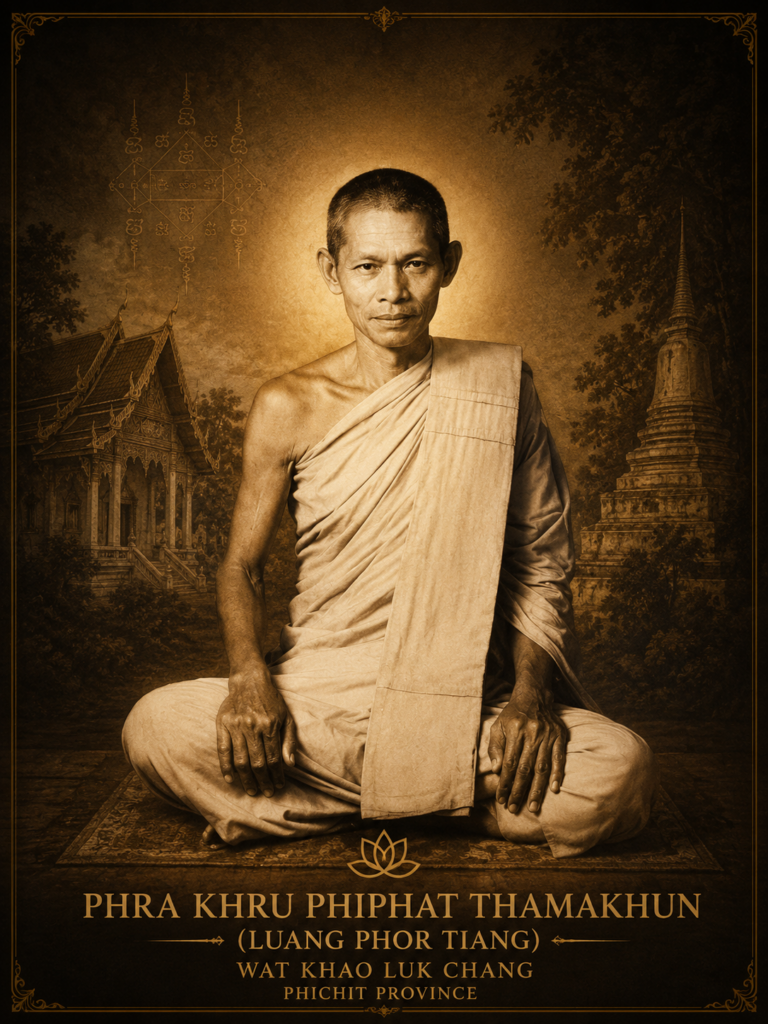
Luang Phor Tiang Wat Khao Luk Chang
Biography Early life Luang Pho Tiang was born on 20 February 1901 — a Thursday, the 13th waxing moon of the 3rd lunar month, Year of the Ox — at Ban Dong Klang, Dong Pakham Subdistrict, Mueang District, Phichit Province. Ordination He was ordained on 10 February 1923 at the ordination hall of Wat Dong ... Read more ↓
Biography
Biography
Early life
Luang Pho Tiang was born on 20 February 1901 — a Thursday, the 13th waxing moon of the 3rd lunar month, Year of the Ox — at Ban Dong Klang, Dong Pakham Subdistrict, Mueang District, Phichit Province.
Ordination
He was ordained on 10 February 1923 at the ordination hall of Wat Dong Klang. The key officiants at his ordination were:
- Preceptor (upajjhāya): Phra Khru Silatharak (Yim Thattiang), abbot of Wat Tha Luang and chief monk of Phichit Province
- Karma-vachariya: Chao Adhikan Pun
- Anusasana-acharya: Phra Palat Pao
Following ordination, he devoted himself to the study of Buddhist scriptures and monastic discipline in the traditional manner of monks of that era.
Studies and lineage
In his early years as a monk, Luang Pho Tiang pursued a broad range of sacred and scholarly disciplines:
- Traditional medicine, studied under Doctor Kaew Thabuathong in Pho Prathap Chang District
- Foundational sacred wicha and Buddhist magic, received from Abbot Pun, his ordination teacher
- Vipassana meditation, sacred yantra knowledge, and various forms of Buddhist sorcery, studied under Luang Pho Phit of Wat Khamang
Through years of sustained discipline and practice, he became highly skilled and widely respected for his mastery of these sacred sciences.
Monastic conduct and ecclesiastical recognition
Throughout his monastic life, Luang Pho Tiang was known as a monk who strictly upheld the Dharma and Vinaya. He regularly guided devotees to honour the Triple Gem, assisted people in hardship, and worked persistently for the preservation of Buddhism. In recognition of these contributions, he received the ecclesiastical title of Phra Khru Phiphat Thamakhun.
Passing
During the later years of his life, Luang Pho Tiang’s health gradually declined and he required frequent medical treatment. He passed away peacefully on 12 March 1977 at 9:20 AM, at the age of 76, having spent 53 years in the monkhood.
Sacred objects
Overview
The sacred amulets created by Luang Pho Tiang of Wat Khao Luk Chang came in many forms. His takrut remain the most widely sought after among collectors, followed by his early-generation coins and statues, both of which have grown notably scarce on the collector market.
Takrut — construction and variants
The inner core of Luang Pho Tiang’s takrut was typically made from copper. Collectors may encounter several distinct construction types:
- Single-metal lead versions
- Three-layer rolled metal versions, combining lead, brass, and copper
- Examples wrapped with woven cords, in a style similar to the takrut of Luang Pho Phit of Wat Khamang
- Both lacquered and unlacquered finishes
- Plain versions without woven cords
Spiritual significance and sacred inscriptions
In Thai amulet tradition, Luang Pho Tiang’s takrut are particularly respected for their association with kongkraphan chatri — protection and invulnerability against danger and harm.
The sacred yantra inscriptions inside the takrut are drawn from ancient warrior treatises and are connected to what is traditionally known as the “Life Partner Takrut” or “Buddha Weapon Takrut.” The core inscription carries a solemn Buddhist mantra associated with protection and spiritual strength:
“Asisattithanucheva sappete awuthani cha bhakka bhakka vijun. Nānilomangmāmenaphussanti.”
According to traditional belief, the takrut is further empowered through:
- The support of the four elements
- The blessings of the thirty directions
- The protection of the eight directional Itipiso
- The nine sacred virtues
- The Three Refuges
Additional sacred inscriptions were applied to the reverse of the takrut to strengthen the spiritual completeness of the original design.
Frequently asked questions
Who was Luang Pho Tiang of Wat Khao Luk Chang?
Luang Pho Tiang, formally titled Phra Khru Phiphat Thamakhun, was a highly respected Buddhist master of Phichit Province. He was a direct disciple of Luang Pho Ngoen and received sacred wicha from Luang Pho Phit of Wat Khamang. He spent 53 years in the monkhood before passing away in 1977.
What are Luang Pho Tiang’s most collectible sacred objects?
His takrut are the most widely recognised and sought after. His early-generation coins and statues are also collected, though these have become increasingly difficult to find and have risen in value over time.
What materials were used in Luang Pho Tiang’s takrut?
The inner core was typically copper. Variants include single-metal lead versions and three-layer rolled metal versions combining lead, brass, and copper. Some were wrapped with woven cords, while others were left plain, and finishes include both lacquered and unlacquered forms.
What is the spiritual purpose of Luang Pho Tiang’s takrut?
His takrut are traditionally revered for kongkraphan chatri — protection and invulnerability against danger and harm. The inscriptions are rooted in ancient warrior treatises and are associated with the “Life Partner Takrut” or “Buddha Weapon Takrut” tradition.
Who were Luang Pho Tiang’s main teachers?
His foundational sacred wicha was received from Abbot Pun, his ordination teacher. He later studied Vipassana meditation, sacred yantra knowledge, and Buddhist sorcery under Luang Pho Phit of Wat Khamang. He also studied traditional medicine under Doctor Kaew Thabuathong.
When and where was Luang Pho Tiang ordained?
He was ordained on 10 February 1923 at the ordination hall of Wat Dong Klang, Phichit Province. His preceptor was Phra Khru Silatharak (Yim Thattiang), abbot of Wat Tha Luang and chief monk of Phichit Province at the time.