Luang Phor Boey (Lp Boi)
Luang Phor Boey (หลวงพ่อบ่อย), also romanised as Luang Phor Boi, was a revered Thai Buddhist monk born in BE 2435 (AD 1892), the Year of the Dragon, in Ban Sam Muang, Bang Pla Ma Subdistrict, Bang Pla Ma District, Suphanburi Province, who spent the greater part of his monastic life in residence at Wat Manao (วัดมะนาว) — also written Wat Manow — a Rattanakosin-era temple in Nakhon Pathom Province. He is best known in Thai amulet collector circles for a series of deeply personal sacred amulet batches consecrated between BE 2473 (AD 1930) and BE 2508 (AD 1965), most famously the BE 2500 (AD 1957) self-image amulets (พระรูปเหมือน) cast using betel nut chew he had personally saved for fifteen to twenty years, a material tradition widely regarded as one of the most intimate and spiritually charged in twentieth-century Thai amulet history. Read more ↓
Amulets by Luang Phor Boey (Lp Boi) 2 total · 1 available
![[SOLD] Rian Roop Muen Luang Phor Boei Lang Phra Chao Ha Pra Ong Roon Rae BE2508 Nur Thong Lueng Wat Manao](https://tac-media.sgp1.digitaloceanspaces.com/2026/08/Rian-Roop-Muen-Luang-Phor-Boei-Lang-Phra-Chao-Ha-Pra-Ong-Roon-Rae-BE2508-Nur-Thong-Lueng-Wat-Manao-300x300.png)
Biography
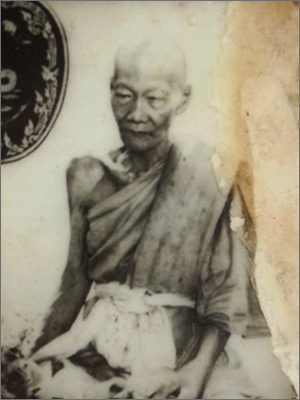
Who Was Luang Phor Boey (Lp Boi) (หลวงพ่อบ่อย)?
Luang Phor Boey (หลวงพ่อบ่อย), also romanised as Luang Phor Boi, was a revered Thai Buddhist monk born in BE 2435 (AD 1892), the Year of the Dragon, in Ban Sam Muang, Bang Pla Ma Subdistrict, Bang Pla Ma District, Suphanburi Province, who spent the greater part of his monastic life in residence at Wat Manao (วัดมะนาว) — also written Wat Manow — a Rattanakosin-era temple in Nakhon Pathom Province. He is best known in Thai amulet collector circles for a series of deeply personal sacred amulet batches consecrated between BE 2473 (AD 1930) and BE 2508 (AD 1965), most famously the BE 2500 (AD 1957) self-image amulets (พระรูปเหมือน) cast using betel nut chew he had personally saved for fifteen to twenty years, a material tradition widely regarded as one of the most intimate and spiritually charged in twentieth-century Thai amulet history.
Early Life and Ordination
Luang Phor Boey (หลวงพ่อบ่อย) was born in BE 2435 (AD 1892), the Year of the Dragon, in Ban Sam Muang, Bang Pla Ma Subdistrict, Bang Pla Ma District, Suphanburi Province. His father, Chomsi (ชมศรี), was a rice farmer; his mother’s name is not widely documented in English sources. The community in which he was raised was notable not only for its agricultural heritage but also for a local ironworking tradition, where villagers supplemented their farming income through blacksmithing — a detail that would later inform the metal-casting character of his early amulet work.
At the age of 21, in BE 2456 (AD 1913), he received full bhikkhu (ภิกขุ) ordination at Wat Manao (วัดมะนาว), committing himself to the Vinaya (วินัย) discipline and the path of renunciation. He completed three rains retreats (วัสสา) at the temple before seeking broader Dharma education, embarking on a period of formal study and spiritual deepening that would take him far beyond Suphanburi and ultimately bring him back to Wat Manao as its most celebrated resident monk.
Spiritual Development and Practice
Around BE 2459 (AD 1916), Luang Phor Boey (หลวงพ่อบ่อย) travelled to Thonburi (ธนบุรี) to undertake advanced study of Dharma (ธรรม) and Vinaya (วินัย) at Wat Srisuttharam (วัดศรีสุทธาราม), also known as Wat Chee Pa Khao (วัดชีปะขาว). He remained there for approximately eight to nine years, receiving rigorous grounding in canonical Buddhist texts and monastic discipline within the Rattanakosin scholarly tradition.
After returning to Wat Manao, he sought out two of the most celebrated Vipassana (วิปัสสนา) masters of his era: Luang Phor Niam (หลวงพ่อเนียม) of Wat Noi (วัดน้อย) and Luang Phor Phan (หลวงพ่อพัน) of Wat Bang Nom Kho (วัดบางนมโค) in Ayutthaya Province. Training under these two lineage-bearing masters placed Luang Phor Boey firmly within the forest-influenced Vipassana tradition (กรรมฐาน), emphasising meditative insight, mental purification, and the direct observation of the three characteristics of existence. In BE 2467 (AD 1924), he returned permanently to Wat Manao, where he would remain in residence for the rest of his life. Throughout his decades of monastic service, he was widely noted for an austere and humble lifestyle: he declined high ecclesiastical positions, refused large monetary donations, and maintained an unwavering commitment to simplicity and seclusion — qualities that devotees believe imbued his sacred objects with exceptional spiritual potency.
Major Amulet Consecrations and Ceremonies
Luang Phor Boey (หลวงพ่อบ่อย) began his sacred amulet creation (การสร้างพระเครื่อง) around BE 2473 (AD 1930). For these early metal amulets, local villagers contributed an assortment of metals — brass (ทองเหลือง), bronze (สำริด), silver (เงิน), gold (ทอง), stone mortar fragments, and traditional household utensils — which were melted down and cast together. Because of the varied metallurgical composition of each melt, individual pieces display noticeably different tonalities: some exhibit a warmer, gold-rich hue; others carry the cooler tones of silver or the deep patina of bronze. Collectors and authentication experts regard the natural wrinkles in the metal texture and the distinctive filing marks along the amulet sides as the most reliable physical hallmarks of genuine early pieces from this monk — traits present in virtually every authenticated example.
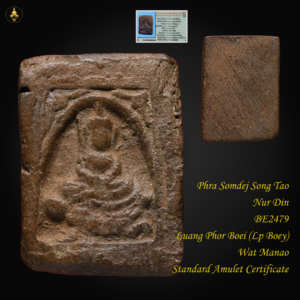
In BE 2479 (AD 1936), Luang Phor Boey produced a celebrated series of clay amulets known as Phra Chao Ha Phra Ong (พระเจ้าห้าพระองค์) — “The Five Buddhas.” Each piece depicted the Buddha in association with a sacred creature or symbol: the Naga (นาค), the Cow (วัว), the Lion (สิงห์), the Turtle (เต่า), and the Bird — sometimes interpreted as a Rooster (ไก่). This batch is particularly admired by collectors who specialise in early-twentieth-century Thai clay amulets (พระดิน) for its iconographic richness and the meritorious intent behind each of the five forms.
The most personally significant amulet batch in Luang Phor Boey’s entire output was created in BE 2500 (AD 1957). These amulets featured his own image (รูปเหมือน) and were fashioned from an extraordinarily intimate combination of materials. The primary ingredient was betel nut chew — known in Thai as chahn mark (จานหมาก) — which Luang Phor Boey had personally accumulated and saved over a period of fifteen to twenty years. This material was mixed with incense powder (ผงธูป), dried flowers (ดอกไม้แห้ง), and a quantity of earth (ดิน), with palm sugar (น้ำตาลโตนด) used as the binding agent. The resulting amulets were produced in three distinct varieties, each reflecting the proportional dominance of one material:
- Chahn Mark Type (แบบจานหมาก): Composed predominantly of betel nut chew; notably light in weight and typically exhibiting a warm, reddish-brown surface. Regarded by collectors as the most personal expression of the monk’s accumulated spiritual energy.
- Incense Powder Type (แบบผงธูป): Higher in incense powder content; slightly heavier than the chahn mark variety, with a smoother, denser surface texture and a subtly darker colouration.
- Clay Type (แบบดิน): The heaviest and densest of the three varieties, with a higher proportion of earth; surface texture is more granular, and pieces in this category are generally considered the most robust in terms of physical preservation.
In BE 2508 (AD 1965), during the auspicious ubosot boundary consecration ceremony (พิธีผูกพัทธสีมา) at Wat Manao, Luang Phor Boey created two coin-type amulets (เหรียญ): a square-cut coin (เหรียญตัดเหลี่ยม) and a full-body coin (เหรียญเต็มองค์). Both types were distributed freely to devotees in attendance at the ceremony. These coins are particularly valued by collectors for their direct association with a major ecclesiastical event in the temple’s history, and examples in fine condition with original surfaces command consistent collector interest in the Thai amulet market.
Detailed batch records beyond those noted above — including any additional BE years, supplementary phim (พิมพ์) variants, or rian (เหรียญ) issues not described here — require consultation of Thai-language temple sources and specialist auction catalogues.
Legacy and Temple Significance
Luang Phor Boey (หลวงพ่อบ่อย) left a legacy defined not by institutional rank or political influence within the Thai Sangha (สงฆ์), but by the quiet authority of a life lived in complete accordance with monastic discipline and meditative practice. His deliberate refusal of high ecclesiastical titles and large donations became, in devotee culture, the very proof of his spiritual authenticity — a monk whose sacred objects were believed to carry power precisely because he sought none for himself.
Wat Manao (วัดมะนาว) in Nakhon Pathom Province continues to be associated with his memory, and devotees from Suphanburi, Nakhon Pathom, and beyond visit the temple to pay respects at his commemorative shrine. The BE 2500 (AD 1957) self-image amulets in particular are venerated as objects of protection (ของขลัง) and spiritual refuge. His lineage connection to Luang Phor Niam (หลวงพ่อเนียม) and Luang Phor Phan (หลวงพ่อพัน) of the Ayutthaya Vipassana tradition further elevates his standing among collectors who prize monks with documentable master-to-disciple spiritual lineages. Annual merit-making activities (งานบุญ) at Wat Manao serve to keep his memory alive across successive generations of devotees and collectors throughout Thailand and the broader Southeast Asian collector community.