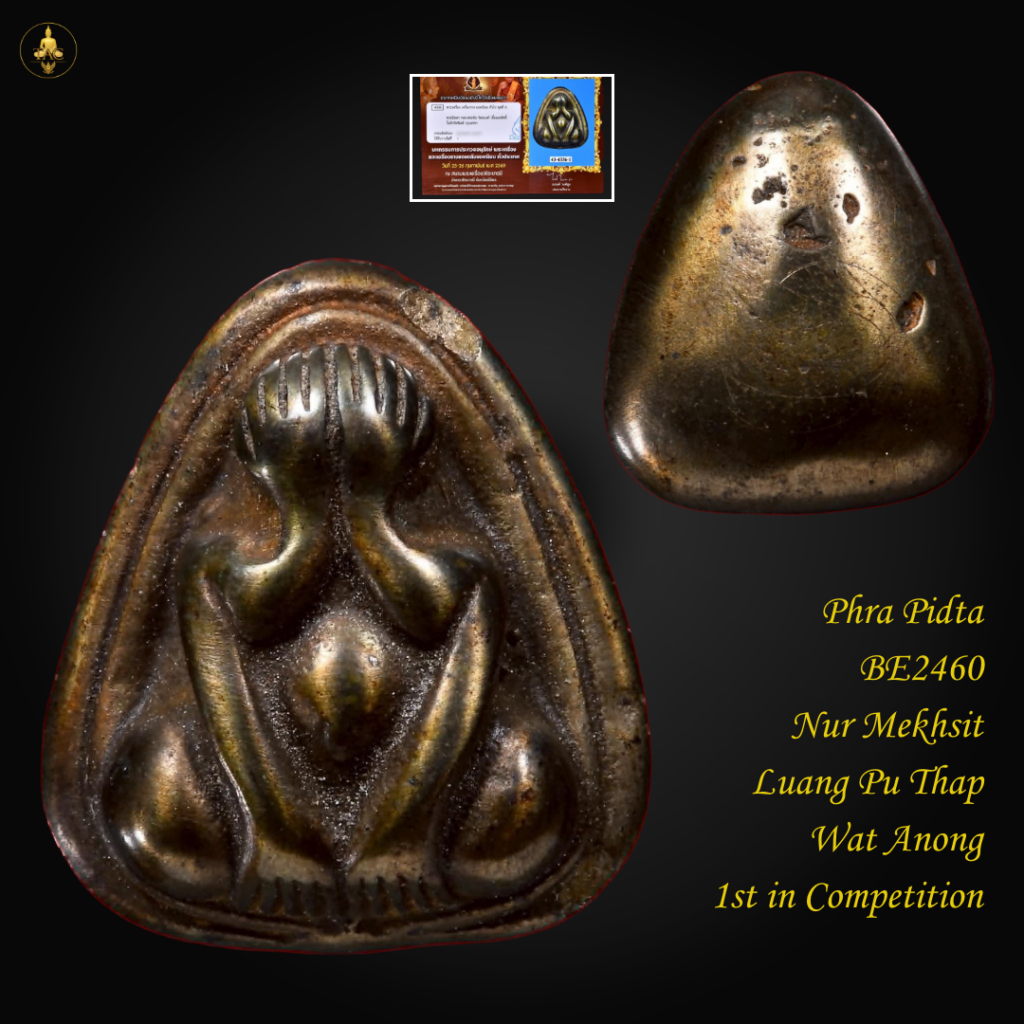

Phra Pidta Pim Chalut BE2460 Nur Mekhsit Luang Phor Thap Wat Anong
| Type | Phra Pidta Pim Chalut |
| Monk | Luang Phor Chamnan (Lp Chamnan) Wat Ratchakhru Worawihan, Bang Yi Ruea |
| Temple | Wat Anongkharam |
| B.E. Year | 2460 |
| Material | Nur Mekhsit |
| Condition | Very Good |
| Certificate | Competition |
| Competition | Won 1ST placing |
| SKU | TAC-PhraPidtaPimChalut-LpThap-001 |
Authentic Phra Pidta Pim Chalut Luang Phor Thap, Wat Anong BE 2460. Nur Mekhsit material. Competition certified. Trusted Thai amulet Singapore dealer.
What is the Phra Pidta Pim Chalut Luang Phor Thap from Wat Anong?
The Phra Pidta Pim Chalut Luang Phor Thap is an authentic Thai amulet created at Wat Anong in BE 2460, cast from Nur Mekhsit — a rare greenish-gold metal alloy renowned for its shimmering appearance. This Competition-certified amulet is regarded by devotees as one of the most distinguished Phra Pidta pieces from the early Rattanakosin period.
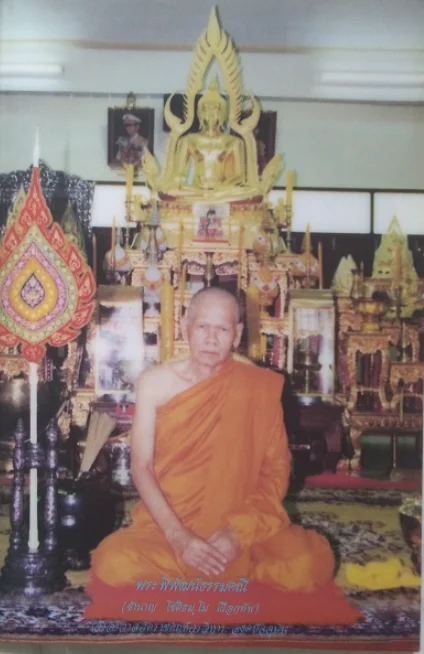
Luang Phor Thap of Wat Anong was born on Friday, the first month of the Year of the Rabbit, BE 2374, and passed away on 29 January BE 2465 at the age of 92, having spent 53 years as a monk. As documented by Payap Khamphan in the book Phra Pidta Mahamongkol, he was a reclusive figure who showed no interest in wealth, fame, or praise.
Throughout his life, Luang Phor Thap devoted himself diligently to the study of magic and occult sciences. During the era of alchemical pursuit, he was among those who took the craft most seriously, earning deep respect from contemporaries across the monastic world.
His mastery was so widely recognised that even Somdej Phra Sangkharaj (Pae) of Wat Suthat, while pursuing knowledge in Phra Kring amulet-making, and Luang Pu Suk of Wat Pak Khlong Makham Tao, sought him out to exchange knowledge in the crafting of Mekhsit amulets — a testament to his exceptional expertise.
Phra Pidta Pim Chalut and Wat Anong Heritage
Wat Anong holds a distinguished place in Thai Buddhist amulet history as the residence of Luang Phor Thap, who served as a temple attendant of Somdej Phutthacharn (Nawam). The temple’s association with this revered monk cemented its reputation as a centre for Mekhsit amulet craftsmanship during the late 19th and early 20th centuries.
The villagers who knew Luang Phor Thap addressed him as “Luang Pu,” a term of deep affection reserved for senior monks of great virtue, despite him holding no official ecclesiastical rank. His humble standing only deepened the respect collectors and devotees hold for the Phra Pidta Pim Chalut Wat Anong series today.
Understanding the broader context of Thai amulet tradition helps collectors appreciate why Wat Anong pieces are so highly sought after. For a deeper background, the Thai Buddhist amulet tradition is well documented and continues to draw scholarly and collector interest worldwide.
Nur Mekhsit Phra Pidta Pim Chalut — Composition and Craftsmanship
The Nur Mekhsit Phra Pidta Pim Chalut is distinguished by its characteristic shimmering greenish-gold metallic surface. As noted by Tien Ki Lao Nang in Siam Amulet magazine (issue 25, 2011), the Mekh Sithi material is brittle in nature — surfaces that are touched or polished turn white with a purplish tint, before gradually returning to a greenish-golden colour over time.
Experts confirm that Mekhsit uses a metal alloy formula similar to Mekhphat — primarily an alloy mixed with copper filings and sulfur, with some masters adding mercury. The key distinction lies in the resulting colour: a bluish-white result indicates Mekhphat, while a greenish-yellowish-gold hue, resembling the wings of a beetle, identifies it as Mekhsit. Ancient collectors recommend soaking the amulet in rainwater to restore a slow-returning patina.
Payap Khamphan documents that Luang Phor Thap cast his amulets individually, one by one. Some pieces were left unfinished, while others had their fingers carefully refined for a more beautiful appearance. Both single-sided and double-sided prints exist, with convex and flat backs, some bearing sacred inscriptions and others left plain — making each piece uniquely individual.
When Luang Phor Thap completed his amulets, he distributed them freely to disciples, nobles, merchants, and commoners alike. Many recipients immediately had the pieces encased in gold, silver, or copper at a goldsmith in front of the temple, with the metal left exposed to touch the body — a practice that gives rise to the collector designation “Original Casing from the Temple.”
Spiritual Benefits of Phra Pidta Pim Chalut by Luang Phor Thap
The Phra Pidta Pim Chalut Luang Phor Thap is traditionally venerated for its association with fortune, protection, and auspiciousness. According to Payap Khamphan’s documented accounts, Luang Phor Thap’s Mekhsit amulets are believed by devotees to enhance fortune, prestige, and auspiciousness, while also being regarded as a means to alleviate misfortune, suffering, sorrow, and illness.
Collectors in Singapore, Malaysia, and across Greater China associate the Phra Pidta (“closed-eyes Buddha”) posture specifically with spiritual blocking — the idea that the meditating Buddha’s sealed eyes and hands shield the wearer from harm. This is a core reason why this authentic Thai amulet remains deeply sought after among serious collectors today.
- Fortune and prestige: Devotees associate the Nur Mekhsit composition with the attraction of wealth, elevated social standing, and auspicious circumstances.
- Protection from harm: The Phra Pidta posture is traditionally regarded as creating a spiritual barrier against misfortune, danger, and negative energies.
- Relief from suffering: Collectors venerate this amulet for its reputed ability to alleviate illness, sorrow, and personal hardship, in keeping with the broader Phra Pidta devotional tradition.
Phra Pidta Pim Chalut BE 2460 — Authentication and Collector Value
The Phra Pidta Pim Chalut BE 2460 carries a Competition certificate — one of the most rigorous forms of authentication in the Thai amulet collector world. Competition-certified pieces have been evaluated and recognised at formal amulet competitions, providing collectors with a documented provenance that significantly elevates both confidence and market value.
Given that Luang Phor Thap passed away in BE 2465 — meaning this amulet was consecrated just five years before his passing — the Luang Phor Thap amulet from BE 2460 represents a late-period work from a master at the height of his spiritual practice. From the year of his passing until 2024, over 102 years have elapsed, placing these pieces firmly among the rarest early Rattanakosin-era amulets available to collectors.
The rarity is further compounded by the individualised casting method Luang Phor Thap employed. Because each piece was cast separately rather than in mass production, no two amulets are identical. For collectors seeking a Thai amulet Singapore acquisition of genuine historical and spiritual significance, the Competition-certified Phra Pidta Pim Chalut from Wat Anong represents an exceptional and irreplaceable piece.
Attributes reflect Thai Buddhist devotional tradition and are not measurable claims.
![[SOLD] Phra Khun Paen Pim Toh Nur Phong BE2505 Luang Phor Thap Wat Krabok Kheng Phueng](https://tac-media.sgp1.digitaloceanspaces.com/2026/03/phra-khun-paen-pim-toh-nur-phong-be2505-luang-phor-thap-wat-krabok-kheng-phueng-150x150.webp)