Luang Pu Kherng Thammacharo Wat Thepsinghan
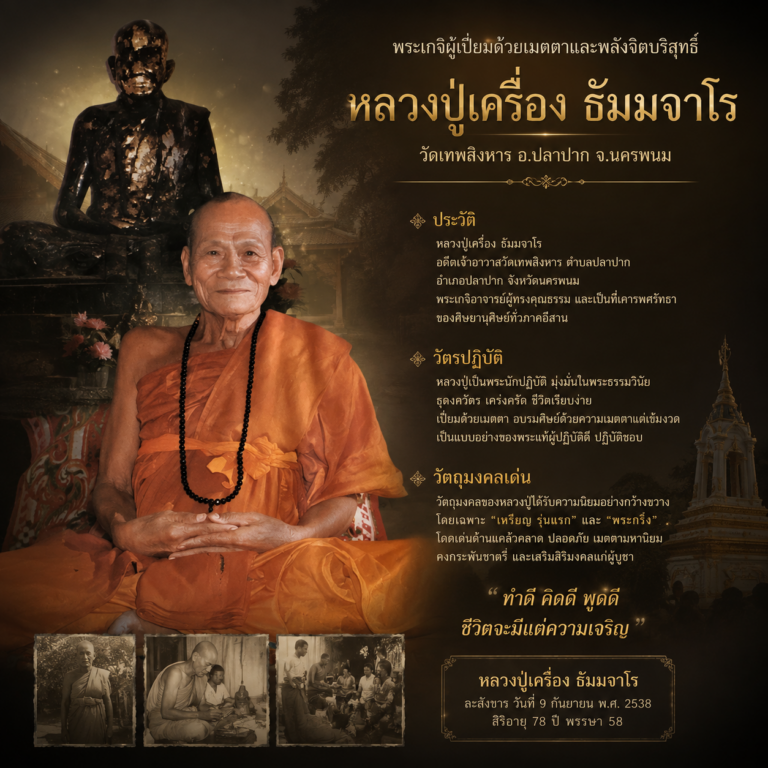
Luang Pu Kherng Thammacharo (หลวงปู่เครื่อง ธัมมจาโร) was a highly revered Thai Buddhist monk born on Saturday, the 8th waxing day of the 6th lunar month, BE 2410 (AD 1867), in Ban Na Yung, Amphoe Nam Som, Udon Thani Province. He resided at Wat Thepsinghan (วัดเทพสิงหาร) and was celebrated as a monk who lived across six reigns, attaining the remarkable age of 113 years, and was a direct disciple of both Samret Lun of Nakhon Champasak and the great forest master Luang Pu Mun Bhuridatto. Read more ↓
Biography
Who Was Luang Pu Kherng Thammacharo?
Luang Pu Kherng Thammacharo (หลวงปู่เครื่อง ธัมมจาโร) was a highly revered Thai Buddhist monk born on Saturday, the 8th waxing day of the 6th lunar month, BE 2410 (AD 1867), in Ban Na Yung, Amphoe Nam Som, Udon Thani Province. He resided at Wat Thepsinghan (วัดเทพสิงหาร) and was celebrated as a monk who lived across six reigns, attaining the remarkable age of 113 years, and was a direct disciple of both Samret Lun of Nakhon Champasak and the great forest master Luang Pu Mun Bhuridatto.
Early Life and Ordination
Luang Pu Kherng Thammacharo (หลวงปู่เครื่อง ธัมมจาโร) was born on a Saturday, the 8th waxing day of the 6th lunar month, in BE 2410 (AD 1867), the Year of the Rabbit, in Ban Na Yung (บ้านนายูง), Amphoe Nam Som (อำเภอน้ำโสม), in the Udon Thani region of northeastern Thailand. His father, Luang Sakda Thamrueang (หลวงศักดา ธรรมเรื่อง), served as the village headman. His mother was Nang Phan Thamrueang (นางพัน ธรรมเรื่อง). The family supported themselves through rice farming, hunting wild game, and trading salted meats in town.
At the age of 21, Luang Pu Kherng received his first ordination as a Buddhist monk, but disrobed after one rains retreat (vassa) and returned to lay life. He married and fathered two children — one son and one daughter. Tragedy struck when both children fell gravely ill and passed away in quick succession. His wife, Nang Nak (นางนาค), overcome with grief, subsequently fell ill and also died. Devastated beyond measure, Luang Pu Kherng fled the village in a state of overwhelming sorrow, wandering into the forest. Through deep reflection on the impermanence of life, he recognised that his suffering was karmic retribution for his years as a hunter. This profound realisation led him to seek ordination for a second time, committing himself to the Buddhist path for the remainder of his life.
His second and permanent ordination took place at Phattha Sima Wat Si Saket (พัทธสีมาวัดศรีสะเกษ), located in the Vientiane district of Laos, when he was 28 years of age — BE 2438 (AD 1895).
Spiritual Development and Practice
Following his second ordination, Luang Pu Kherng Thammacharo (หลวงปู่เครื่อง ธัมมจาโร) pursued two distinct streams of Buddhist study and practice with extraordinary dedication, distinguishing himself in both the samatha (สมถะ) and vipassana (วิปัสสนา) traditions.
In the realm of samatha — the path of tranquillity and worldly power — Luang Pu Kherng trained under the legendary Samret Lun (สำเร็จลุน) of Nakhon Champasak (นครจำปาศักดิ์), a master of extraordinary reputation whose esoteric teachings encompassed advanced practices rarely transmitted in the modern era. Under Samret Lun’s guidance, Luang Pu Kherng is said to have attained remarkable abilities including levitation, walking on water, invisibility, invulnerability, and mastery of the kasina meditations (กสิณ) — the concentrated visualisation of the four elements: water, fire, wind, and earth.
In the realm of vipassana — insight meditation — Luang Pu Kherng studied for a full four years under none other than Luang Pu Mun Bhuridatto (หลวงปู่มั่น ภูริทัตโต), the founding patriarch of the Thai Forest Tradition. Luang Pu Kherng later recalled to his disciples that this was during the early period of Luang Pu Mun’s teaching career, when the great master had relatively few students. Notably, while Luang Pu Mun held greater seniority in rains retreats by over seven years, he was in fact three years younger than Luang Pu Kherng in age. Luang Pu Kherng often praised Luang Pu Mun as a monk of pure intention and clear direction, with nibbana (นิพพาน) as the ultimate goal.
During his decades of wandering as a thudong (ธุดงค์) forest monk, Luang Pu Kherng also encountered Luang Pu Waen Sujinno (หลวงปู่แหวน สุจิณโณ) while travelling on the Laotian side of the Mekong River — a meeting that left a deep impression on both masters. Luang Pu Kherng wandered freely across Thailand and Laos until the age of 73, when he finally settled permanently at Wat Thepsinghan (วัดเทพสิงหาร) in his home district of Nam Som, Udon Thani, to the great joy of the local community who had long hoped for a revered teacher to guide them in the Dhamma.
Luang Pu Kherng taught his disciples that human beings should cultivate four virtues: longevity (ayu อายุ), lustre (vanna วรรณะ), happiness (sukha สุขะ), and strength (phala พละ) — and that these qualities naturally arise in those who uphold morality and consistent Dhamma practice. He attributed his own extraordinary lifespan of 113 years to this very principle.
Major Amulet Consecrations and Ceremonies
Luang Pu Kherng Thammacharo (หลวงปู่เครื่อง ธัมมจาโร) is generally known among Thai amulet devotees for sacred objects associated with Wat Thepsinghan (วัดเทพสิงหาร), Amphoe Nam Som, Udon Thani. Common amulet types attributed to or associated with his tradition include monk effigies (roop muean รูปเหมือน), commemorative medallions (rian เหรียญ), and pressed-powder or metal votive tablets (phim พิมพ์). Given his deep lineage connections to Samret Lun of Champasak and Luang Pu Mun Bhuridatto, sacred objects from his sphere are particularly valued by collectors seeking amulets rooted in the northeastern Thai and Lao forest master tradition.
Specific batch records — including precise BE year of consecration, formal batch names, material compositions, and ceremony documentation — are not widely documented in English sources at this time. Collectors seeking detailed batch-level information are encouraged to consult Thai-language temple records from Wat Thepsinghan directly, or established Thai amulet authentication communities and publications. Thai Amulets Collection (TAC) will update this section as verified records become available.
Legacy and Temple Significance
Luang Pu Kherng Thammacharo (หลวงปู่เครื่อง ธัมมจาโร) is remembered in the northeastern Thai Buddhist tradition as a monk who truly lived across six royal reigns — a distinction earned by his extraordinary lifespan of 113 years, spanning from the reign of King Rama IV to well into the modern era. In devotee culture, he is honoured with the title Ariyasong Hok Phaendin (อริยสงฆ์ ๖ แผ่นดิน) — “Holy Monk of Six Reigns” — a title that speaks to the rarity and spiritual gravity of his presence in Thai Buddhism.
His dual lineage — tracing directly to both Samret Lun (สำเร็จลุน) of Nakhon Champasak and Luang Pu Mun Bhuridatto (หลวงปู่มั่น ภูริทัตโต) — places Luang Pu Kherng at a unique intersection of esoteric Lao-Isan mystical practice and the mainstream Thai Forest Tradition. This dual inheritance makes his spiritual legacy particularly compelling both within Thailand and among collectors in the broader Mekong region, including collectors in Singapore, Malaysia, Hong Kong, Taiwan, and China who seek amulets with deep, verifiable teacher lineages.
Wat Thepsinghan (วัดเทพสิงหาร), located in Tambon Na Yung (ตำบลนายูง), Amphoe Nam Som (อำเภอน้ำโสม), Udon Thani Province, serves as the home temple and principal place of veneration for Luang Pu Kherng. The local community who welcomed him back at the age of 73 found in him not only a teacher of Dhamma but also a living symbol of perseverance, compassion, and spiritual attainment. Today, devotees and collectors travel to Wat Thepsinghan to pay respects, seek blessings, and acquire sacred objects associated with the master. His life story — marked by personal tragedy, renunciation, and eventual transcendence — continues to inspire practitioners and amulet devotees throughout the region.
It is also notable that among monks of comparable rarity and age, Luang Pu Kherng is often mentioned alongside Luang Pu Khammi Phutthasaro (หลวงปู่คำมี พุทธสาโร) of Wat Tham Khuha Sawan, Lopburi Province — another centenarian monk who also trained under Samret Lun of Champasak — underscoring how rare and precious this shared lineage truly is within the broader landscape of Thai Buddhist history.