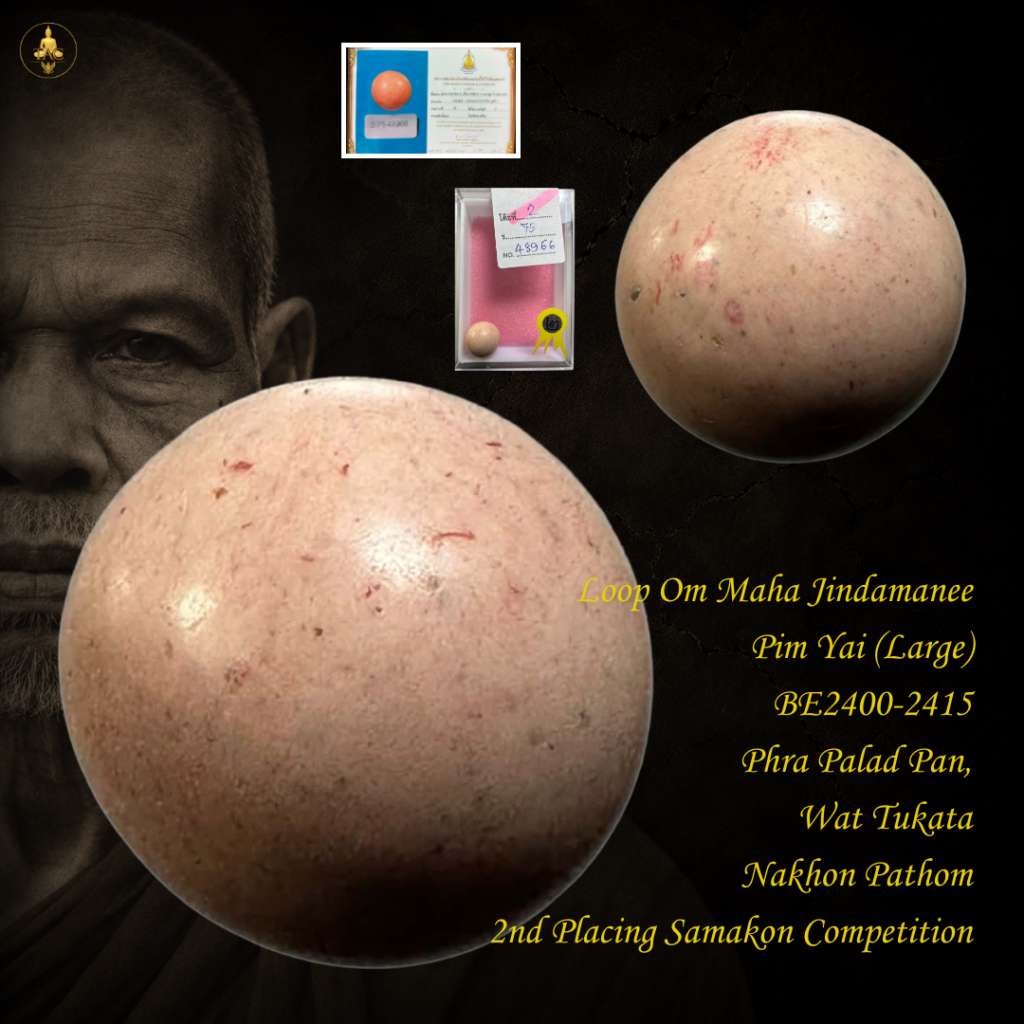

Loop Om Maha Jindamanee Pim Yai (Large) BE2400-2415 Phra Palad Pan, Wat Tukata Nakhon Pathom
| Type | Loop Om Maha Jindamanee Pim Yai |
| Monk | Phra Palad Pan |
| Temple | Wat Tukata |
| B.E. Year | 2400 |
| Material | Nur Jindamanee |
| Pim / Mold | Pim Yai |
| Condition | Excellent |
| Certificate | Competition |
| Competition | Won 2ND placing |
| SKU | TAC-LoopOmMahaJindamaneePimYai-PhraPaladPan-001 |
Authentic Loop Om Maha Jindamanee Pim Yai Phra Palad Pan, Wat Tukata BE 2400-2415. Nur Jindamanee material. Samakon Competition certified. Singapore dealer.
What is the Loop Om Maha Jindamanee Pim Yai amulet by Phra Palad Pan?
The Loop Om Maha Jindamanee Pim Yai Phra Palad Pan is a rare classical-era monk effigy amulet produced at Wat Tukata between BE 2400 and BE 2415, crafted from sacred Nur Jindamanee material. Certified by the Samakon Competition, it is regarded as one of the most significant Thai monk image amulets from the early Rattanakosin period.
Phra Palad Pan was a revered senior monk of Wat Tukata whose spiritual authority and mastery of sacred arts made him a highly respected figure during the mid-Rattanakosin era. His monk effigy amulets — particularly the Pim Yai (large mould) format — are treasured by collectors across Southeast Asia and Greater China for their classical craftsmanship and deep consecration tradition.
The Loop Om form, meaning a fully rounded monk effigy seated in meditation posture, represents the monk’s concentrated spiritual power made tangible. The Pim Yai designation distinguishes this as the large-format pressing, which collectors associate with stronger visual presence and greater ceremonial significance within the broader range of Phra Palad Pan amulet editions.
For collectors in Singapore and across the region, this amulet represents a rare opportunity to acquire a piece of authentic early Rattanakosin sacred art. The combination of classical Nur Jindamanee composition, the Pim Yai mould, and Samakon-level certification places it firmly among the most sought-after classical monk image amulets on the market today.
Loop Om Maha Jindamanee Pim Yai and Wat Tukata Heritage
Wat Tukata is a historic temple whose heritage spans the Rattanakosin period, serving as the spiritual home of Phra Palad Pan and the source of the Loop Om Maha Jindamanee Pim Yai Wat Tukata tradition. The temple’s sacred environment and unbroken lineage of senior monks provided the consecration foundation upon which these amulets were blessed and empowered.
The production of monk effigy amulets at temples like Wat Tukata followed rigorous ritual protocols rooted in the Thai Buddhist amulet tradition, which encompasses centuries of Theravada practice, sacred inscription, and ceremonial empowerment. Each Loop Om pressing produced during the BE 2400–2415 period would have been subject to extended meditation-based blessing ceremonies conducted by Phra Palad Pan himself.
The temple’s role in producing the Loop Om Maha Jindamanee Pim Yai BE 2400-2415 editions has cemented Wat Tukata’s place in the canon of classical Thai amulet history. Collectors who specialise in early Rattanakosin monk effigies consistently regard this temple’s output as benchmarks of quality and authenticity from that era.
Nur Jindamanee Loop Om Maha Jindamanee Pim Yai — Composition and Craftsmanship
The Nur Jindamanee Loop Om Maha Jindamanee Pim Yai is named after its distinctive sacred clay compound, Nur Jindamanee, which translates broadly as “jewel-essence powder.” This material was traditionally composed of refined sacred earths, powdered relics, and consecrated herbal and mineral ingredients gathered and prepared under strict ritual conditions.
Nur Jindamanee as a base material is particularly prized because it retains fine mould detail across centuries, preserving the crisp facial features, robe lines, and sacred posture of the monk image with remarkable fidelity. The density and texture of a genuine Nur Jindamanee pressing from the BE 2400–2415 period is one of the key physical markers used by expert examiners during authentication.
The Pim Yai pressing format allowed artisans to render Phra Palad Pan’s seated meditation form at a scale that showcases the full range of sacred detail embedded in the mould. Collectors and scholars of authentic Thai amulet craftsmanship regard Nur Jindamanee compositions from this classical era as technically superior to many later reproductions, owing to the purity of raw materials available during the mid-Rattanakosin period.
Spiritual Benefits of Loop Om Maha Jindamanee Pim Yai by Phra Palad Pan
The Loop Om Maha Jindamanee Pim Yai Phra Palad Pan is traditionally venerated by devotees for its association with protective blessings and personal authority. Collectors associate monk effigy amulets of this classical era with concentrated meditative power, as the Loop Om form is regarded as an embodiment of the monk’s accumulated spiritual merit and Dhamma mastery.
Among the faithful in Singapore, Malaysia, Thailand, and across Greater China, the key spiritual qualities associated with this amulet include:
- Protective Blessing: Devotees regard the amulet as a source of spiritual protection during travel and daily life, shielding the wearer from harm and misfortune.
- Authority & Leadership: The monk effigy form is traditionally associated with commanding respect and projecting personal authority in professional and social settings.
- Spiritual Growth: Collectors and practitioners venerate this amulet as a meditation support, believing proximity to the monk’s image cultivates inner calm and deepens Buddhist practice.
Loop Om Maha Jindamanee Pim Yai BE 2400-2415 — Authentication and Collector Value
The Loop Om Maha Jindamanee Pim Yai BE 2400-2415 carries Samakon Competition certification, the gold standard of Thai amulet authentication recognised across the collector community in Thailand and internationally and already encased with waterproof casing. A Samakon certificate confirms that a panel of master examiners has verified the amulet’s age, material composition, and provenance against known reference specimens.
Given that these amulets were produced between BE 2400 and BE 2415 — over 160 years ago — surviving examples in verifiable condition are exceptionally rare. The combination of age, Nur Jindamanee material integrity, and Samakon-level certification means that collector demand for genuine examples consistently outpaces supply.
For collectors based in Singapore seeking a Thai amulet Singapore dealer with verified provenance, the Samakon certificate accompanying this piece provides the highest available assurance of authenticity. Pieces of this classification are considered heirloom-grade collectibles as much as objects of devotion, and their rarity continues to appreciate among serious collectors across the region.
Attributes reflect Thai Buddhist devotional tradition and are not measurable claims.
![[SOLD] Loop Om Maha Jindamanee BE2400-2415 Phra Palad Pan, Wat Tukata Nakhon Pathom](https://tac-media.sgp1.digitaloceanspaces.com/2026/06/Loop-Om-Maha-Jindamanee-BE2400-2415-Phra-Palad-Pan-Wat-Tukata-Nakhon-Pathom-Samakon-Competition-150x150.png)