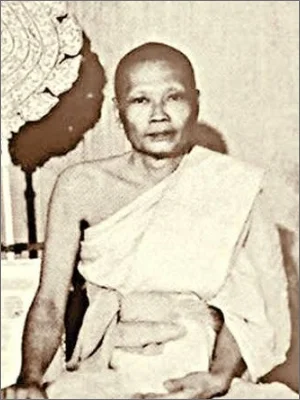
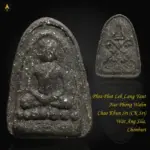
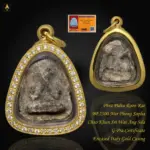
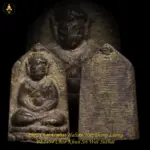
Phra Chaiwat Pim Lek Nur Phong BE2482-2485 Chao Khun Sri (CK Sri) Wat Suthat Thepwararam
| Monk | Chao Khun Sri Wat Suthat |
| Temple | Wat Suthat |
| B.E. Year | 2482 |
| Material | Phong |
| SKU | TAC-0506 |
Authentic Phra Chaiwat Pim Lek Nur Phong BE2482-2485 Chao Khun Sri (CK Sri) Wat Suthat Thepwararam by Chao Khun Sri Wat Suthat.
What is the Phra Chaiwat Pim Lek Nur Phong BE2482-2485 Chao Khun Sri (CK Sri) Wat Suthat Thepwararam by Chao Khun Sri Wat Suthat?
The Phra Chaiwat Pim Lek Nur Phong BE2482-2485 Chao Khun Sri (CK Sri) Wat Suthat Thepwararam by Chao Khun Sri Wat Suthat is the inaugural generation of half-body Phra Chaiwat amulets pressed in phong (sacred powder) at Wat Suthat, Bangkok, created between BE2482 and BE2485 (1939–1942) under the direct supervision of Chao Khun Sri, formally known as Phra Rajayanmuni Sonthi.
Chao Khun Sri and the First Phong Chaiwat from Wat Suthat
Chao Khun Sri Wat Suthat, formally titled Phra Rajayanmuni and carrying the ecclesiastical name Sonthi, was one of the most senior monks at Wat Suthat Thepwararam during the mid-twentieth century. He served as chief officiant for major pluk sek (consecration ceremonies) at the temple and had direct access to rare sacred materials held within its repositories. His standing gave him both the authority and the resources to initiate something that had not been done before at Wat Suthat: a Phra Chaiwat pressed entirely in phong.
This amulet, created between BE2482 and BE2485, represents the first time sacred powder served as the primary nuea (material/substance) for a Chaiwat at this temple. Before this run, the tradition at Wat Suthat had not produced a half-body Chaiwat in phong form. That makes pieces from this period the founding reference for the entire Wat Suthat Chaiwat lineage in powder material.
The creation period — 1939 to 1942 — coincided with considerable social and political change in Thailand, following the 1932 constitutional revolution. Senior monks at Bangkok’s major royal temples responded by intensifying devotional production, and Chao Khun Sri’s phong Chaiwat sits squarely within that context.
Muan Sarn Composition and How the Piece Was Made
The phong blend Chao Khun Sri used was not a single powder but a calibrated combination of five distinct ancient powder types, each carrying its own documented lineage of monastic transmission. The five are: Itthije powder (associated with spiritual authority), Phathamang powder (protective qualities), Maharach powder (dignity), Phutthakun powder (merit accumulation), and Trinisinghe powder (comprehensive protection). This muan sarn (sacred powder blend) traces directly back to Luang Pu Boon of Wat Klang Bang Kaew, whose expertise in preparing and consecrating magical substances remains a reference point in Thai Buddhist amulet circles.
To the powder base, Chao Khun Sri added rare sacred herbs — Senchan Khao and Krachaechan — before pressing the pim (mould). The consecration was not a single ceremony. Multiple ceremonial sessions were conducted over an extended period, allowing for the gradual accumulation of spiritual intention within the physical matrix of each pressed piece. This layered approach to pluk sek is one reason collectors regard the first-generation pieces as particularly complete in their muan sarn preparation.
The variant collectors identify as the gray-type is distinguished by its specific powder composition and the resulting surface colour and texture. That characteristic appearance is one of the primary visual markers used in authentication today.
What Collectors Look For in This Piece
First-generation phong amulets from a major royal temple are uncommon in any generation of Thai Buddhist material culture. Original distribution of this run was restricted largely to temple patrons and Chao Khun Sri’s close disciples, which kept quantities low from the outset. Over eight decades, attrition has narrowed the pool further. The Thai Buddhist amulet tradition places high weight on documented lineage, and the traceable muan sarn lineage back to Luang Pu Boon of Wat Klang Bang Kaew adds a layer of cross-temple historical interest that specialist collectors note.
Chao Khun Sri also had a collaborative relationship with Luang Por Pring of Wat Bangpakok during this period, and comparative study between pieces from these two masters has become a point of scholarly interest for collectors focusing on mid-twentieth century Bangkok amulet production.
When examining a piece from this run, collectors focus on:
- The gray-type powder surface — characteristic colour and grain consistent with the five-powder muan sarn blend
- Pim accuracy — iconographic clarity of the half-body Chaiwat image, including dimensional proportions consistent with first-generation pressing
- Natural aging patina across both obverse and reverse, consistent with over eight decades of age
- Structural integrity — the phong should hold without significant crumbling or surface loss
- Herb inclusions — traces of Senchan Khao and Krachaechan visible within the powder matrix under magnification
No certificate information is listed for this piece at this time. Collectors should factor that into their assessment and seek experienced specialist opinion where needed.
We at TAC regard this piece as one of the more historically grounded entries in the Wat Suthat phong lineage — it is the founding generation of half-body Chaiwat in sacred powder from this temple, pressed under Chao Khun Sri with muan sarn tracing back to Luang Pu Boon of Wat Klang Bang Kaew. For a collector building a Wat Suthat or mid-century Bangkok phong reference set, a first-generation piece with documented muan sarn lineage is not easy to replace.
Attributes reflect Thai Buddhist devotional tradition and are not measurable claims.