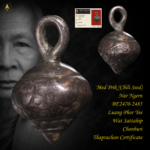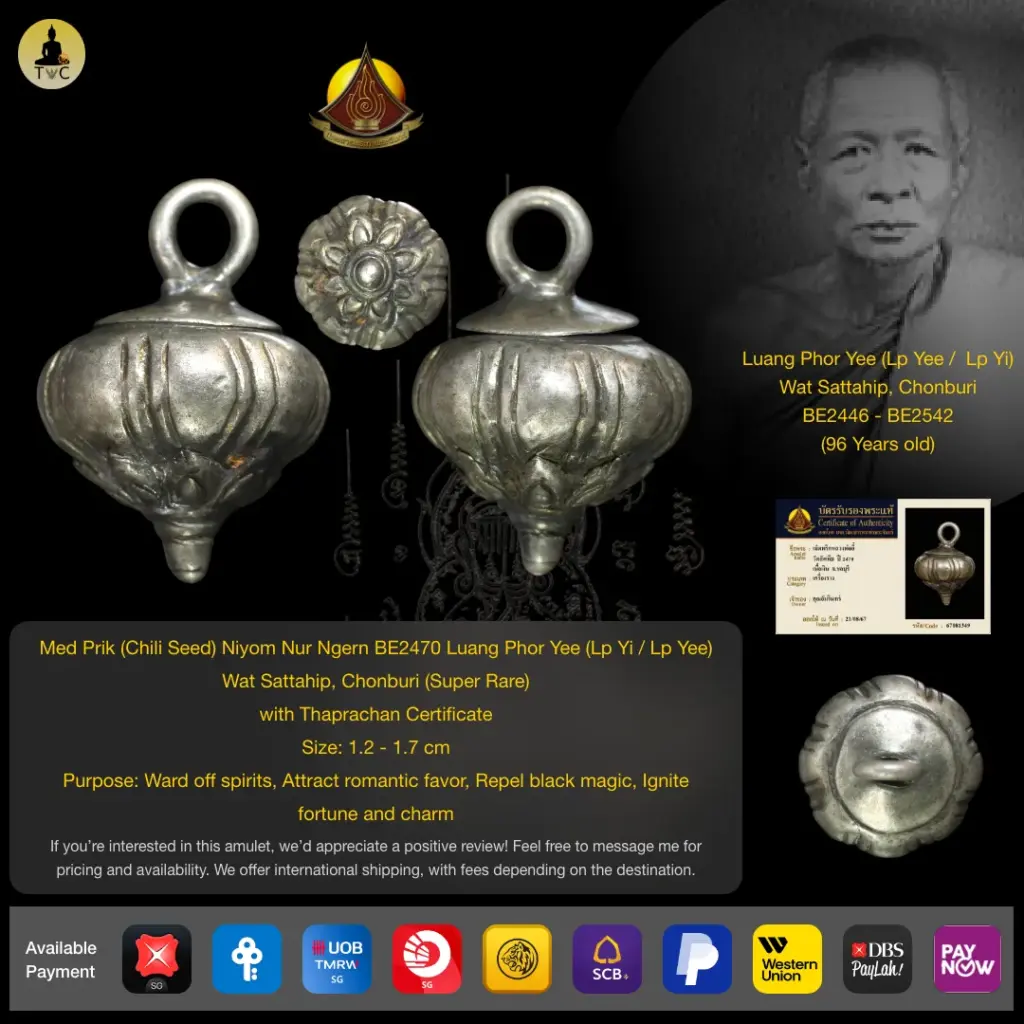
Med Prik (Chili Seed) Niyom Nur Ngern BE2470 Luang Phor Yee Wat Sattahip, Chonburi (Super Rare)
| Type | Med Prik (Chili Seed) |
| Monk | Luang Phor Yee Wat Sattahip, Chonburi |
| Temple | Wat Sattahip |
| B.E. Year | 2470-2485 |
| Material | Nur Ngern |
| Condition | Very Good |
| Certificate | Thaprachan |
| SKU | TAC-0651 |
The Med Prik (Chili Seed) Niyom Nur Ngern BE2470 Luang Phor Yee (Yi) Wat Sattahip, Chonburi (Super Rare) Luang Phor Yee Wat Sattahip, Chonburi is among …
The Med Prik (Chili Seed) Niyom Nur Ngern BE2470 Luang Phor Yee (Yi) Wat Sattahip, Chonburi (Super Rare) Luang Phor Yee Wat Sattahip, Chonburi is among the most coveted pre-war Thai talismans available to collectors in Singapore and across Southeast Asia. Created in BE2470 (1927 CE), this small chili-seed-shaped amulet is revered for its potent Maha Sanae (great charm and attraction) properties, combined with strong protective and invulnerability blessings.
Luang Phor Yee Wat Sattahip, Chonburi was regarded as one of the most spiritually authoritative monks on the Eastern Seaboard of Thailand. His mastery encompassed Maha Sanae, Kongkrapan (invulnerability), and protective magic, earning him deep reverence across Chonburi Province throughout his lifetime.
The BE2470 Med Prik series was produced in strictly limited quantities and distributed almost exclusively to close disciples and military personnel during the pre-World War II era. Luang Phor Yee passed away around BE2492, leaving behind a legacy of deeply revered talismans that continue to be sought by serious collectors decades later.
In Thai occult symbolism, the chili seed form represents fire, the repulsion of evil forces, and the stimulation of luck, love, and personal charisma. The compact shape was intentionally designed for discreet carrying — sewn into garments, tucked into waistbands, or kept in a pocket — making it a practical talisman as well as a sacred one.
Med Prik (Chili Seed) Niyom Nur Ngern BE2470 Luang Phor Yee (Yi) Wat Sattahip, Chonburi (Super Rare) and Wat Sattahip Heritage
Wat Sattahip, located in Amphoe Sattahip, Chonburi Province, served as the spiritual base from which Luang Phor Yee conducted his sacred works throughout the early twentieth century. The temple’s proximity to a significant naval district meant its monks frequently served military communities, lending an additional dimension of protective intent to amulets produced there.
The Med Prik (Chili Seed) Niyom Nur Ngern BE2470 was consecrated within this temple environment, reflecting a lineage of disciplined Wicha (esoteric knowledge) passed through the monks of Wat Sattahip. The temple’s role as a centre of occult craftsmanship in the Chonburi region is well documented among Thai amulet scholars and collectors.
Thai Buddhist amulet culture has centuries of documented history, with sacred objects serving as focal points of merit, protection, and devotion across the region. For collectors wishing to understand this broader tradition, the Thai Buddhist amulet tradition provides essential cultural and historical context for pieces such as this BE2470 series from Wat Sattahip.
Ngern Med Prik (Chili Seed) Niyom Nur Ngern BE2470 Luang Phor Yee (Yi) Wat Sattahip, Chonburi (Super Rare) — Composition and Craftsmanship
The material designated Nur Ngern — a silver-blended sacred alloy — forms the physical foundation of this talisman. The alloy was compounded from fragments of old silver votive tablets, Yant-stamped foils, and sacred yantras that were melted down and recast, preserving accumulated spiritual potency within the metal itself.
This base alloy was further enriched with powder from charmed herbs, cemetery soils, and herbal resins associated with attraction magic, including dok payom and wan sao long. The resulting mixture was cast into chili-seed-shaped pellets, each individually hand-inscribed or blessed by Luang Phor Yee himself.
The consecration process extended over several months and included graveyard Tudong (ascetic forest) meditation, extended night chanting, and solo invocations conducted by Luang Phor Yee. A final consecration ceremony was held at Wat Sattahip with selected local monks in attendance, completing the ritual empowerment of the series.
Spiritual Benefits of Med Prik (Chili Seed) Niyom Nur Ngern BE2470 Luang Phor Yee (Yi) Wat Sattahip, Chonburi (Super Rare) by Luang Phor Yee Wat Sattahip, Chonburi
The Med Prik (Chili Seed) Niyom Nur Ngern BE2470 carries a broad spectrum of blessings rooted in Luang Phor Yee’s command of both attraction and protective Wicha. Early wearers reported that the talisman would resonate or generate warmth when danger approached, a quality attributed to the intensity of the consecration ritual.
- Maha Sanae — great personal charm and attraction, drawing favour in social and professional contexts
- Metta Mahaniyom — loving-kindness and widespread popularity among those encountered
- Klaew Klaad — instinctive avoidance of danger and evasion of harmful circumstances
- Kongkrapan Chatri — invincibility from physical and spiritual harm
- Protection against black magic, spirit oppression, and misfortune
Med Prik (Chili Seed) Niyom Nur Ngern BE2470 Luang Phor Yee (Yi) Wat Sattahip, Chonburi (Super Rare) BE 2470 — Authentication and Collector Value
Authenticated examples of the Med Prik (Chili Seed) Niyom Nur Ngern BE2470 Luang Phor Yee (Yi) Wat Sattahip, Chonburi (Super Rare) carry a Thaprachan Certificate, the standard authentication credential recognised across the Thai amulet collector community. Thaprachan certification confirms the piece’s age, material composition, and origin within the acknowledged BE2470 production series.
Fewer than one hundred pieces from this series are believed to exist today. The vast majority were never made available for public sale, having been gifted directly by Luang Phor Yee to close disciples and military personnel, which further limits the supply accessible on the open collector market.
Certified examples in original condition command high five-figure prices in Thai Baht and are regarded as master-class artifacts among serious Thai talisman enthusiasts in Singapore, Malaysia, Thailand, China, Taiwan, and Hong Kong. The combination of pre-war age, Nur Ngern composition, extreme scarcity, and Thaprachan certification places this piece in a category reserved for the most historically significant talismans of the twentieth century.
Attributes reflect Thai Buddhist devotional tradition and are not measurable claims.
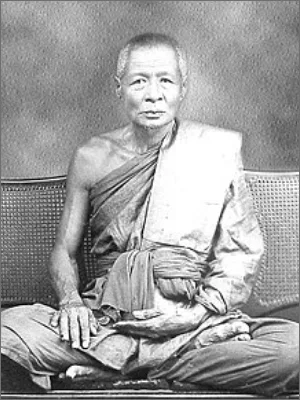
![[SOLD] Phra Somdej Prom 4 (4面崇笛佛) BE2483-86 Luang Phor Yee (Lp Yee) Wat Sathahip (Wat Sattahip)](https://tac-media.sgp1.digitaloceanspaces.com/2026/03/sold-phra-somdej-prom-4-4-be2483-86-luang-phor-yee-lp-yee-wat-sathahip-wat-sattahip-150x150.webp)