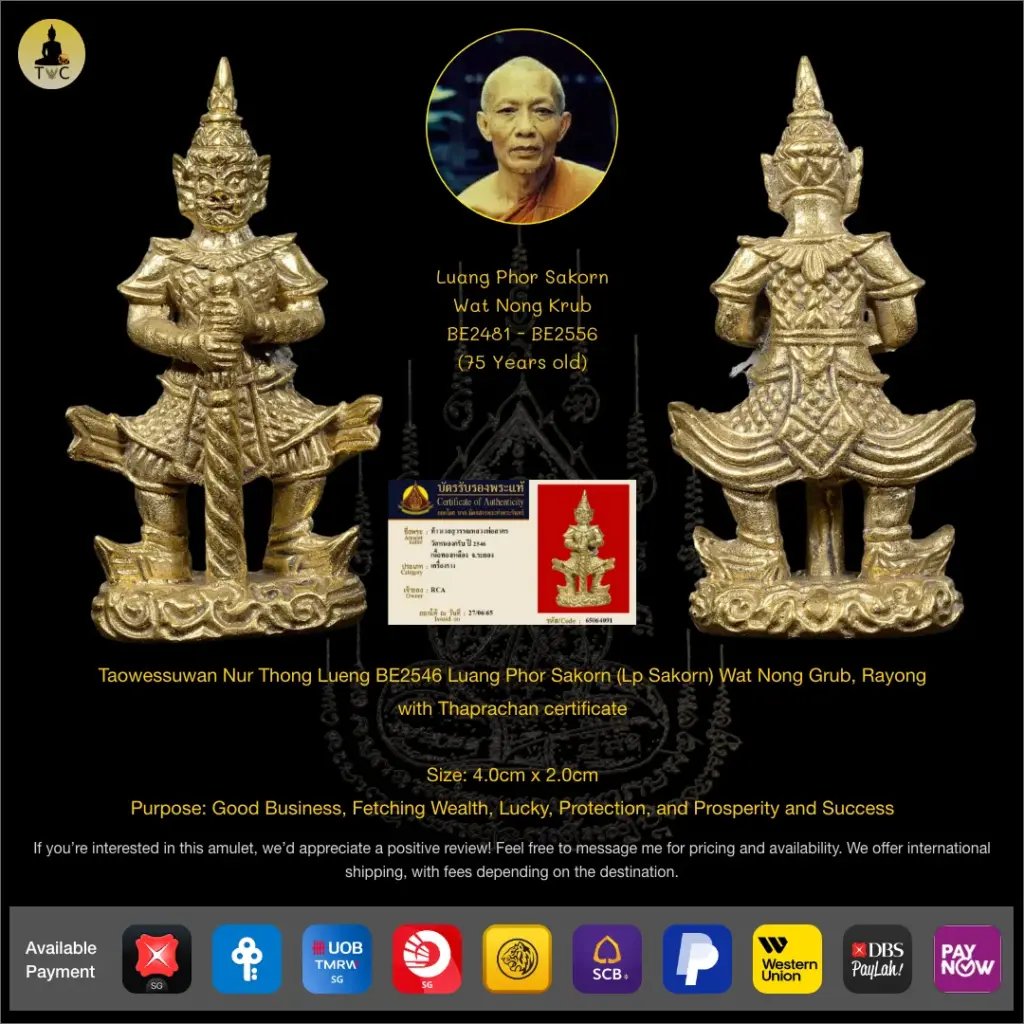
Taowesuwan Nur Thong Lueng BE2546 Luang Phor Sakorn Wat Nong Grub, Rayong
| Monk | Luang Phor Sakorn Wat Nong Krub |
| Temple | Wat Nong Grub |
| B.E. Year | 2546 |
| Material | Thong Lueng |
| SKU | TAC-0673 |
Taowesuwan • Nur Thong Lueng BE2546 • Wat Nong Grub, Rayong • Listing notes: consecrated by Luang Phor Sakorn (disciple-lineage associated with Luang Pu Tim, Wat Lahanrai) • With Thaprachan certificate
Taowesuwan • Nur Thong Lueng
BE2546 • Wat Nong Grub, Rayong • Listing notes: consecrated by Luang Phor Sakorn (disciple-lineage associated with Luang Pu Tim, Wat Lahanrai) • With Thaprachan certificate
Taowesuwan (ท้าวเวสสุวรรณ) — guardian-king iconography in Nur Thong Lueng (นวโลหะ/ทองเหลือง style alloy listing), issued BE2546 at Wat Nong Grub, Rayong.
What This Piece Represents (Collector Lens)
In Thai amulet culture, Taowesuwan is treated as a “boundary guardian” image — a symbolic protector associated with order, discipline, and the firm handling of unseen obstacles. Collectors often look for clear facial expression, strong armour lines, and an overall “upright” silhouette, because those design cues match how Taowesuwan is understood: decisive, watchful, and protective (คุ้มครอง). For this BE2546 piece, the appeal is also documentary: the issuer-temple is stated as Wat Nong Grub (Rayong), and the listing includes third-party certification, which becomes part of the collector’s verification trail.
Amulet Information
Name: Taowesuwan Nur Thong Lueng (ท้าวเวสสุวรรณ) • BE2546
Type / Variant: Taowesuwan (Guardian King) • standard standing iconography
Material: Nur Thong Lueng (Golden Alloy) • (material-th not specified in the listing beyond “Thong Lueng”)
Year (BE): 2546 (2003 CE)
Temple: Wat Nong Grub (วัดหนองกรับ), Rayong, Thailand
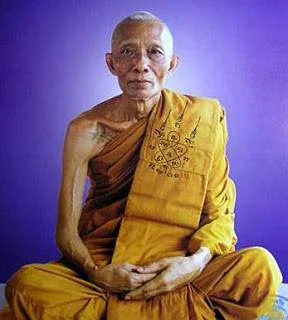
Monk: Luang Phor Sakorn (หลวงพ่อสาคร)
Lineage Note: Listing notes / commonly cited association: Luang Phor Sakorn is connected in disciple-lineage discourse to Luang Pu Tim (Wat Lahanrai). Independent verification is still recommended.
Certification: Thaprachan certificate (as stated)
SKU: TAC-TWS-THL-2546-LPSK-WNG-RYG
Price:
SGD 199
History & Lineage Context
The listing identifies this Taowesuwan as a BE2546 (2003) issue in golden alloy. Beyond that, the listing does not specify a named “Roon” (รุ่น), a detailed release title, or a quantified mintage. When those details are absent, collectors typically anchor their assessment on what can be observed (metal tone, strike quality, surface condition), and what can be documented (certificate reference, issuer-temple attribution).
The lineage note matters because Thai collectors often treat “teacher–disciple proximity” as a cultural signal of practice continuity (สายวิชา). However, good scholarship keeps the language careful: where a lineage claim is not fully documented in the listing itself, it should be held as “collector discourse / attributed notes,” and then cross-checked against reliable temple or biography sources.
Purpose-of-issue is not specified in the listing. Many temple issues exist to support construction, repairs, or community projects, but for this piece, the correct statement is simple: the listing does not provide the project context. If you have the original amulet box, temple paper, or ceremony sheet, those items can add materially to provenance.
About Nur Thong Lueng (Golden Alloy)
“Thong Lueng” (ทองเหลือง) is commonly used to describe brass/golden-alloy tones in Thai amulet making. In collector terms, the metal’s value is not only in composition, but in how well it preserves detail across decades — especially crisp edges, armour lines, and the face. Surface patina can also become a “time marker,” though it should never be used alone to claim age.
- Visual cues: warm gold tone, consistent strike, and readable micro-lines in the armour.
- Collector care note: avoid harsh chemical polishing; gentle handling preserves original surface character.
- Verification cue: compare the piece against known-pim references (พิมพ์) when available, especially facial geometry and weapon outline.
Design Notes: Taowesuwan Iconography
Taowesuwan images typically emphasize authority: crown or helmet forms, armour plates, and a grounded stance. Collectors often read this as a “protective posture” (คุ้มครอง) — not theatrical, but firm. When evaluating, focus on proportional balance (head-to-body), clarity of the facial plane, and whether the weapon/hand details remain distinct rather than merged by soft casting.
Traditional Spiritual Attributes & Metaphysical Properties
In traditional Thai belief framing, Taowesuwan amulets are associated with protection and the strengthening of personal “boundaries” — the idea that one’s conduct, intention, and discipline shape what influences can reach you. Devotees often treat the amulet as a reminder of steadiness: do merit (ทำบุญ), keep precepts (ศีล), and act with restraint when provoked.
- Protection (คุ้มครอง): culturally linked to warding off misfortune and disruptive influences; framed as devotional belief, not a guarantee.
- Authority & steadiness: often chosen by people in leadership, security, high-pressure work, or those wanting firmer “personal limits.”
- Maha Lap (มหาลาภ) in context: some devotees associate Taowesuwan with “resource flow” and opportunities, typically paired with generosity and ethical conduct.
Rarity Assessment & Collector Significance
The listing does not specify mintage, release sub-batches, or an official “Roon” name, so a hard rarity statement would be inappropriate. What can be said safely is “collector-opinion indicators”: BE2546 is early enough to be considered “mature era” for modern Thai metal issues; Wat Nong Grub attribution and the stated Thaprachan certification increase the piece’s documentary strength; and Taowesuwan remains a culturally persistent category with stable collector demand. True rarity would depend on documented production counts, confirmed variants, and condition-grade relative to known market comparables.
Conclusion
This Taowesuwan Nur Thong Lueng, issued BE2546 under Wat Nong Grub (Rayong) and attributed to Luang Phor Sakorn, sits at the intersection of iconography and documentation: a protective guardian image that collectors understand well, supported here by a stated certificate. If you can pair the piece with original temple papers or ceremony notes, its provenance story becomes even cleaner — which is exactly how serious collecting is built: belief framed respectfully, and evidence handled carefully.
Front view for pim (พิมพ์) comparison: face, armour lines, and stance.
Back view: texture, wear pattern, and any maker/casting markers visible.
Side/profile view: thickness, rim definition, and casting depth.