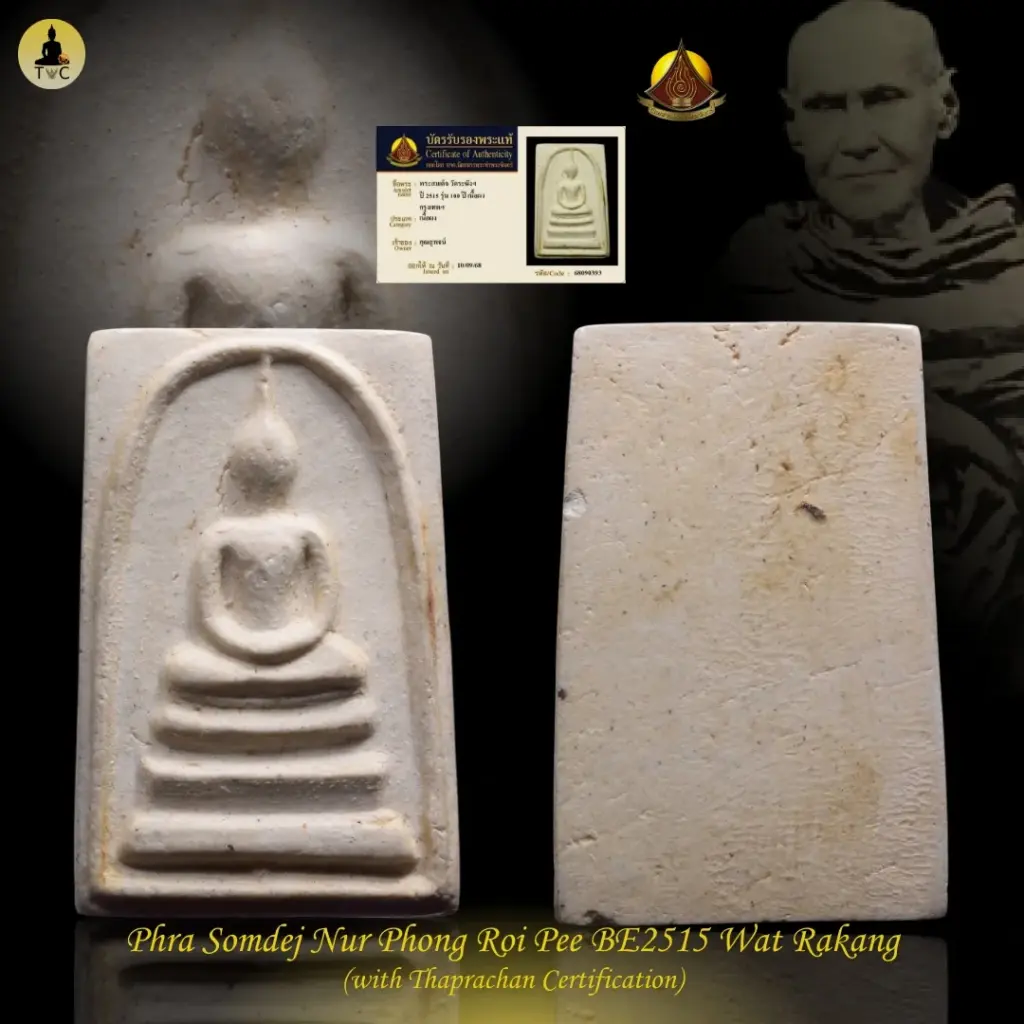
Phra Somdej Nur Phong Roi Pee BE2515 Wat Rakang Kositaram
| Type | Phra Somdej |
| Monk | Archan Toh |
| Temple | Wat Rakang |
| B.E. Year | 2515 |
| Material | Phong Roi Pee (Nur Phong) |
| Condition | Good |
| Certificate | Thaprachan |
| SKU | TAC-0684 |
Phra Somdej • Nur Phong Roi Pee BE2515 • Wat Rakang Khositaram, Bangkok • Centennial-style commemorative “Roi Pee” tradition • Thaprachan Certified Overview — the classic Somdej “arched
Phra Somdej • Nur Phong Roi Pee
BE2515 • Wat Rakang Khositaram, Bangkok • Centennial-style commemorative “Roi Pee” tradition • Thaprachan Certified
Overview — the classic Somdej “arched throne” architecture, presented in sacred powder (Nur Phong) with mature surface character.
Collector Lens
A Wat Rakang “Roi Pee” Somdej is best understood as a continuity piece — a commemorative-style issue that pays homage to the Somdej tradition anchored to Somdej Phra Phutthachan (Toh Phrommarangsi) and the temple’s long-standing role in Thai sacred-object culture. For collectors, the value is not only the form, but the institutional lineage: Wat Rakang’s Somdej language is one of the most referenced templates in the entire Somdej universe.
Collector Identity Card
Name: Phra Somdej Nur Phong Roi Pee
Year (BE): 2515
Temple: Wat Rakang Khositaram Woramahavihara, Bangkok
Material: Nur Phong (sacred powder / Pong Viset tradition)
Certificate: Thaprachan
SKU: TAC-0015
Price:
SGD 308
Provenance & Historical Significance
“Roi Pee” (100-year) naming is commonly used in Thai amulet culture to indicate a commemorative intent — a temple milestone, an institutional anniversary, or a centennial-style remembrance within a lineage. In Wat Rakang’s case, the Somdej template is inseparable from Somdej Toh’s legacy: the archetypal seated Buddha on a tiered base, framed in a simple but commanding architectural silhouette.
This listing’s strength is visual clarity plus supporting documentation (Thaprachan). The photos show a mature sacred-powder surface with natural tonal variation, and relief definition consistent with a Wat Rakang Somdej-style issue. Where batch-specific details (exact ceremony roster, official production count) are not provided, this article keeps its claims conservative — grounded in temple origin, stated year, material class, and certification.
Detail view — sacred powder texture and tier proportions (Somdej architectural language).
Temple of Origin: Wat Rakang Khositaram
Wat Rakang Khositaram Woramahavihara, on the Thonburi side of the Chao Phraya River in Bangkok, is one of Thailand’s most consequential Somdej temples. Its Somdej identity is historically linked to Somdej Toh, whose teachings and cultural imprint made “Phra Somdej” the reference class for Thai sacred tablets.
For collectors, Wat Rakang issues are not judged purely by aesthetics — they are read as “lineage objects”: how faithfully the piece carries the Somdej silhouette, how the sacred powder behaves over time, and how documentation supports the attribution.
Reverse surface — natural tone movement and handling character typical of sacred powder pieces over time.
Materials & Craft Notes (Nur Phong)
“Nur Phong” refers to sacred powder construction (often discussed in Thai as Pong Viset / Pong Phutthakhun traditions). In Somdej culture, powder pieces are appreciated for how they age: gentle color drift, micro-surface drying patterns, and the way relief edges soften without losing structure.
Collector Technical Read
• Form language: Somdej “arched throne” with tier base proportion consistent to Rakang-style templates
• Material behavior: powder matrix with natural tonal variance (not flat, overly uniform “new” tone)
• Integrity: relief remains legible; edges show normal maturity rather than harsh rework
Traditional Spiritual Attributes (Belief Framing)
Within Thai devotional practice, Somdej amulets are often regarded as “all-rounders” — not for dramatic claims, but for stable, daily support rooted in Buddhist remembrance and discipline.
- Kong Krapan / Protection: a protective sentiment — steadying the mind and reducing fear.
- Metta Mahaniyom: social harmony, respect from others, smoother dealings.
- Klaew Klaad: “avoidance of trouble” — arriving safe, leaving safe; fewer unnecessary incidents.
- Boon & Baramee: merit support — a reminder of right speech, right action, right livelihood.
Note: The above reflects cultural and devotional beliefs. Collectors document these traditions respectfully while relying on evidence (photos, provenance, certification) for authentication decisions.
Documentation: Thaprachan Certificate
Thaprachan certification is widely recognized in the collector ecosystem. Here, it serves as a practical anchor alongside the visual record — especially important for Somdej-class pieces where condition, relief language, and powder behavior must align with attribution.
Certificate reference — Thaprachan.
Conclusion
This Phra Somdej Nur Phong Roi Pee (BE2515) is presented as a Wat Rakang commemorative-style Somdej in sacred powder, supported by Thaprachan documentation. As a collector piece, it sits in the “continuity lane” — a respectful extension of the Somdej language rather than a novelty object. The most sensible way to hold it is the traditional way: evidence first, belief framed respectfully, and appreciation anchored in lineage.
For availability, additional photo angles, and documentation review, contact us via
WhatsApp.
Authentication statements are limited to the information and documentation provided (including the stated Thaprachan certificate).
Buyers should perform independent verification when needed.
Attributes reflect Thai Buddhist devotional tradition and are not measurable claims.