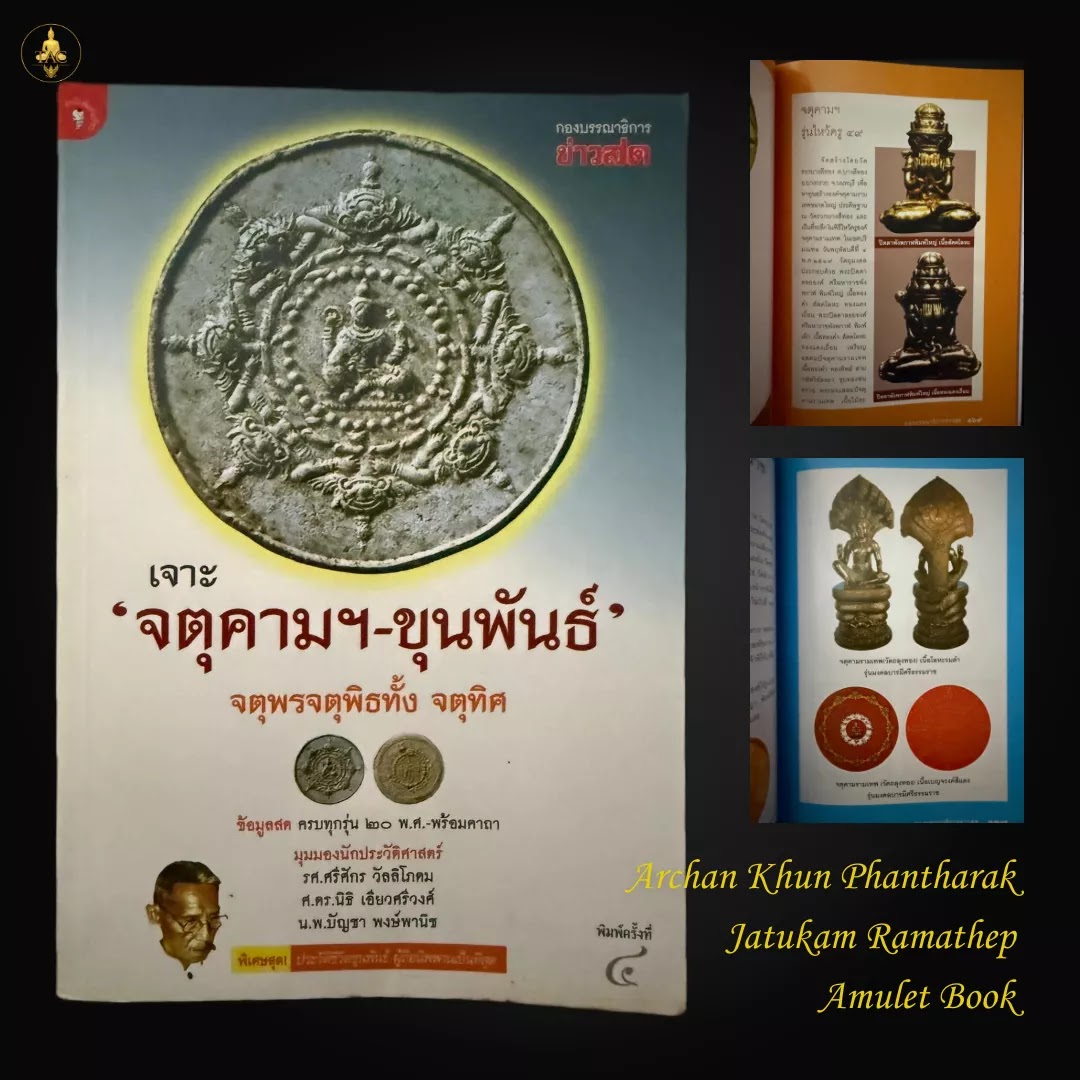
Archan Khun Phantharak Jatukam Ramathep Amulet Book
$150.00
Archan Khun Phantharak Jatukam Ramathep Amulet Book • Research Reference Edition
Nakhon Si Thammarat City Pillar Tradition • Jatukam Ramathep Studies • Kom Chad Luek Publishing
Cover of
Description
Archan Khun Phantharak Jatukam Ramathep Amulet Book • Research Reference Edition
Nakhon Si Thammarat City Pillar Tradition • Jatukam Ramathep Studies • Kom Chad Luek Publishing
Cover of the Thai reference book “เจาะ จตุคาม-รามเทพ ขุนพันธุ์” centred on Jatukam Ramathep, Khun Phantharak Ratchadet, and the ritual world of Lak Mueang Nakhon Si Thammarat.
What This Book Represents (Collector Lens)
This is a research-style Thai amulet reference book rather than a simple souvenir volume. In collector terms, it sits at the intersection of tamnan (legend), ritual tradition, and historical interpretation. The book is important because it frames Jatukam Ramathep not only as a popular amulet phenomenon, but as a cultural system linked to the City Pillar of Nakhon Si Thammarat, the memory of Khun Phantharak Ratchadet, and a broader southern Thai sacred geography.
Book Information
Title: เจาะ “จตุคาม-รามเทพ” ขุนพันธุ์ จตุพรจตุพิธทั้ง จตุทิศ
English Reference Name: Archan Khun Phantharak Jatukam Ramathep Amulet Book
Type: Thai Amulet Reference Book / Research-Style Hardcover or Softcover Study Volume
Publisher: Kom Chad Luek Publishing (คมชัดลึก)
Primary Subject: Jatukam Ramathep, Khun Phantharak Ratchadet, Lak Mueang Nakhon Si Thammarat
Contributors: Dr. Srisakra Vallibhotama, Assoc. Prof. Nithi Aiewsriwong, Pol. Maj. Khun Phantharak Ratchadet
Total Pages: Approximately 250–300 pages (varies by printing)
Language: Thai
SKU: TAC-KhunPhantharak-JatukamBook-001
Price:
SGD 150
1. Author / Contributors
The book does not present itself as the work of a single collector-author. Instead, it draws authority from several named contributors. The cover credits Dr. Srisakra Vallibhotama (ศรีศักร วัลลิโภดม), known for archaeology and cultural history, and Assoc. Prof. Nithi Aiewsriwong (นิธิ เอียวศรีวงศ์), one of Thailand’s best-known historians. Their inclusion gives the book a more academic frame than many mass-market amulet publications.
It also centres Pol. Maj. Khun Phantharak Ratchadet (ขุนพันธรักษ์ราชเดช), the legendary police officer closely associated in Thai memory with the Nakhon Si Thammarat City Pillar and the early ritual life of Jatukam Ramathep amulets. That combination of historians and ritual-lineage narrative is one of the book’s defining features.
2. Publisher
The book is published by Kom Chad Luek Publishing (คมชัดลึก), a Thai media and publishing house known for cultural, current-affairs, and investigative-style publications. For collectors, this matters because it suggests the book was produced during a period when Jatukam had already become a major public topic rather than a niche southern cult object.
3. Total Pages
Typical copies are described as having approximately 250–300 pages, although the exact page count may vary slightly by printing. In practical terms, this places it in the category of a substantial reference volume rather than a short commemorative booklet.
4. Main Subject of the Book
The book focuses on the Jatukam Ramathep amulet phenomenon, especially the historical, symbolic, and ritual framework behind the cult’s rise in Thailand. It covers mythological origins, ritual consecrations, local legends, and the development of important amulet batches. Rather than treating Jatukam as only a commercial boom-era object, the text tries to place it within the sacred landscape of southern Thailand.
5. Which Amulets Are Included
The book documents several early and influential Jatukam-related issues connected with Lak Mueang Nakhon Si Thammarat. Commonly referenced groups include:
- BE2530 City Pillar batch
- BE2532 Jatukam Ramathep coin
- BE2535 Ramathep series
- BE2547 revival-period batches linked to the later boom
For collectors, these early shrine-linked issues are usually the most important because they are tied most closely to ritual context rather than later commercial expansion.
6. What the Book Says About Symbolism
A major theme is the symbolic grammar of Jatukam imagery. The central deity is presented as a guardian force connected with Nakhon Si Thammarat. The phrase on the cover, “จตุพรจตุพิธทั้ง จตุทิศ”, points to the idea of blessings or auspicious influence radiating through the four directions. In collector language, this supports the reading of the coin as a protective mandala rather than a simple commemorative medallion.
- wealth
- protection
- authority
- fortune
7. Role of Khun Phantharak Ratchadet
Khun Phantharak Ratchadet, often shortened by collectors to Khun Pan, occupies a central position in the book. He is remembered as a legendary officer who protected the City Pillar shrine, helped revive Jatukam worship, and shaped the ritual environment surrounding early consecrations. In Thai amulet culture, this role matters because the authority of a batch is often judged not only by design but by ritual lineage and custodianship.
8. Historical & Cultural Research
Unlike many amulet books that stay at the level of batch lists and price memory, this one expands into historical interpretation. It discusses the influence of the Srivijaya Kingdom, the older cultural world of Nakhon Si Thammarat, and the role of guardian deities associated with the City Pillar. That wider frame gives readers a way to understand why Jatukam iconography looks the way it does and why southern ritual history became so important to the cult.
9. Importance to Collectors
During the height of the Jatukam craze, collectors used books like this to separate early ritual-linked material from later boom-era production. It became influential because it documented early issues, preserved myths and symbolic explanations, and linked amulets back to Thai cultural history rather than pure market demand. Even today, that makes it useful for anyone trying to understand the difference between historically significant batches and later commercial releases.
10. Unique Feature of the Book
One of the book’s strongest qualities is its blend of academic history + amulet study. Few Thai amulet publications bring together named historians, archaeology-driven interpretation, ritual narrative, and collector-facing amulet discussion in the same volume. That mixed approach is part of why the book still has reference value.
11. Cultural Impact
The wider Jatukam phenomenon became one of the largest amulet crazes in modern Thai history. At its peak, thousands of batches were produced, shops sold out quickly, and prices rose sharply across the country. This book belongs to that same historical moment, but it tries to explain the roots behind the phenomenon rather than simply ride the market wave.
Deeper Collector Insight: Srivijaya Symbolism, Khun Pan Rituals, and Sacred Early Batches
One reason Jatukam coins look so distinctive is that their design language echoes older Srivijaya-era coinage and sacred seals. Southern Thailand, especially Nakhon Si Thammarat, was historically linked to the Srivijaya maritime world. Archaeological material from that cultural zone includes circular seal-like forms, mandala arrangements, guardian figures, and Hindu-Buddhist protective imagery. Collectors often read the Jatukam coin structure as four directions → eight directions → cosmic centre, with the deity at the middle, protective beings around the ring, and an outer boundary representing the sacred universe or จักรวาล.
The influence of Khun Pan’s rituals on early batches is another major point. During the restoration and ritual life of the Nakhon Si Thammarat City Pillar, ceremonies reportedly drew on Brahmin chanting, Buddhist blessing, local guardian-spirit invocation, and formal offerings to the shrine. This layered ritual environment helped define the spiritual identity of early Jatukam issues. In collector belief, the earliest coins were not merely commemorative objects; they were ritual tokens born from a carefully maintained sacred setting.
Among the earliest releases, the most sacred are usually considered to be the shrine-linked groups: BE2530 City Pillar batch, BE2532 series, and BE2535 Ramathep issues. Later, the BE2547 revival batches triggered the national boom, but serious collectors often still place the greatest historical weight on the earlier City Pillar-connected pieces because of their direct association with Khun Phantharak Ratchadet and the older ritual tradition.
Collector Insight
Serious Jatukam collectors usually pay closest attention to amulets with direct linkage to the Nakhon Si Thammarat City Pillar, early BE2530–2535 chronology, and ritual memory associated with Khun Phantharak Ratchadet. Later releases may still be visually impressive, but in collector hierarchy they are often viewed as more commercial in character.
Interior reference page showing how the book presents Jatukam material for study.
Further interior page illustrating the publication’s documentary style.
Additional page reference supporting the book’s role as a Jatukam study aid.
Final page reference image from the volume.
Reviews
There are no reviews yet.