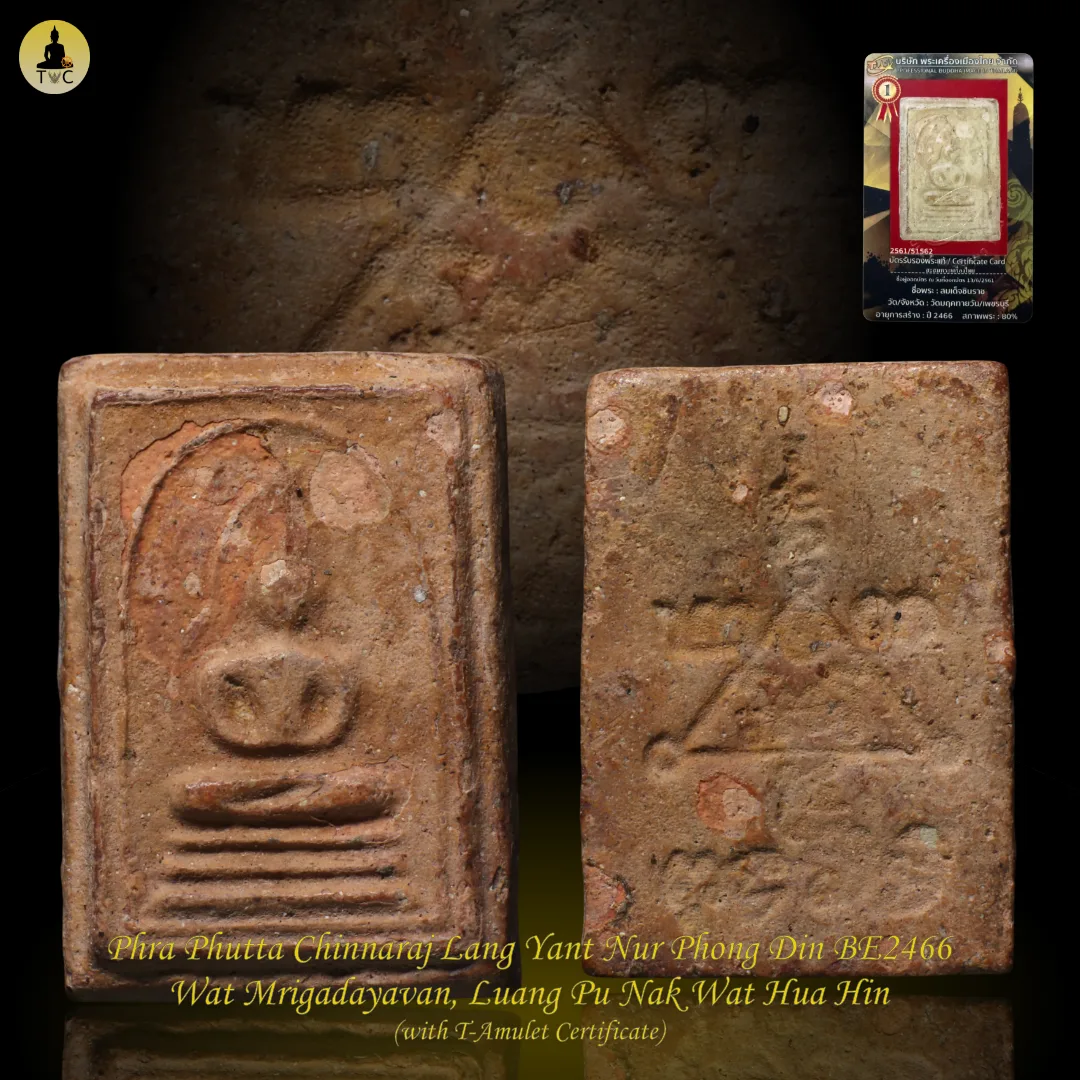
Phra Phutta Chinnaraj Lang Yant Nur Phong Din BE2466 Wat Mrigadayavan, Luang Pu Nak Wat Hua Hin
$468.00
Phra Phutta Chinnaraj Lang Yant • Nur Phong Din
BE2466 • Wat Mrigadayavan • Lineage of Luang Pu Nak Punyanako (Wat Hua Hin) • With T-Amulet Certificate
A classic Phra Phutta Chinnaraj f
Description
Phra Phutta Chinnaraj Lang Yant • Nur Phong Din
BE2466 • Wat Mrigadayavan • Lineage of Luang Pu Nak Punyanako (Wat Hua Hin) • With T-Amulet Certificate
A classic Phra Phutta Chinnaraj front with Lang Yant (หลังยันต์) on the reverse, recorded as Nur Phong Din (เนื้อผงดิน) and dated BE2466, associated with Wat Mrigadayavan and Luang Pu Nak Punyanako (Wat Hua Hin).
What This Piece Represents (Collector Lens)
This is the kind of piece collectors keep for two reasons: the icon and the seal. The front carries the dignified form of Phra Phutta Chinnaraj—one of Thailand’s most beloved Buddha images—while the back carries a yant (ยันต์) that signals intention, discipline, and protective tradition. With an early date attributed as BE2466 and a lineage tied to Luang Pu Nak Punyanako, this piece sits naturally within the Hua Hin / royal-seaside religious world where practice, patronage, and local faith met in a very real way.
Amulet Information
Name: Phra Phutta Chinnaraj Lang Yant Nur Phong Din (พระพุทธชินราช หลังยันต์ เนื้อผงดิน)
Material: Nur Phong Din (ผงดิน)
Year (BE): 2466
Temple: Wat Mrigadayavan (วัดมฤคทายวัน)
Monk: Luang Pu Nak Punyanako (Phra Kru Viriyathikari) • Wat Hua Hin
Lineage Note: Hua Hin lineage associated with Luang Pu Nak; Wat Mrigadayavan name and royal-seaside historical context are part of the tradition surrounding his era.
SKU: TAC-CHINNARAJ-LANGYANT-2466-LPNAK-TA-001
Price:
SGD 468
History & Lineage Context
In the Hua Hin tradition, amulets connected to Luang Pu Nak are remembered in the same breath as the royal seaside period—when temples were not just quiet monasteries, but living places where villagers, monks, and visiting patrons gathered. A Chinnaraj Lang Yant in sacred powder sits comfortably in that world: devotional on the front, purposeful on the back, made to be kept close as a reminder of steady conduct and protection through faith.
Luang Pu Nak (Phra Kru Viriyathikari), widely respected in Hua Hin and beyond, is remembered as a Vipassanā practitioner with deep training in traditional occult sciences. Born in 1877 in Phetchaburi roots, he studied scriptures and Pali from a young age and was ordained with the monastic name Punnyanako. His teachers—named in local accounts—placed him in a strong lineage of masters, and elders often describe him as calm, composed, compassionate, and few-spoken, with words that cut straight to the meaning. He passed away at 3:53 PM on July 24, 1934, and his cremation was held on March 17, 1935.
Wat Mrigadayavan carries a name that echoes the “deer park” setting in Buddhist history—linked to the turning of the wheel of Dhamma and the first sermon tradition. In local narrative, the temple sits in the royal seaside environment near the palace area, and during the reign of King Rama VI, religious discussions and sermons in the region became part of the living culture. Luang Pu Nak’s reputation—both for practice and for spiritual craft—helped anchor the faith of the community, and his era became a reference point for collectors who value lineage, story, and the disciplined spirit behind the work.
The Wat Mrigadayavan is located beside Wang Klai Kangwon Palace, which was built during the reign of King Rama VI as a summer residence. When the King stayed there, he often invited virtuous monks to deliver sermons and engage in Dhamma discussions. Luang Pu Nak Punyanako, then abbot of Wat Mrugadayavan before later moving to Wat Hua Hin, was among those monks. His impeccable conduct, combined with his reputation as a master of powerful occult sciences, earned him deep respect throughout Phetchaburi Province and surrounding areas.
Around 1919, during the reign of King Rama VI, Luang Pu Nak was appointed chief officiant for the creation of the Phra Somdej Mrugadayavan amulet. This amulet is rectangular in form and made from sacred powders, closely resembling the style of Phra Somdej Wat Rakang created by Somdej Phra Phutthacharn (To Phromrangsi). Its primary material is finely crushed seashell lime, blended with the highly sacred Trinisinhe powder—a revered substance traditionally used in Phra Somdej creation since the era of Somdej Phra Sangkharaj (Suk Kai Thuean) and Somdej Phra Phutthacharn (To Phromrangsi).
Trinisinhe powder is believed to possess powerful qualities of loving-kindness, protection, and invincibility. In this batch, it was combined with other auspicious materials and bound together using tung oil and linseed oil. The seashell lime absorbs the oil, giving the amulet a soft, moist appearance, while the Trinisinhe powder remains unabsorbed, appearing as pale yellow specks embedded in the surface—often likened to the texture of peanut brittle. Because of this unique composition, some ancient masters referred to the amulet as “Phra Phong Nam Man”, or oil-infused powder amulet, regarding it as the forerunner of all later oil-based powder amulets.
The Phra Phong Nam Man of Wat Mrugadayavan appears in several colors, including white, black, red, yellow, and orange. The white variety, often described as having a “bone-like” appearance, is especially prized by collectors, as it was long believed to be extremely difficult to counterfeit. Even so, authentic pieces across all colors can be identified through distinctive characteristics such as mold structure, edge finishing, and the naturally aged texture of dried oil on the surface—features that remain difficult to replicate convincingly. For this reason, all color variations continue to be highly sought after today.
About the Material
Nur Phong Din (powder/earth-based sacred material) is prized for its natural, grounded surface character—often matte, gently grained, and expressive under close inspection. Collectors treat powder pieces with care because the surface is part of the identity: it tells you about age, handling, and authenticity cues that can’t be replicated by polishing or cleaning.
- Handling: keep dry and avoid water contact; do not scrub the face or yant side.
- Observation cues: look for natural grain, edge character, and consistent “powder feel” under light.
- Storage: a clean pouch/box, away from heat and humidity, helps preserve surface integrity.
Design / Pim / Variant Notes
The front presents Phra Phutta Chinnaraj in a balanced, formal posture—collectors typically examine facial proportion, silhouette, and line clarity. The reverse is the defining feature: Lang Yant (หลังยันต์), where the yant layout, line confidence, and surface continuity become key verification points. Together, front and back form a complete “identity pair” that collectors document carefully.
Traditional Spiritual Attributes & Metaphysical Properties
In Thai Buddhist culture, Chinnaraj images are often kept as an anchor for steadiness—supporting a calm mind, mindful choices, and a protective atmosphere. A yant on the reverse is traditionally understood as a focused “seal” of intention. These are respected beliefs within the tradition, framed as devotional practice rather than guarantees.
- คุ้มครอง (Khum Khrong): a protective reminder tied to faith and disciplined conduct.
- แคล้วคลาด (Klaew Khlaat): traditionally associated with safety and avoiding misfortune.
- เมตตา (Metta): a calmer presence and smoother interactions through inner steadiness.
Rarity Assessment & Collector Significance
Collector significance here comes from the early dating (BE2466), the clear Lang Yant identity on the reverse, and the lineage association with Luang Pu Nak Punyanako in the Hua Hin / Mrigadayavan tradition. The presence of a T-Amulet Certificate adds a strong documentation anchor. For collectors, the most practical “evidence cues” are the powder surface character, edge and mold consistency, and the yant clarity—recorded together with the certificate image as a complete verification set.
Conclusion
This Phra Phutta Chinnaraj Lang Yant in Nur Phong Din, dated BE2466 and tied to the Luang Pu Nak / Wat Mrigadayavan world, is best appreciated as a disciplined devotional piece—front for reverence, back for intention. With clear photos and a T-Amulet Certificate, it is well-suited for collectors who value lineage, context, and proper documentation.
Front view — face, silhouette, and powder surface character.
Back view — Lang Yant (หลังยันต์) clarity for verification.
T-Amulet Certificate — retained as part of the documentation set.
Reviews
There are no reviews yet.