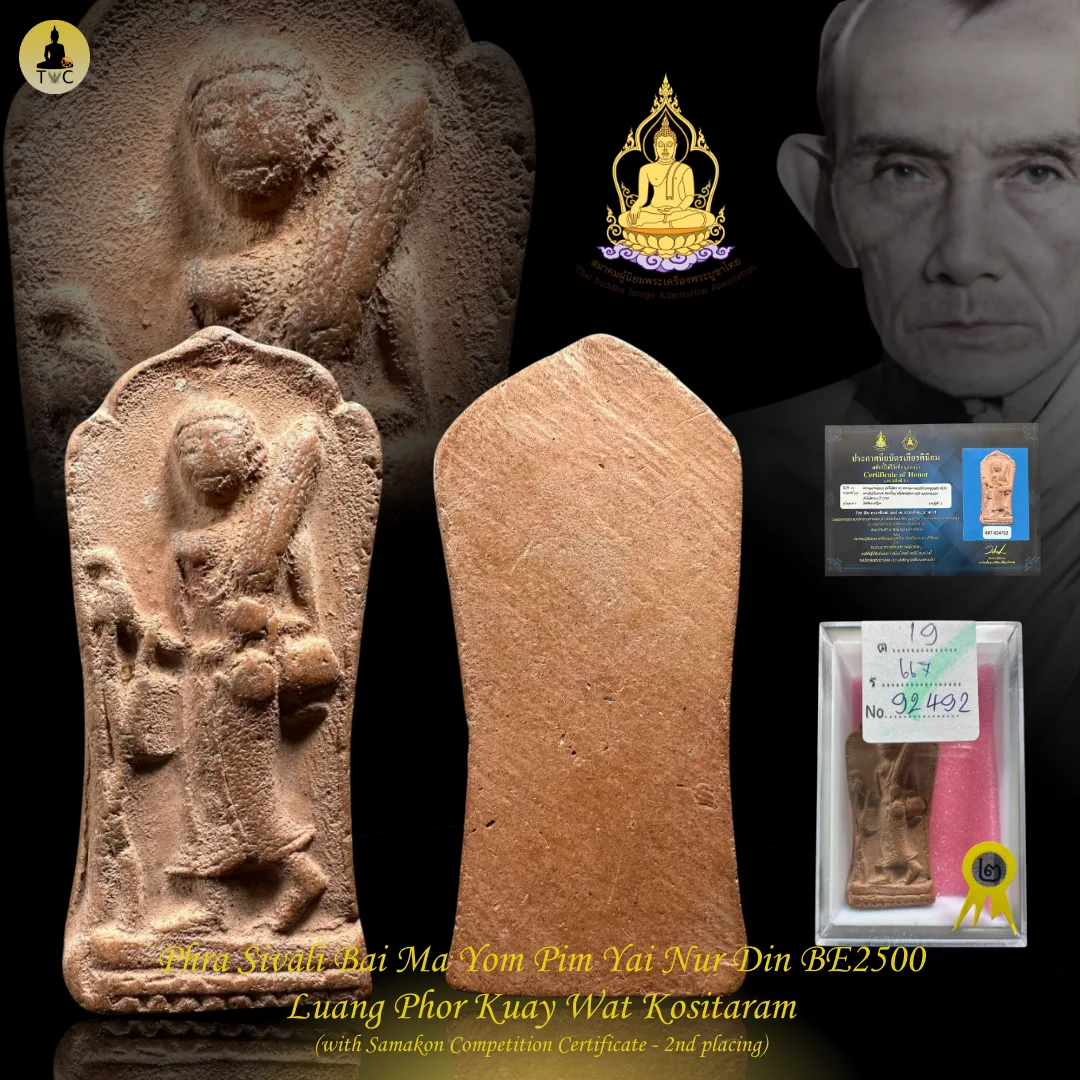
Phra Sivali Bai Ma Yom Pim Yai Nur Din BE2500 Luang Phor Kuay Wat Kositaram
$608.00
Phra Sivali Bai Ma Yom (Pim Yai) • Nur Din
BE2500 / CE1957 • Wat Kositaram, Chainat • Consecrated by Luang Phor Kuay (Chutintaro) via multi-phase Pluk Sek rites • Samakon Competition 2nd Place; Bai Ma Yom mould — Walking
Description
Phra Sivali Bai Ma Yom (Pim Yai) • Nur Din
BE2500 / CE1957 • Wat Kositaram, Chainat • Consecrated by Luang Phor Kuay (Chutintaro) via multi-phase Pluk Sek rites • Samakon Competition 2nd Place; Bai Ma Yom mould — Walking Sivali Arahant of Abundance lineage
Overview: Phra Sivali Bai Ma Yom Pim Yai (พระสีวลีใบมะยมพิมพ์ใหญ่) — Nur Din (เนื้อดิน — sacred earthen clay with temple powder admixtures) — BE2500 / CE1957 — Luang Phor Kuay (Chutintaro), Wat Kositaram, Chainat — Walking Sivali (Tudong posture) with glod and bowl — Samakon Competition 2nd Place.
What This Piece Represents (Collector Lens)
Phra Sivali (พระสีวลี) occupies a singular position in the Thai Buddhist amulet tradition as the one figure — among all the historical disciples of the Buddha — explicitly praised by the Buddha himself as foremost in the receiving of alms and the drawing of requisites. The canonical reference, well-known to practitioners across the Theravada world, describes Sivali as unparalleled in this quality not only among humans but among all beings in the three realms. For Thai collectors and devotees, this doctrinal standing gives the Phra Sivali amulet a specificity of purpose that distinguishes it from generic “protection” or “prosperity” pieces: it is oriented precisely toward the conditions of material sufficiency and the flow of generosity — toward one who practices, travels, trades, or works. The Walking Sivali iconography — the Tudong (ธุดงค์) or ascetic wandering posture, with glod (umbrella-staff) and alms bowl — reinforces this: Sivali is portrayed in active movement through the world, receiving and distributing merit in motion.
Within the Phra Sivali collecting category, the Luang Phor Kuay (Chutintaro) of Wat Kositaram, Chainat, series occupies a recognised position of quality and historical interest. LP Kuay’s Nur Din (earthen clay) works from the early period — the Yuk Dton (ยุคต้น — early era) of the Kositaram school — are studied for their compact, confident relief character, the particular quality of their clay body tempering with temple powders, and the multi-phase Pluk Sek (เสกพลัง — empowerment) methodology LP Kuay applied. The Bai Ma Yom (ใบมะยม — Star Gooseberry leaf) mould designation refers to the leaf-shaped frame that characterises this mould design — a Kositaram-specific form that provides a clear pim classification reference within LP Kuay’s broader Sivali corpus. The Samakon (สมาคม — Association) Competition 2nd Place recognition adds an external authentication dimension: Samakon competitions are structured events in the Thai amulet community where submitted pieces are assessed by panels of expert judges against documented reference standards, and a placed result provides a formal provenance anchor that the collector market treats as meaningful independent verification.
Amulet Information
Name: Phra Sivali Bai Ma Yom Pim Yai (พระสีวลีใบมะยมพิมพ์ใหญ่)
Material: Nur Din (เนื้อดิน — sacred earthen clay with temple powder admixtures)
Year: BE2500 / CE1957
Temple: Wat Kositaram (วัดโกสิตาราม), Chainat
Province: Chainat
Monk: Luang Phor Kuay (Chutintaro) — หลวงพ่อขวัญ (จุทินฺทโร)
Lineage Note: Early-era (Yuk Dton) Kositaram school Nur Din; Walking Sivali Tudong posture; Bai Ma Yom mould (Pim Yai); multi-phase Pluk Sek empowerment by LP Kuay; Samakon Competition 2nd Place — formal expert panel authentication
SKU: TAC-LPKuay-SivaliBaiMaYomPimYai-001
Price:
SGD 608
History & Lineage — Phra Sivali Bai Ma Yom Pim Yai (Wat Kositaram)
Luang Phor Kuay Chutintaro (หลวงพ่อขวัญ จุทินฺทโร) was the presiding master of Wat Kositaram in Chainat Province and one of the most respected monk-craftsmen in the central Thai amulet tradition of the mid-20th century. His practice centred on a rigorous integration of formal monastic discipline, meditative wicha (วิชา — ritual knowledge), and the precise timing of consecration activities with auspicious astrological cycles (Reuks Mongkol — ฤกษ์มงคล). In the Kositaram school under LP Kuay’s stewardship, amulet production was not a commercial enterprise separated from monastic life but an extension of his practice: each series of pieces was prepared, empowered, and completed within a framework of active meditation and deliberate merit-making that LP Kuay understood as part of the ongoing cycle of giving and receiving that Phra Sivali himself embodies. The BE2500 (CE1957) period coincides with the centennial of Theravada Buddhism — a year of particular devotional significance across Thailand, when many important amulet series were produced in recognition of the 2,500-year mark of the Buddhist era. LP Kuay’s Sivali series of this period thus carries both an individual master’s consecration weight and a broader commemorative resonance.
The Bai Ma Yom mould form is a distinctive Kositaram school design. Bai Ma Yom (ใบมะยม) refers to the Star Gooseberry leaf, whose pointed oval shape frames the Walking Sivali figure — the leaf outline forming the outer border of the tablet in a way that integrates the natural plant reference into the iconographic programme. In Thai Buddhist folk tradition, the Ma Yom plant carries associations with prosperity and ease; its use as the defining frame of the mould adds a layer of symbolic specificity to the piece beyond the figure itself. The Pim Yai (พิมพ์ใหญ่ — Large mould) designation places this example in the primary scale class of the Bai Ma Yom series, with greater surface area for relief definition compared to the Pim Lek (small) and Pim Klang (medium) variants. Within LP Kuay’s Sivali corpus, the Pim Yai Bai Ma Yom is a key reference type: it provides the clearest surface for studying his workshop’s characteristic clay tempering, relief cutting style, and the specific aging profile of early Kositaram Nur Din.
Wat Kositaram (วัดโกสิตาราม) is a temple in Chainat Province in the central plains of Thailand, situated in a province historically significant as a transit and agricultural centre on the Chao Phraya river system. The temple’s amulet tradition under LP Kuay developed a regional identity distinct from the major Bangkok and Nakhon Si Thammarat schools — rooted in the particular quality of Chainat’s laterite-enriched soils and the specific temple-ground botanical and mineral materials that LP Kuay incorporated into his Nur Din formulas. Collectors who study central Thai amulets of the mid-century period treat Kositaram examples as important regional markers within the broader national amulet landscape, and the school’s Sivali series has maintained consistent study-collection interest among specialists focused on LP Kuay’s lineage.
About the Material — Nur Din Composition
Nur Din (เนื้อดิน — sacred earthen clay material) is one of the oldest amulet material traditions in Thailand, predating the powder-press Somdej lineage and the metal-alloy casting traditions by centuries. In the Kositaram school under LP Kuay, Nur Din was prepared from selected temple-ground earth — clay harvested from the consecrated precincts of Wat Kositaram itself — combined with temple powder admixtures including ash from ritual fires, powdered incense residue from the ordination hall, and in some series, pollen and plant materials from the temple grounds. The resulting compound was kneaded, pressed into moulds, and cured under conditions that LP Kuay managed as part of the ritual process rather than simply as a manufacturing procedure. After nearly seven decades, the aging profile of authentic early Kositaram Nur Din is well-characterised and provides the primary authentication reference for collectors assessing this material class.
- Field porosity and tonality: Authentic early-era Kositaram Nur Din develops an even, muted ochre-to-dark-grey tonal field with a natural surface porosity — a fine-grained open texture — that results from the specific clay composition and seventy years of ambient aging; uneven or artificially darkened surfaces, or a field that reads as sealed or lacquered, are inconsistent with genuine examples and collectors under raking light can identify the difference in surface character.
- Temple powder admixtures: The incorporation of ritual ash and incense powder from Wat Kositaram’s ordination precincts into the clay body is detectable at the surface grain level and contributes to the characteristic texture variation at the relief edges — where the pressed boundary between figure and ground shows a particular soft-compaction profile distinct from later or reproduced examples.
- Robe and staff transition lines: In well-preserved LP Kuay Pim Yai examples, the relief lines defining the Walking Sivali’s robing and the glod staff retain definition without the sharpness of reproduction pressing or the artificial sharpening of cleaned fakes; honest examples show slightly softened but continuous lines — what collectors describe as “mature field transitions” — that reward careful study under magnification and directional light.
Design / Pim / Variant Notes
The Bai Ma Yom Pim Yai presents Walking Sivali (Tudong posture) in full — the figure striding forward, right hand bearing the glod umbrella-staff, left hand carrying or gesturing toward the alms bowl. This posture is iconographically specific to the Sivali type: it references the historical Sivali’s life as a wandering monk who, despite having been born into royal circumstances, took the alms-round as both practice and teaching, and whose presence on any journey was understood in the early Buddhist community to ensure the provision of all necessities. The Bai Ma Yom leaf frame is compact and well-integrated into the design: the pointed oval of the leaf border creates a vertical composition that focuses attention on the figure while the leaf outline itself reinforces the natural and botanical register of the piece’s symbolic vocabulary. The Pim Yai scale gives the composition sufficient room to render the Walking Sivali posture at meaningful detail — the glod, the bowl, the monastic robing, and the forward-stepping stance are all legible at normal handling distance, making the mould both devotionally communicative and a substantive study reference within LP Kuay’s Sivali series.
Traditional Spiritual Attributes & Metaphysical Properties
In Thai Buddhist devotional culture, Phra Sivali amulets are approached with a distinctive intentional clarity compared to more generalised protective types. Because the figure’s canonical standing is so precisely defined — foremost in receiving alms, a magnet for requisites and benefactors — devotees typically approach this type with intentions directly connected to livelihood, trade, travel, and the conditions that support sustained practice and daily life. The three-part traditional attribute set associated with Sivali in Thai popular Buddhism — Maha Larp, Metta Mahaniyom, and Klaew Klad — maps cleanly onto these intentions: abundance, social ease, and safe movement through the world. In LP Kuay’s Kositaram tradition specifically, the understanding of Sivali’s attributes was embedded in a practice framework: daily recitation of the Sivali kata, regular alms-giving, and the maintenance of moral conduct were understood as the conditions that activated the piece’s attributed functions, not the wearing of the amulet alone. This framing — shared by LP Kuay with his lay supporters — gives the piece a pedagogical dimension beyond its devotional use. These are traditional attributions held within Thai Buddhist devotional culture, reflecting sincere practice around this amulet class rather than verified empirical claims.
- มหาลาภ (Maha Larp — Abundant Fortune & Attraction of Requisites): The defining traditional attribute of the Phra Sivali type, rooted directly in the canonical description of Sivali as foremost in receiving alms; in Thai devotional practice, this is understood as an attraction of material sufficiency — food, income, business opportunity, and the generosity of others — toward the devotee who maintains Sivali practice with sincere intent and moral conduct.
- เมตตามหานิยม (Metta Mahaniyom — Loving-Kindness & Social Grace): The social dimension of Sivali’s attributed function — in Thai devotional culture, the Walking Sivali posture is understood to radiate metta (loving-kindness) outward as the figure moves, creating conditions of goodwill, ease in negotiation, and favourable regard from customers, colleagues, and superiors; this attribute is particularly invoked by traders, service workers, and those in frequent public interaction.
- แคล้วคลาด (Klaew Klad — Evasion of Harm & Safe Passage in Travel): Sivali’s Tudong wandering tradition gives the Walking posture a specific protection-in-transit resonance in Thai devotional understanding; devotees who travel regularly for work, trade, or pilgrimage traditionally regard Phra Sivali as a companion whose presence ensures safe passage and the provision of all necessities along the way.
Rarity & Collector Significance — Phra Sivali Bai Ma Yom Pim Yai BE2500
Early-era (Yuk Dton) Kositaram Nur Din pieces in coherent condition are among the more carefully curated examples in the central Thai amulet collecting field. Three converging factors define the collector significance of this specific example. First, the BE2500 dating places the piece in the centennial year of Theravada Buddhism — a production context of recognised devotional and historical weight that sustains independent collector interest beyond LP Kuay’s school specifically. Second, the Pim Yai Bai Ma Yom designation within LP Kuay’s Sivali corpus is a primary reference mould: it is the type most frequently used by specialists to calibrate their understanding of early Kositaram clay character and relief standards, giving pieces in good study condition an ongoing research utility that sustains long-term collector interest. Third — and most practically significant for provenance — the Samakon Competition 2nd Place result provides a formal external authentication benchmark. In the Thai amulet community, Samakon (สมาคม) competition placements are awarded by structured panels of experienced judges who assess pieces against documented reference examples and published classification standards; a 2nd place result in this context is a substantive credential that meaningfully reduces authentication uncertainty and supports both collector confidence and secondary market liquidity. The accompanying competition certificate (shown in the photo reference set) is the documentary anchor for this credential and should be preserved alongside the piece.
Conclusion
The Phra Sivali Bai Ma Yom Pim Yai Nur Din BE2500 by Luang Phor Kuay of Wat Kositaram is a well-defined and externally authenticated example from one of the most studied mid-century central Thai amulet schools. Its convergence of early-era Kositaram clay character, the primary Walking Sivali mould type, the BE2500 centennial year context, and a formal Samakon Competition 2nd Place result makes it a substantive reference piece within the LP Kuay collecting category. For the collector seeking a documented entry point into the Kositaram Sivali tradition, or for the devotee who approaches Phra Sivali practice with the intentions of livelihood, trade ease, and safe travel, this piece offers both historical grounding and clear devotional purpose.
Obverse close detail — robe relief transitions and glod staff line definition; stable field granularity consistent with early-era Kositaram Nur Din aging profile
Reverse face — earthen Nur Din matrix with temple powder admixtures; natural aging patina — porosity profile and tonal field consistency reference for authenticity assessment
Collector presentation — study storage condition; tablet edge and side profile visible — thickness and edge character consistent with Pim Yai hand-pressed mould production
Samakon Competition Certificate — 2nd Place award; formal expert panel authentication document — provenance anchor for this example; should be preserved and stored with the amulet
Reviews
There are no reviews yet.