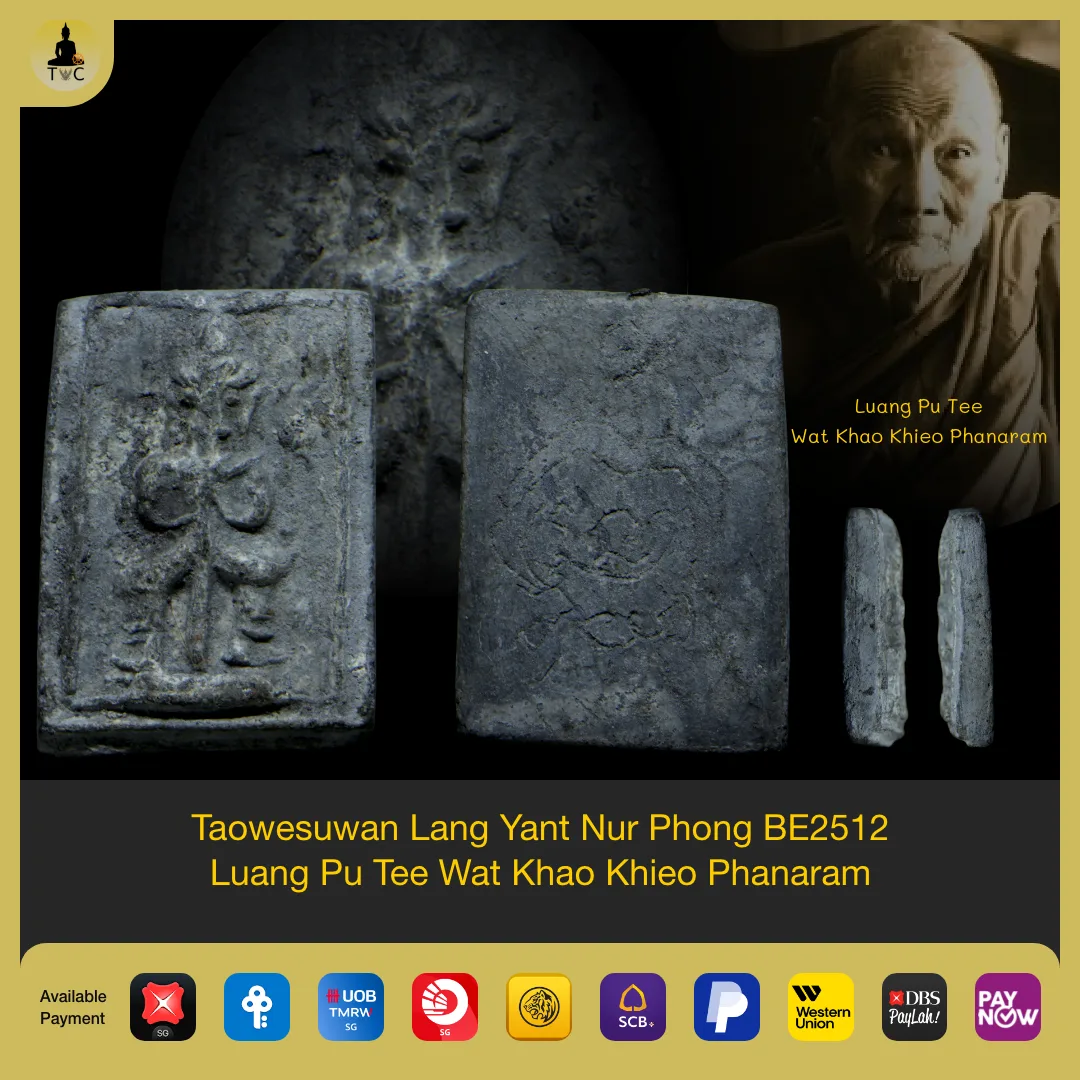
Taowesuwan Lang Yant Nur Phong Dam BE2512 Luang Pu Tee Wat Khao Khieo Phanaram
$138.00
Taowesuwan Lang Yant • Nur Phong
BE2512 / CE1969 • Wat Khao Khieo Phanaram, Suphanburi • Consecrated by Luang Pu Tee via Khmer-Thai guardian katha rites and Wicha Lang Yant • Guardian obverse (assertive posture) with acti
Description
Taowesuwan Lang Yant • Nur Phong
BE2512 / CE1969 • Wat Khao Khieo Phanaram, Suphanburi • Consecrated by Luang Pu Tee via Khmer-Thai guardian katha rites and Wicha Lang Yant • Guardian obverse (assertive posture) with activated protective yantra reverse; limited-run Central-region pim
Overview: Taowesuwan Lang Yant (ท้าวเวสสุวรรณ หลังยันต์) — Nur Phong (เนื้อผง — sacred powder with herbs, holy soils, scripture ash, Itthijae and Trinisinghe powders) — BE2512 / CE1969 — Luang Pu Tee, Wat Khao Khieo Phanaram, Suphanburi — Taowesuwan guardian obverse in firm, protective stance; activated Lang Yant protective yantra reverse.
What This Piece Represents (Collector Lens)
Taowesuwan (ท้าวเวสสุวรรณ) — Vaiśravaṇa in Sanskrit, Vessavana in Pali — is the Guardian King of the North and one of the Four Heavenly Kings (Catumaharajika) of Buddhist cosmology. In Thai popular devotional culture he holds a particularly active role: where the other three Guardian Kings appear primarily in liturgical contexts, Taowesuwan has become the focus of a living practice tradition with dedicated shrines, daily katha recitation, and a robust amulet category built around his specific qualities of fearless guardian authority, command of the yaksha (ยักษ์ — spirit beings), and the protection of wealth and righteous order. The Lang Yant (หลังยันต์) reverse design is the defining technical distinction of this pim: a structured yantra schema pressed into the powder face, combining Khom-script sacred syllables, geometric field divisions, and numerical arrays. This dual-face design — guardian figure on the obverse, yantra schema on the reverse — functions as a unified protective programme: the figure generates the guardian presence; the yantra provides the geometric activation field that focuses and stabilises it.
For collectors, the BE2512 (CE1969) dating places this piece in the late 1960s — a period when Central Thai forest-temple masters were producing Nur Phong guardian types with particularly compact mould character and carefully sourced material matrices. The Suphanburi regional school of this era draws on a specific heritage: Suphanburi Province lies in territory with deep historical Khmer cultural connections, and LP Tee’s wicha integrates Khmer-derived sacred lettering systems, yantra design traditions, and guardian katha formulas into the formal Theravada consecration framework — a synthesis that defines the character of this piece’s protective methodology.
Amulet Information
Name: Taowesuwan Lang Yant (ท้าวเวสสุวรรณ หลังยันต์)
Material: Nur Phong (เนื้อผง — sacred powder matrix with sacred herbs and rare botanicals, holy soils, scripture ash, Itthijae and Trinisinghe powders)
Year: BE2512 / CE1969
Temple: Wat Khao Khieo Phanaram (วัดเขาเขียวพนาราม), Suphanburi
Province: Suphanburi
Monk: Luang Pu Tee (หลวงปู่ตี๋), Wat Khao Khieo Phanaram
Lineage Note: Khmer-Thai Central-region guardian wicha; Taowesuwan obverse in assertive standing posture; Wicha Lang Yant protective yantra reverse pressed with Khom-script arrays; Itthijae and Trinisinghe formula powders; limited-run BE2512 series with support from prominent masters of the era
SKU: TAC-LPTee-TaowesuwaLangYant-001
Price:
SGD 138
History & Lineage — Taowesuwan Lang Yant (Wat Khao Khieo Phanaram)
Luang Pu Tee of Wat Khao Khieo Phanaram in Suphanburi Province was a Central Thai master whose practice integrated the formal Theravada monastic framework with the Khmer-influenced guardian ritual traditions that characterise the Suphanburi regional spiritual landscape. Suphanburi has historical connections with Khmer cultural transmission predating the Thai kingdoms — connections that persisted into popular devotional practice through the preservation of Khom script (ขอม — Khmer-derived sacred lettering), yantra design conventions, and specialist katha formulas for guardian invocations. LP Tee’s consecration methodology for guardian-type amulets drew directly on this heritage, combining formal Pali chanting with Katha Taowesuwan invocations and the Wicha Lang Yant (วิชาหลังยันต์) — the specialist knowledge of yantra composition, activation sequence, and field stabilisation that distinguishes a fully empowered dual-face powder tablet from a decorative one. Contemporary accounts note support from prominent masters of the era in this edition’s consecration assembly, reinforcing the batch’s protective focus and placing it within the broader Central Thai network of inter-master consecration collaboration characteristic of the late 1960s Suphanburi school.
Taowesuwan’s role in Thai devotional culture extends beyond his formal cosmological standing. As Guardian King and commander of the yaksha forces, he is understood as an active, interventionist protector — one who enforces the boundaries of righteous space and expels malevolent forces rather than merely observing. This quality makes him particularly relevant for devotees in challenging environments: those in security or enforcement work, traders in competitive contexts, and individuals concerned about hostile spiritual forces or deliberate malice. The BE2512 production period reflects a broader social context in Central Thailand’s late 1960s — a period of heightened demand for protective guardian-type amulets with strong anti-malevolent properties in the Suphanburi regional community.
Wat Khao Khieo Phanaram (วัดเขาเขียวพนาราม) is a forest-adjacent temple on a hillside in Suphanburi Province — a geographical setting consistently associated in Thai Buddhist culture with concentrated spiritual power, the dwelling of guardian spirits, and the traditional hermit-master practice tradition of monks who combine formal discipline with intensive meditation and specialised ritual knowledge. The temple’s environment is understood by devotees and collectors as contributing to the specific protective quality of amulets consecrated there; the elevated, forested terrain is not merely a backdrop but an active dimension of the consecration context within LP Tee’s wicha framework.
About the Material — Nur Phong Composition
The Nur Phong (เนื้อผง — sacred powder material) of this BE2512 series reflects the Central Thai guardian amulet formulation tradition of the period: a multi-component blend in which each ingredient contributes both ritual and material properties to the finished piece. LP Tee’s powder formula incorporated sacred herbs and rare botanicals from the Wat Khao Khieo Phanaram temple grounds and forest environment, holy soils (Din Sak Sit — ดินศักดิ์สิทธิ์) from auspicious locations, and scripture ash (Phong Bailan — ผงใบลาน) from burnt palm-leaf manuscript pages. The two named formula powders — Itthijae (อิทธิเจ) and Trinisinghe (ตรีนิสิงเห) — represent specific wicha-powder traditions within Central Thai amulet craft: Itthijae is associated with the generation of metta and personal authority, while Trinisinghe is specifically linked to protection against malevolent forces and the reinforcement of the wearer’s khlang (field of protective energy). The combination of these two formula powders with the guardian obverse and the activated yantra reverse creates a layered protective programme built into the material itself.
- Powder stratification at flanks: Authentic BE2512 Nur Phong from the Suphanburi school develops a visible stratification effect at the tablet’s flank surfaces — a differential layering produced by the varying density of the powder components during pressing — that is identifiable under raking light and serves as a primary material authentication reference for collectors examining this type alongside the obverse relief quality.
- Itthijae and Trinisinghe formula integration: The inclusion of these two formula powders contributes to a characteristic grain texture across the obverse field — slightly coarser and more tonally variable than single-component powder tablets — that experienced collectors associate with the Suphanburi guardian series of the late BE2510s period and can read as a period-consistency indicator under close examination.
- Reverse Lang Yant pressing: The yantra arrays on the reverse face are pressed into the fresh Nur Phong compound before curing, producing raised or incised Khom-script syllables and geometric field divisions; in well-preserved examples, the legibility of these arrays is a primary condition assessment criterion alongside the obverse guardian relief, as both faces are functionally integral to the piece’s attributed protective purpose.
Design / Pim / Variant Notes
The obverse presents Taowesuwan in a firm, assertive standing posture — the specific visual vocabulary of active guardianship rather than meditative repose. The compact, strong-relief mould character typical of late-BE2510s Central Thai guardian pims concentrates considerable visual authority within a small tablet footprint suited for pendant wearing and daily carriage. Collectors describe the late-1960s Suphanburi mould style as having well-defined relief boundaries, confident line modelling, and a relatively shallow but precise surface rendering that reads clearly even through the soft wear of handling over decades. The reverse Lang Yant schema is the defining design distinction of this pim within LP Tee’s production: the yantra arrays combine Khom-script sacred syllables, geometric field divisions, and numerical sequences in a structured layout specific to LP Tee’s Wicha Lang Yant practice tradition. Collectors approaching a piece from this series examine both faces with equal care — the obverse for guardian relief integrity and the reverse for yantra legibility and completeness — as the dual-face design constitutes a unified protective system rather than a principal face with an incidental back.
Traditional Spiritual Attributes & Metaphysical Properties
In Thai Buddhist and popular devotional culture, Taowesuwan amulets are approached with a protective intentionality that distinguishes them from Metta-type or Maha Larp-type pieces. The core attribute cluster is oriented around guardian authority, boundary enforcement, and the active repulsion of hostile forces — both mundane and non-mundane. The Lang Yant reverse reinforces this through the yantra activation framework, understood in the Thai wicha tradition as a geometric encoding of protective power that functions as a passive field operating continuously around the wearer rather than requiring active attention to maintain. These are traditional attributions held within Thai Buddhist devotional culture, reflecting sincere practice around this amulet class rather than verified empirical claims.
- กันภัย / ป้องกันอันตราย (Gan Phai — Anti-Malevolent Protection): The primary traditional attribute of Taowesuwan amulets — protection against black magic, harmful spirits, deliberate malice, and hostile supernatural forces; the combination of the guardian figure with the activated Lang Yant reverse is specifically understood to create a reinforced field addressing both direct threats through the guardian’s commanding presence and subtle or invisible threats through the yantra field’s activation schema.
- แคล้วคลาด (Klaew Klad — Safe Conduct & Evasion of Harm): Taowesuwan’s guardianship extends to physical protection and safe passage — particularly valued by devotees in security work, enforcement, demanding occupations, and regular travel; daily recitation of Katha Taowesuwan is understood in LP Tee’s practice tradition to reinforce this attribute by continually invoking the guardian’s active protective presence.
- บารมี / โชคลาภ (Baramee / Chok Lap — Personal Authority, Moral Courage & Steady Prosperity): As a celestial king and lord of treasures in Buddhist cosmology, Taowesuwan connects to a prosperity-and-authority attribute cluster distinct from the abundance-type Maha Larp — oriented toward steady authority, just conduct, and reliable prosperity aligned with righteous discipline rather than fortunate circumstance.
Rarity & Collector Significance — Taowesuwan Lang Yant BE2512
The BE2512 Taowesuwan Lang Yant is documented as a limited-run series within LP Tee’s production at Wat Khao Khieo Phanaram — consistent with the production pattern of Central Thai forest-temple masters of the period, who typically issued guardian-type amulets in smaller batches for local devotional communities rather than broad commercial distribution. Within the Taowesuwan collecting category — a sub-field that has grown substantially in Thailand and across Singapore, Malaysia, and Taiwan over the past two decades — pieces from named masters with documented Khmer-Thai wicha lineage and clearly identified Lang Yant reverse designs are among the more studied types. The late-BE2510s (late 1960s) production window is increasingly recognised as a quality benchmark period for Central Thai guardian Nur Phong: the regional school’s craft traditions were fully developed, and temple-ground material sources remained intact. Collector assessment for this piece focuses on four criteria: crispness and depth of the guardian relief on the obverse; legibility and completeness of the yantra arrays on the reverse; the powder stratification profile at the flanks; and edge field stability — authentic BE2512 Central Thai Nur Phong showing characteristically rounded wear points consistent with over fifty years of ambient aging rather than artificial edge processing or over-cleaning.
Conclusion
The Taowesuwan Lang Yant Nur Phong BE2512 by Luang Pu Tee of Wat Khao Khieo Phanaram is a purposefully composed Central Thai guardian amulet that unifies the commanding iconographic presence of Taowesuwan with the geometric activation structure of the Lang Yant reverse, empowered through a Khmer-Thai wicha tradition rooted in the Suphanburi regional school. For collectors building a study of Central Thai guardian Nur Phong types, it documents the late-1960s mould and material character of the Kositaram-adjacent Suphanburi lineage at a well-defined production moment. For devotees who approach Taowesuwan practice with intentions of protection against hostile forces, safe passage, and the cultivation of righteous authority, this piece provides a historically substantive and ritually specific focus for their practice.
Front face — Taowesuwan (ท้าวเวสสุวรรณ) in firm, assertive standing guardian posture — strong relief with compact fields; late-BE2510s Central Thai mould character — BE2512 / CE1969, Luang Pu Tee, Wat Khao Khieo Phanaram, Suphanburi
Side and back profile — Nur Phong powder stratification visible at flanks; rounded edge wear consistent with authentic BE2512 Central Thai aging over fifty-plus years; reverse field transition reference
Reverse — Lang Yant (หลังยันต์) protective yantra schema — Khom-script sacred syllables, geometric field divisions, and numerical arrays pressed into the Nur Phong surface and activated through LP Tee’s Wicha Lang Yant practice; yantra legibility is a co-equal authentication criterion alongside obverse guardian relief quality
Reviews
There are no reviews yet.