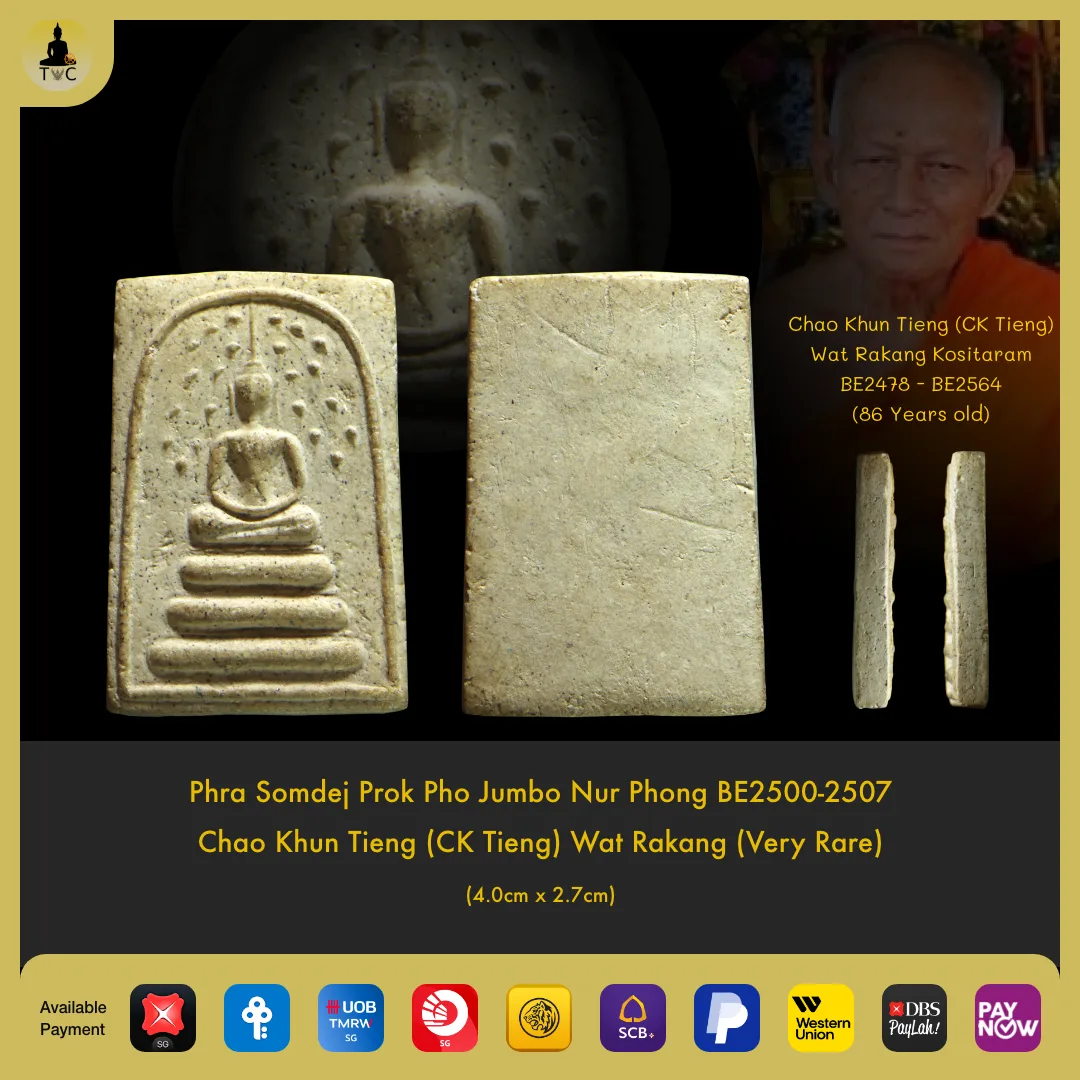
Phra Somdej Prok Pho Jumbo BE2500-2507 Chao Khun Tieng Wat Rakang
$150.00
Phra Somdej Prok Pho “Jumbo” • Nur Phong
BE2500–2507 / CE1957–1964 • Wat Rakang Kositaram, Bangkok • Consecrated by Chao Khun Tieng (CK Tieng) via multi-round Phutthaphisek • Somdej Wat Rakang lineage; Jumbo-format; Very
Description
Phra Somdej Prok Pho “Jumbo” • Nur Phong
BE2500–2507 / CE1957–1964 • Wat Rakang Kositaram, Bangkok • Consecrated by Chao Khun Tieng (CK Tieng) via multi-round Phutthaphisek • Somdej Wat Rakang lineage; Jumbo-format; Very Rare
Overview: Phra Somdej Prok Pho (พระสมเด็จปรกโพธิ์) “Jumbo” format — Nur Phong (เนื้อผง) — BE2500–2507 / CE1957–1964 — Chao Khun Tieng, Wat Rakang Kositaram, Bangkok. Very Rare.
What This Piece Represents (Collector Lens)
Within Thai amulet collecting culture, the Phra Somdej is the single most studied and documented category — and Wat Rakang Kositaram is its canonical home, the temple where Somdej Toh (the 19th-century master credited with founding the Somdej tradition) resided and consecrated the original benchmark pieces. A BE2500–2507 (CE1957–1964) Jumbo-format Somdej Prok Pho from Wat Rakang under Chao Khun Tieng (CK Tieng) occupies a specific and respected position within that lineage: it is a mid-20th-century continuation piece, produced by a direct-lineage abbot using canonical Phong Itthije powder formulas, in the enlarged “Jumbo” pim (พิมพ์ — mould format) that makes this batch immediately distinguishable from standard-run Somdej examples. For collectors, the Jumbo format combined with the Prok Pho (Buddha-under-Bodhi) iconography and the Chao Khun Tieng consecration lineage represents a coherent, teachable, and comparatively well-documented sub-category within the broader Somdej Wat Rakang collecting field.
Amulet Information
Name: Phra Somdej Prok Pho “Jumbo” (พระสมเด็จปรกโพธิ์ จัมโบ้)
Material: Nur Phong (เนื้อผง — sacred powder blend)
Year: BE2500–2507 / CE1957–1964
Temple: Wat Rakang Kositaram (วัดระฆังโฆสิตาราม), Bangkok
Province: Bangkok
Monk: Chao Khun Tieng (Phra Ratchawithetthammaporn — หลวงพ่อเที่ยง), Wat Rakang Kositaram
Lineage Note: Direct-lineage Somdej Wat Rakang continuation batch; Phong Itthije canonical powder formula; multi-round Phutthaphisek consecration BE2500–2507; Jumbo-format pim; Very Rare survival rate
SKU: TAC-CKTieng-SomdejProkPhoJumbo-001
Price:
SGD 150
History & Lineage — Phra Somdej Prok Pho Jumbo (Wat Rakang Kositaram)
The Phra Somdej Prok Pho batch spanning BE2500 to BE2507 (CE1957–1964) was produced across multiple consecration rounds under the supervision of Chao Khun Tieng, the then-abbot of Wat Rakang Kositaram. The production followed the classical Somdej Wat Rakang methodology: sacred powders were formulated according to the Phong Itthije lineage recipe, carefully cured over extended periods, and pressed in batches that were subsequently stored within the Ubosot (โบสถ์ — ordination hall) for daily immersion in chanting before phased release to devotees and supporters of the temple. The seven-year span of the batch reflects the iterative nature of traditional Somdej production, where the same consecration vehicle was reinvoked across multiple ceremony cycles to accumulate spiritual charge before distribution.
Chao Khun Tieng (Phra Ratchawithetthammaporn) was a highly regarded abbot of Wat Rakang Kositaram during the mid-20th century. In the Thai amulet tradition, he is recognised specifically for his rigorous adherence to the canonical Somdej powder formulas and his careful stewardship of the Phutthaphisek (พุทธาภิเษก — Buddha-empowerment ceremony) rites inherited from preceding Wat Rakang abbots. His commitment to multi-stage consecration — rather than single-session blessing common in later commercial editions — is a primary factor that distinguishes his Somdej pieces in the eyes of serious collectors. Senior Bangkok monastic circles participated in the BE2500–2507 consecration rounds, lending additional lineage depth to the batch.
Wat Rakang Kositaram (วัดระฆังโฆสิตาราม), located on the Thonburi bank of the Chao Phraya River in Bangkok, is the most historically important temple in the Somdej amulet tradition. It was the residence and practice site of Somdej Toh (Somdej Phra Phutthachan Toh Phrommarangsi), the 19th-century monk credited with establishing the Phra Somdej as a distinct and codified amulet type. Editions produced at Wat Rakang carry the weight of that founding lineage regardless of era; the BE2500–2507 batch under Chao Khun Tieng was explicitly intended to continue that lineage, fund ongoing temple maintenance and Buddhist activities during the post-war period, and provide blessings of Metta Mahaniyom and Klaew Klaad to a generation of devotees in need of spiritual anchoring during a period of significant social change in Thailand.
About the Material — Nur Phong Composition
Nur Phong (เนื้อผง — sacred powder material) is the canonical medium for Phra Somdej amulets and the material through which the Somdej Wat Rakang tradition is defined. The Chao Khun Tieng batch draws from the established Phong Itthije lineage powder — a compound named in classical Thai Pali-script texts and associated with Somdej Toh’s original formulations. This is supplemented by Phong Patamang and Phong Trinisinghe (protective formula powders), scripture ash from consecrated manuscripts, temple incense residue, and seasonal floral pollens. Cured binders and holy water were used to bring the powder to pressable consistency and to initiate the long surface patina that characterises well-aged Nur Phong. Fragments from earlier Wat Rakang batches were reportedly incorporated to maintain material lineage continuity across generations — a practice documented in several Thai amulet encyclopaedias covering the Somdej tradition.
- Phong Itthije lineage: The foundational powder formula of the Somdej Wat Rakang tradition, associated directly with Somdej Toh’s original compound; its presence in a batch is a primary lineage marker collectors look for in period documentation and surface analysis.
- Aging surface evidence: Authentic Nur Phong of this era displays fine micro-grain texture, natural pore structure, soft relief, and edge bloom rather than sharp factory seams — signs of genuine cured powder rather than later reproduction material.
- Gold foil traces: Some specimens from the Chao Khun Tieng batch retain faint traces of gold foil applied during consecration; this is a period-consistent feature and a useful secondary reference point for authentication.
Design / Pim / Variant Notes
The Prok Pho pim (พิมพ์ปรกโพธิ์ — Bodhi-canopy mould) depicts the Buddha seated in meditation beneath a stylised representation of the Bodhi tree’s spreading branches, the iconographic moment of Enlightenment and victory over Mara. In Thai amulet tradition, this composition is understood to convey protection, steadfastness, and the shelter of the dhamma. The “Jumbo” designation refers to a format larger than the standard Somdej pressing — a deliberate design choice for this batch that gives the piece enhanced visual presence both as a pendant and as an altar display piece. The press character of Chao Khun Tieng’s Nur Phong examples is characteristically soft and even, with edges that have mellowed naturally through the curing process rather than appearing mechanically trimmed. Collectors should note that within the BE2500–2507 range, minor mould variation across rounds may produce slight relief-depth differences between individual specimens — this is expected for period multi-round batches and does not affect classification.
Traditional Spiritual Attributes & Metaphysical Properties
In Thai amulet culture, the Phra Somdej is broadly associated with metta (loving-kindness), protective power, and auspicious fortune — a combination that has made it the most universally worn and collected Thai amulet type across all social and professional backgrounds. The Prok Pho iconography specifically reinforces the protective and steadying dimensions of the piece. The Chao Khun Tieng consecration lineage adds a further layer associated with klaew klaad (safe passage and evasion of harm) drawn from the multi-round Phutthaphisek methodology. Collectors and devotees in Singapore, Malaysia, Taiwan, and Hong Kong typically regard Somdej Wat Rakang pieces as an entry point into serious collecting precisely because the tradition is well documented and the attributes are clearly mapped within the Thai Buddhist devotional canon. These are traditional attributions held within Thai Buddhist practice — they reflect sincere cultural and spiritual belief rather than verified empirical claims.
- เมตตามหานิยม (Metta Mahaniyom — Great Loving-kindness & Esteem): The most prominent attribute of the Somdej Wat Rakang lineage; devotees wear the piece with intentions around social goodwill, relationship harmony, and the cultivation of positive regard from peers and superiors.
- แคล้วคลาด (Klaew Klaad — Evasion of Danger): Associated specifically with the Phutthaphisek multi-round consecration method; wearers in traditionally oriented communities believe the piece assists in avoiding accidents, misfortune, and harm during travel and daily life.
- มหาลาภ (Maha Lap — Great Auspicious Fortune): The third principal attribute of this batch, linked to the Phong Itthije powder formula; collectors note this as part of the three-fold traditional attribution explicitly cited in the temple’s intent documentation for the BE2500–2507 issue.
Rarity & Collector Significance — Phra Somdej Prok Pho Jumbo BE2500–2507
The rarity of the Chao Khun Tieng Jumbo Prok Pho batch arises from three compounding factors. First, the time-intensive curing and multi-stage pressing process inherently limits production volumes relative to later commercially oriented batches. Second, a significant portion of pressed pieces were retained within the Ubosot for extended chanting immersion before any public distribution, further reducing the number that entered general circulation. Third, surviving specimens in high condition are tightly held by advanced collectors — particularly those in the Bangkok and Chiang Mai collector networks who have studied the Somdej Wat Rakang tradition in depth. The Jumbo-format pim is a further differentiator within the broader BE2500–2507 Chao Khun Tieng output: it was produced in smaller quantities than standard-format pressings and is correspondingly less frequently encountered in the open market. Evidence cues collectors use to assess this batch include fine micro-grain surface, natural pore structure on the pressed face, soft relief without mechanical sharpness, and the characteristic edge bloom of properly cured Nur Phong. Piece-to-piece variation in patina tone reflects legitimate differences in storage environment and handling history across a sixty-plus-year lifespan.
Conclusion
The Phra Somdej Prok Pho “Jumbo” Nur Phong BE2500–2507 from Wat Rakang Kositaram, consecrated under Chao Khun Tieng, represents a coherent and historically grounded collecting opportunity within the Somdej Wat Rakang canon. The piece carries the weight of the temple’s founding lineage, the rigour of a multi-round Phutthaphisek consecration, the distinctive Prok Pho iconography, and the enlarged Jumbo format — a combination that gives it a clear identity within the broader Somdej collecting field. For new collectors, this batch provides an accessible and well-documented entry into the Somdej tradition. For experienced collectors, the Chao Khun Tieng Jumbo Prok Pho is a period piece that rewards study of surface character, powder composition, and lineage documentation in equal measure.
Front composite view — Phra Somdej Prok Pho (พระสมเด็จปรกโพธิ์) Jumbo Nur Phong — Chao Khun Tieng, Wat Rakang Kositaram, Bangkok — BE2500–2507 / CE1957–1964
Alternate composite view — Nur Phong (เนื้อผง) surface showing aged patina; natural pore structure consistent with cured Somdej Wat Rakang powder from the mid-20th century
Close-detail obverse — Prok Pho (ปรกโพธิ์) Bodhi-canopy iconography; Jumbo-format soft relief; natural edge bloom characteristic of properly cured Nur Phong
Detail reference — front face, isolated — micro-grain Nur Phong surface visible
Detail reference — front face at angle — edge bloom and soft relief profile of Jumbo-format Nur Phong pressing
Detail reference — obverse close-up — Prok Pho Bodhi-canopy relief and Jumbo-format proportions
Detail reference — front face variation — natural patina tone from storage environment; period-consistent for BE2500–2507 Nur Phong
Detail reference — surface texture close-up — fine micro-grain and natural pore structure of cured Nur Phong (เนื้อผง)
Detail reference — lateral edge view — natural edge bloom with no mechanical seam; evidence cue for period-authentic Nur Phong pressing
Detail reference — full front, clear light — Prok Pho relief and Jumbo format proportions against neutral background
Detail reference — reverse face isolated — natural powder surface showing aged patina from six decades of ambient exposure
Detail reference — reverse close, angled — cured Nur Phong pressed surface; faint traces of consecration gold foil visible on some specimens of this batch
Reviews
There are no reviews yet.