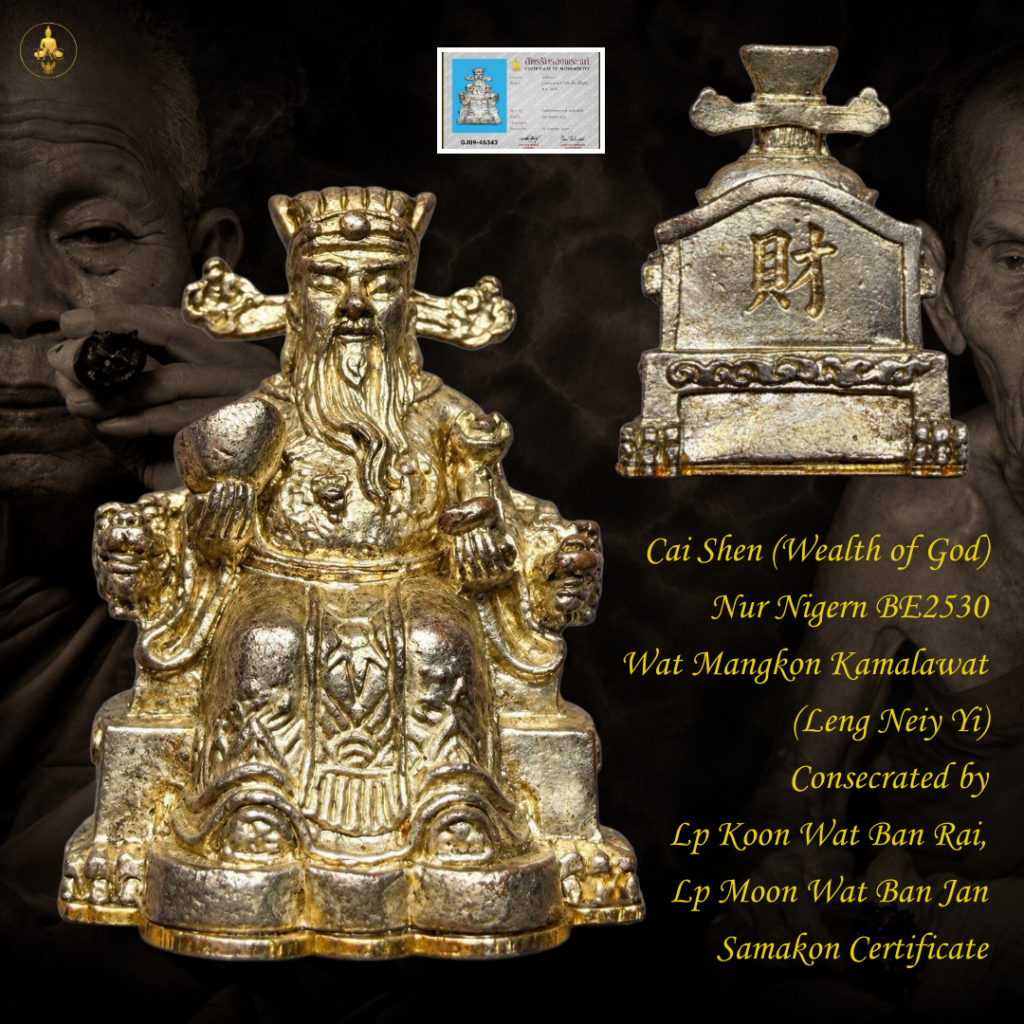
Cai Shen (Wealth of God) Nur Ngern Phasom BE2530 Wat Mangkon Kamalawat (Leng Neiy Yi) Consecrated by Lp Koon Wat Ban Rai, Lp Moon Wat Ban Jan
| Type | Cai Shen (Wealth of God) |
| Monk | Luang Phor Koon (Lp Koon) Wat Ban Rai, Nakhon Ratchasima |
| Temple | Wat Mangkon Kamalawat (Leng Neiy Yi) |
| B.E. Year | 2530 |
| Material | Nur Ngern Phasom |
| Condition | Very Good |
| Certificate | Samakom |
| SKU | TAC-CaiShen(WealthOfGod)-LpKoonWatBanRai&LuangPuMoonWatBanJan-001 |
Authentic Cai Shen (Wealth of God) Luang Phor Koon Wat Ban Rai & Luang Pu Moon Wat Ban Jan, Wat Mangkon Kamalawat BE 2530. Nur Ngern Phasom. Samakon certified. Singapore dealer.
What is the Cai Shen (Wealth of God) amulet by Luang Phor Koon Wat Ban Rai & Luang Pu Moon Wat Ban Jan?
The Cai Shen (Wealth of God) Luang Phor Koon Wat Ban Rai & Luang Pu Moon Wat Ban Jan is a sacred Thai amulet consecrated in BE 2530 at Wat Mangkon Kamalawat (Leng Neiy Yi), cast in Nur Ngern Phasom — a mixed silver-alloy metal — and certified by the Samakon authority. It embodies the deity Cai Shen, the Chinese God of Wealth, blessed by two of Thailand’s most revered monks.
This remarkable piece emerged from a rare collaborative consecration involving Luang Phor Koon Wat Ban Rai & Luang Pu Moon Wat Ban Jan, two master monks whose combined spiritual authority made the BE 2530 batch exceptionally sought after. Luang Phor Koon of Wat Ban Rai was widely celebrated across Thailand and Southeast Asia for his powerful katha and unwavering compassion toward devotees. His participation in a Cai Shen consecration at a Chinese Buddhist temple demonstrated a rare cross-tradition spiritual collaboration.
Luang Pu Moon of Wat Ban Jan was equally renowned for his meditative attainments and strict adherence to Dhamma practice. Together, the two masters brought a depth of blessing that collectors in Singapore, Malaysia, and Greater China regard as exceptional. The Cai Shen (Wealth of God) Luang Phor Koon Wat Ban Rai & Luang Pu Moon Wat Ban Jan thus occupies a singular position in both Thai Theravada and Chinese Buddhist devotional traditions.
Cai Shen (Wealth of God) and Wat Mangkon Kamalawat (Leng Neiy Yi) Heritage
Wat Mangkon Kamalawat (Leng Neiy Yi) — also known as the Dragon Lotus Temple — is Bangkok’s most historically significant Chinese Mahayana Buddhist temple, established in BE 2414 on Charoen Krung Road in Samphanthawong District. As the spiritual heart of Bangkok’s Chinese community for over 150 years, it has long served as a bridge between Thai Theravada traditions and Chinese Buddhist practice. For collectors, an amulet consecrated within its walls carries a provenance rooted in one of Southeast Asia’s most venerable religious institutions.
The temple’s role in producing the Cai Shen (Wealth of God) BE 2530 reflects its enduring tradition of hosting high-level consecration ceremonies that draw masters from across the Thai Buddhist landscape. The blend of Chinese iconography — specifically the Wealth God, Cai Shen — with the blessing energy of Thai forest and village masters creates a devotional object that resonates across cultural communities. This cross-tradition character is precisely what makes the Cai Shen (Wealth of God) Wat Mangkon Kamalawat (Leng Neiy Yi) batch so distinctive in the collector market.
For a deeper understanding of the broader context of Thai Buddhist amulet consecration and its cultural significance, collectors may refer to the Thai amulets article on Wikipedia, which outlines the historical and ritual frameworks that govern authentic amulet production in Thailand.
Nur Ngern Phasom Cai Shen (Wealth of God) — Composition and Craftsmanship
Nur Ngern Phasom refers to a blended silver-alloy metal composition traditionally used in high-grade Thai amulet production. The term Nur Ngern means “silver substance,” while Phasom indicates a mixed or blended alloy, often incorporating additional sacred metals to enhance spiritual potency. This material is prized for its lustrous appearance, its resistance to tarnish over time, and its association with purity and wealth in both Thai and Chinese cultural frameworks.
The use of Nur Ngern Phasom for a Cai Shen deity figure is particularly appropriate, as silver has long been associated with lunar energy, financial abundance, and protection in Chinese metaphysical traditions. Craftsmen producing this batch would have worked under the guidance of presiding monks, with the metal poured and shaped during auspicious ceremonial windows aligned with the Samakon consecration calendar. The result is an amulet where material, iconography, and spiritual ceremony are fully integrated.
The Nur Ngern Phasom Cai Shen (Wealth of God) from BE 2530 is notable for the fine detail of the Cai Shen figure — the iconic robed deity associated with the bestowal of wealth and commercial fortune. Collectors who examine pieces from this batch typically note the weight and density consistent with genuine mixed-alloy casting, which serves as one of the primary physical authentication markers for this series.
Spiritual Benefits of Cai Shen (Wealth of God) by Luang Phor Koon Wat Ban Rai & Luang Pu Moon Wat Ban Jan
Devotees and collectors have long associated the Cai Shen (Wealth of God) Luang Phor Koon Wat Ban Rai & Luang Pu Moon Wat Ban Jan with a specific set of spiritual intentions rooted in both Thai Buddhist and Chinese folk belief. The Cai Shen deity is traditionally venerated as a patron of commerce, financial fortune, and prosperous endeavours. When this iconography is combined with the blessing energy of two senior Thai masters, devotees regard the amulet as especially potent for wealth-related intentions.
Collectors across Singapore, Malaysia, Hong Kong, and Taiwan particularly value this piece for its dual cultural resonance — connecting the Theravada tradition of monk-blessed amulets with the Chinese deity veneration that underpins much of the region’s folk religious practice. The following are the primary spiritual associations traditionally held by devotees of this amulet:
- Wealth Accumulation: Cai Shen is traditionally venerated as a divine patron of financial prosperity, and devotees regard this amulet as supportive of business growth and the accumulation of wealth.
- Business Growth: Collectors in commercial sectors associate this piece with smoother business dealings, favourable negotiations, and the attraction of new opportunities.
- Protective Blessing: The combined blessing of two senior monks is regarded by devotees as conferring a layer of spiritual protection on the wearer, guarding against financial loss and misfortune.
Cai Shen (Wealth of God) BE 2530 — Authentication and Collector Value
The Cai Shen (Wealth of God) BE 2530 batch carries a Samakon certificate — issued by the Thai Amulet Association (Samakon), one of the most respected certification bodies in the Thai amulet community. A Samakon certificate provides documented authentication of the amulet’s origin, material, and consecration details, making it a critical document for collectors seeking verified provenance. For the Singapore and Greater China market, Samakon certification significantly increases both confidence and resale value.
From a collector’s perspective, the BE 2530 batch represents a Golden Era production — pieces from this period were consecrated with rigorous ceremonial standards and have now had nearly four decades to develop the natural patina and surface characteristics that experienced collectors look for. The rarity of a dual-monk collaboration, combined with the prestigious temple venue and certified provenance, places this amulet in a collector tier that commands serious attention.
As an authentic Thai amulet certified by Samakon and sourced through a reputable Thai amulet Singapore dealer, the Cai Shen (Wealth of God) Luang Phor Koon Wat Ban Rai & Luang Pu Moon Wat Ban Jan represents a compelling acquisition for both devotional use and long-term collection building. Pieces from this batch, particularly in Nur Ngern Phasom with intact certification, are increasingly difficult to source in the open market.
This BE 2530 Cai Shen (Wealth of God) is a genuinely uncommon piece — a dual-monk consecration at Wat Mangkon Kamalawat (Leng Neiy Yi), involving both Luang Phor Koon of Wat Ban Rai and Luang Pu Moon of Wat Ban Jan, represents a cross-tradition collaboration that rarely occurs and is rarely documented with Samakon certification intact. The Nur Ngern Phasom casting should be examined for casting sharpness and natural surface aging consistent with nearly four decades of age — these are the two details most experienced collectors will want confirmed.
Attributes reflect Thai Buddhist devotional tradition and are not measurable claims.
![[SOLD] Roop Lor Thep Phra Chao (Cai Shen) Nur Ngern BE2520 Wat Mangkon Kamalawat (Leng Neiy Yi) Luang Pu Toh Wat Pradoochimplee Consecrated](https://tac-media.sgp1.digitaloceanspaces.com/2026/05/Roop-Lor-Thep-Phra-Chao-Cai-Shen-Nur-Ngern-BE2520-Wat-Mangkon-Kamalawat-Leng-Neiy-Yi-Luang-Pu-Toh-Wat-Pradoochimplee-Consecrated-Samakon-Certificate-150x150.png)