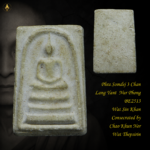
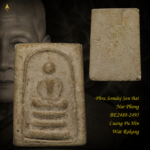
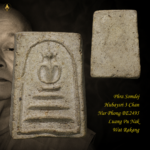
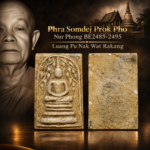
Phra Somdej Song Garuda Pim Klang (Medium) BE2518 (1968) Wat Sin Kan (Thung Si Gun) Donmuang King Rama IX (9) (Bhumobol Adulyadei) with temple box
| Type | Phra Somdej |
| Temple | Wat Sin Khan |
| B.E. Year | 2518 |
| SKU | TAC-0732 |

Adds this amulet and the offer at the bundle price — ready at checkout. Or mention it when you enquire on WhatsApp.
Authentic Phra Somdej Song Garuda Pim Klang BE2518, Wat Sin Kan Don Mueang. Sacred powder with gold flakes, royal Rama IX patronage.
What is the Phra Somdej Song Garuda Pim Klang BE2518 from Wat Sin Kan?
The Phra Somdej Song Garuda Pim Klang BE2518 is a medium-format sacred powder amulet issued by Wat Sin Kan (Thung Si Gun), Don Mueang, Bangkok. Commissioned under the patronage of King Rama IX (King Bhumibol Adulyadej), the muan sarn — sacred powder blend — incorporates gold flakes, crushed ancient amulets, temple incense ash, scripture-cloth powder, and soil from royal temple grounds.
The edition and what makes its origin unusual
Most temple-issue Phra Somdej come from a single abbot’s initiative. This one is different. It was commissioned and overseen under King Rama IX’s personal patronage as part of his broader effort to support Thai Buddhism and promote national unity — a level of royal involvement that places it in a distinct category among Bangkok-district issues of that era.
Wat Sin Kan sits in Don Mueang, a district that was still in an early developmental phase in the mid-1960s. The amulet was tied to temple development and community religious events there, with proceeds supporting religious education and outreach at Wat Sin Kan. That context matters for collectors who care about why a run was made, not just when.
The dual-Garuda design — Song Garuda — carries deliberate meaning. The Garuda is already the emblem of royal authority in Thai iconography. Placing two flanking the base of a Somdej merges that royal symbolism with the protective symbolism of the Buddhist image above. It is not a common motif on temple-issue Somdej from this period.
Nuea, pim, and how this piece was consecrated
The nuea (material/substance) here is phong — sacred powder — pressed into the Pim Klang (medium mould). Gold flakes were mixed directly into the surface, and on most surviving examples they remain visible. The powder blend draws from several sources: crushed older amulets, incense ash accumulated in the temple, cloth used to wrap sacred scripture, and soil taken from royal temple grounds. Each ingredient carries its own ritual lineage within the broader Thai Buddhist amulet tradition.
Consecration followed a multi-stage phutthaphisek (Buddha Abhiseka ceremony). Monks at Wat Sin Kan led preliminary chanting and sanctification before the major ceremony, which drew high-ranking monks from Bangkok’s inner districts. The principal mantras recited were Chinnabanchorn, Itthipiso, and Garuda katha. Oversight came from King Rama IX’s religious council. Each piece was then placed in a temple box bearing Wat Sin Kan insignia to preserve its sanctity before distribution.
What a collector checks — and what comes with this piece
For an amulet of this age and background, authentication starts with the physical. Key points to examine:
- Visible gold flakes embedded in the phong surface — a consistent feature of this run and a primary marker collectors cross-reference
- The dual-Garuda base motif, correctly defined and proportioned for the Pim Klang format
- The original temple box with Wat Sin Kan insignia, which first-batch 1968 issues were distributed with
- Age-consistent surface character on the powder — natural settling and minor surface variation, not artificial aging
No independent certificate is included with this piece. What does accompany it is the original temple box, and for this edition that box is itself a recognised collector’s indicator of a genuine first-batch issue. Collectors who have handled this run treat the box as part of the authentication picture, not just packaging.
Value is set by several converging factors: the royal patronage connection, the rarity of the Song Garuda motif on a Somdej from this district and period, the gold-flake nuea, and the condition of both amulet and box together. Collectors in the region associate the piece with klaew klaad (evasion of danger), metta maha niyom (loving-kindness and social grace), and maha lap (great fortune) — all three traditional properties of the Somdej class.
We acquired this Phra Somdej Song Garuda Pim Klang BE2518 from Wat Sin Kan because the combination of royal Rama IX patronage and the dual-Garuda motif on a sacred powder Somdej from this district is genuinely uncommon — this is not a piece you see regularly in the market. For collectors focused on the Rama IX commemorative period or on Somdej variants outside the mainstream Bangkok temple circuit, this edition is worth serious attention.
Attributes reflect Thai Buddhist devotional tradition and are not measurable claims.