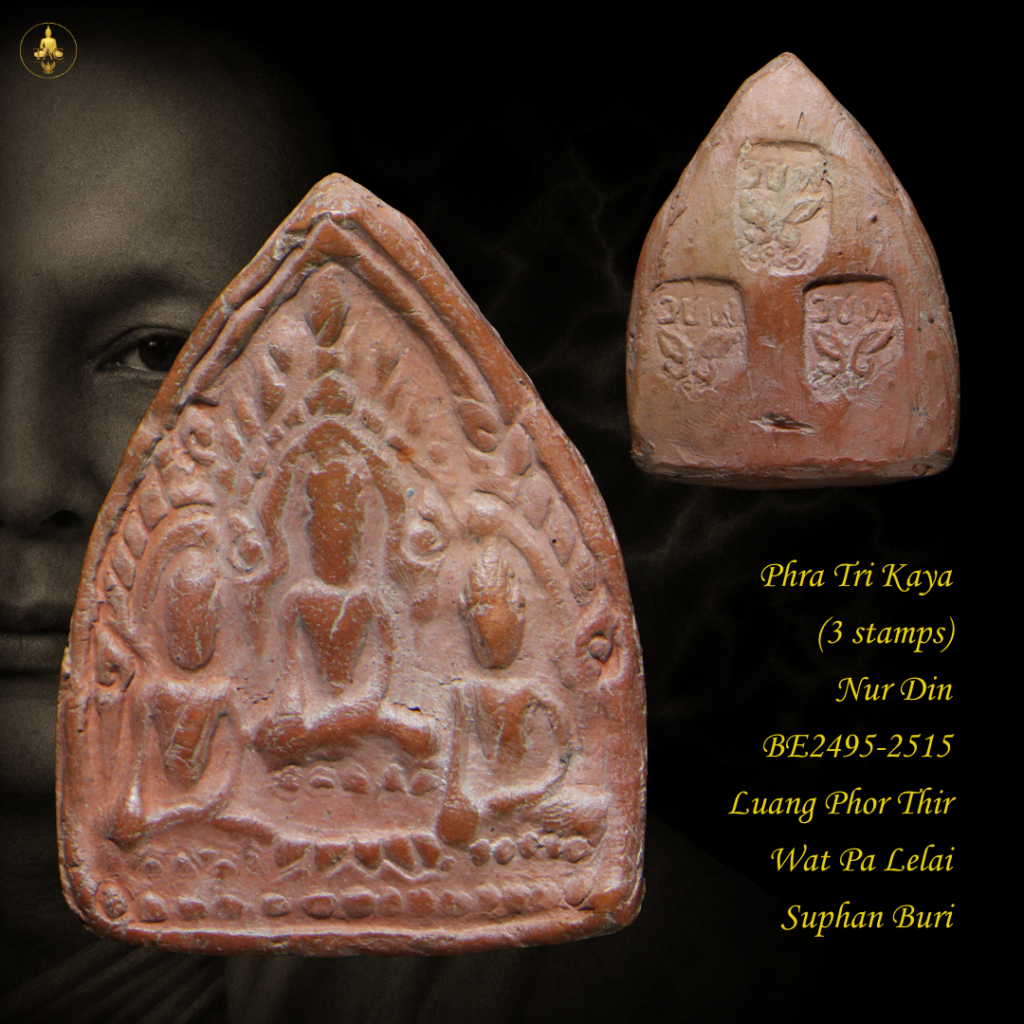
Phra Tri Kaya (3 stamps) Nur Din BE2495-2515 Luang Phor Thir Wat Pa Lelai Suphan Buri
| Type | Phra Tri Kaya |
| Monk | Luang Phor Thir |
| Temple | Wat Pa Lelai |
| B.E. Year | 2500 |
| Material | Nur Din |
| Condition | Very Good |
| SKU | TAC-PhraTriKaya-LpThir-001 |
Authentic Phra Tri Kaya Luang Phor Thir, Wat Pa Lelai BE 2495-2515. Nur Din from ancient Suphan Buri amulets. Singapore dealer. Rare Khun Chang type.
What is the Phra Tri Kaya amulet by Luang Phor Thir?
The Phra Tri Kaya Luang Phor Thir is an authentic Thai amulet produced at Wat Pa Lelai in Suphan Buri between BE 2495 and BE 2515, crafted from Nur Din — a sacred clay compound incorporating powdered fragments of ancient Suphan Buri amulets, concentrated sugarcane juice, sesame oil, resin, and sacred powder, hand-pressed and consecrated under multiple revered masters of the era.
This particular example is a large Khun Chang (Sangkachai) type, measuring 3.50 x 5 cm. The reverse bears a stamped image of a crown and royal umbrella, and traces of white blessing powder remain visible on the surface — an unusual design not commonly encountered in the market.
Luang Phor Thir, formally known as Phra Wisutthisara Thera and formerly titled Phra Kru Rakkhitwan Muni, was born on March 17, 1902. He was appointed abbot of Wat Pa Lelai on November 16, 1951, and served the temple for 33 years until his passing on January 3, 1984, at the age of 83, having been ordained for 61 years.
Those who served Luang Phor Thir as children in his kuti recalled that he personally oversaw the amulet-making process beginning in 1952. He performed a ritual of offering and seeking forgiveness before grinding fragments of ancient amulets into fine powder — a practice that reflects both his reverence for Buddhist heritage and his deep understanding of sacred material traditions.
Phra Tri Kaya Luang Phor Thir and the Heritage of Wat Pa Lelai
Wat Pa Lelai is one of the most historically significant royal temples in Suphan Buri province, Thailand. Its restoration is directly connected to King Rama IV (Prince Mongkut), who encountered the dilapidated temple during his pilgrimage as a monk and, after ascending the throne, ordered its full restoration.
The crown emblem stamped on the reverse of all amulets from this series symbolises Prince Mongkut — the original name of King Rama IV — honouring this royal connection. On some examples, the numeral “4” also appears beneath the crown. This same emblem is inscribed on the façade of the temple’s ordination hall, pressed using the same technique as the stamps on ancient silver coins from the reign of King Rama I.
This historical royal patronage lends the Phra Tri Kaya Wat Pa Lelai series a unique layer of sacred and cultural authority. Collectors and devotees familiar with the Thai Buddhist amulet tradition recognise Wat Pa Lelai as a temple whose amulets carry both royal lineage and the spiritual merit of one of Suphan Buri’s most respected abbots.
Nur Din Phra Tri Kaya — Composition and Craftsmanship
The Nur Din Phra Tri Kaya produced by Luang Phor Thir is distinguished by the extraordinary quality of its base material. He sourced broken pieces of ancient Suphan Buri amulets — including Khun Phaen Kai Pha, Khun Phaen Ban Krang, Khun Krai, and Phra Phong Suphan — and ground them into fine powder before mixing them with concentrated sugarcane juice, sesame oil, resin, and sacred powder.
This mixture was pounded in a mortar until it achieved a sticky, workable paste. The paste was then divided into portions and pressed into molds by hand — one person pressing the amulet while another stamped the back. The handmade nature of this process means that some amulets carry slight creases on the reverse, caused by the mold being removed too forcefully; these are considered hallmarks of authenticity rather than flaws.
The coarser mineral and rock particles naturally present in the clay compound are also considered authentic identifiers. The first batch of completed amulets was consecrated for three months and then distributed to the public during the Loy Krathong festival of 1952 — a historically documented distribution event that grounds the Phra Tri Kaya BE 2495-2515 series in a precise and verifiable timeline.
Spiritual Benefits of Phra Tri Kaya by Luang Phor Thir
The Phra Tri Kaya Luang Phor Thir is traditionally venerated for its efficacy in attracting good fortune, protection, and invincibility. Collectors and devotees regard this series as spiritually comparable to ancient amulets — a reputation grounded in the sacred materials used and the collective merit of the consecration ceremony, which involved multiple highly respected monks of the era.
The Khun Chang (Sangkachai) typology of this amulet is specifically associated with compassion, popularity, and abundance. Devotees regard it as particularly potent for those seeking material blessings alongside spiritual growth, and the series is noted for being extremely popular internationally — including among Thai amulet Singapore collectors and the wider Southeast Asian and Greater China collector communities.
- Protection and invincibility: Devotees traditionally associate the Nur Din composition — incorporating ancient sacred amulet fragments — with strong protective properties comparable to antique amulets.
- Good fortune and wealth: The Khun Chang (Sangkachai) form is regarded by collectors as a symbol of compassion and abundance, created specifically under the belief in popularity, good fortune, and prosperity.
- Charisma and favour: The Luang Phor Thir amulet series is venerated for its association with metta (loving-kindness) energy, making it traditionally sought after by those who wish to cultivate goodwill and influence in their social and professional lives.
Phra Tri Kaya BE 2495-2515 — Authentication and Collector Value
The Phra Tri Kaya BE 2495-2515 series is documented in the Suphan Buri amulet book by Ajarn Manas Ying, which features this standard design as a reference model — a significant indicator of scholarly and collector recognition. The large Khun Chang type measuring 3.50 x 5 cm is specifically listed, providing collectors with a verifiable dimensional reference for authentication.
Authentic examples of this series display several identifiable characteristics: the stamped crown and royal umbrella on the reverse, visible mineral inclusions and coarser particles within the Nur Din clay body, possible crease marks on the back caused by the hand-pressing technique, and traces of white blessing powder on the surface. These physical attributes, cross-referenced against the Ajarn Manas Ying reference book, form the primary basis for authentication.
The consecration ceremony for this series was attended by many famous monks of the time, including Luang Pu Toh of Wat Pradu Chimphli, Luang Pho Mui of Wat Don Rai, and Luang Pho Ngern of Wat Don Yai Hom, among others. This collective consecration by multiple revered masters significantly elevates the spiritual and collector value of the series. Rare, well-preserved examples in original condition — such as this piece — are highly sought after by serious collectors across Singapore, Malaysia, Taiwan, Hong Kong, and mainland China.
Attributes reflect Thai Buddhist devotional tradition and are not measurable claims.