Chapter 01
Does a Thai amulet need a certificate?
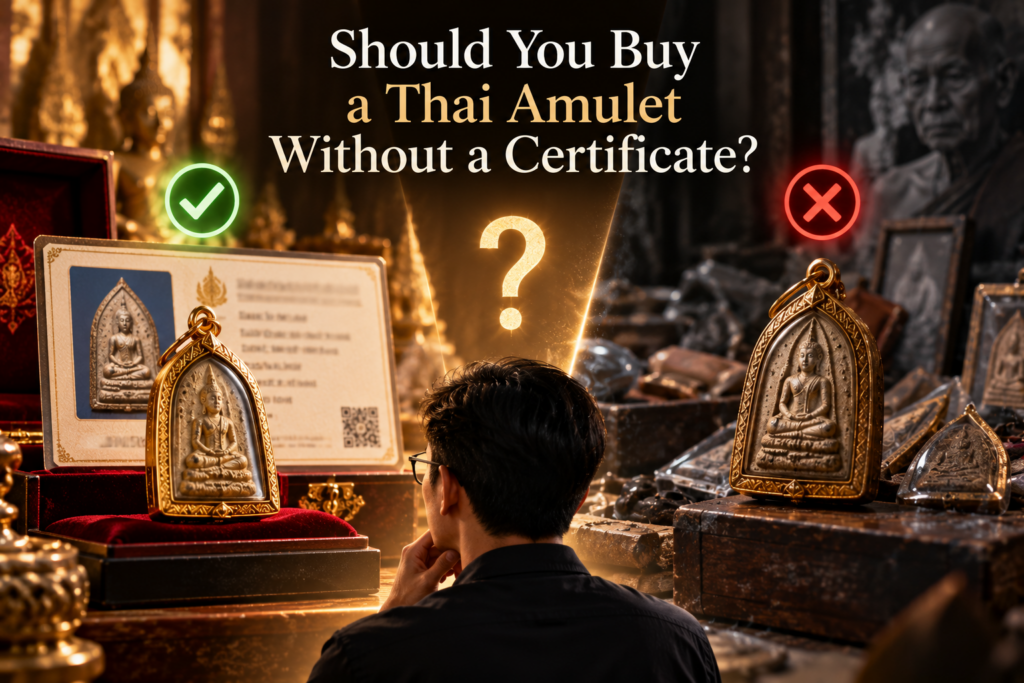
Should you buy a Thai amulet without a certificate? For most pieces, the honest answer is a confident yes and no — plenty of genuine, worthwhile amulets are sold without one, and have been for as long as the hobby has existed. But there's a bigger point that most buyers never hear: a certificate is not the guarantee people assume it is. Understanding how Thai amulet certification actually works — and where it fails — matters far more than simply asking whether a piece has paper attached. The real question isn't "does it have a certificate?" but "is the piece genuine, and do I — or people I trust — actually know it?" Once you see it that way, certificates fall into their proper, limited place.Chapter 02
How Thai amulet certification actually works
Here is what the trade rarely spells out. There is no scientific test and no agreed, standard protocol for authenticating a Thai amulet. A piece submitted for certification is judged by a panel of people — often around nine — who each give a verdict, and the outcome is decided by majority. That's it: it rests entirely on the subjective opinion of whoever happens to sit on the panel that day. And those judges are frequently anonymous. In most cases you never learn who actually assessed your amulet, or how deep their knowledge really is. You're asked to trust a verdict from people you can't see, applying no fixed standard. For a document that's treated as proof, that's a remarkably shaky foundation.Chapter 03
Why a majority vote can reject a genuine piece
Because the result is a vote, it rises and falls on the competence of the panel. If more than half the judges lack the deep, specialist knowledge to recognise a genuine but unusual or rare piece, they will reject it — and the centre then declines to certify it and effectively marks it "fake", even when the amulet is completely real. Many authentic pieces have been wrongly turned away exactly this way. A rejection is the opinion of one particular panel on one particular day, not a statement of fact. So the absence of a certificate — or even a "fail" — tells you much less than people think.Chapter 04
The uncomfortable truth: forged and bought certificates
Then there's the side the market doesn't advertise, and it's important to be honest about it. Certificates can be, and are, forged outright — a convincing document attached to a dubious piece is one of the oldest tricks in the trade. Worse, it is well known in the Thai amulet world that judges have, in various cases, been paid under the table to issue certificates for pieces that are fake — so a genuine-looking certificate can sit on an outright counterfeit. Cases have even surfaced where the same certificate number appears on more than one amulet, including fakes — the document cloned along with the piece. In short, a certificate can be as counterfeit as the amulet it claims to vouch for. This is precisely why you should never rely on one 100%.Chapter 05
So what does a certificate actually prove?
None of this means certificates are worthless — it means they must be read for what they are. A certificate from a respected body is a useful data point: a strong indication that some knowledgeable people examined a piece and accepted it, and on a famous, high-value amulet it's worth having. But it is an opinion, not proof. It can be mistaken, forged or bought. Treat it as one voice among several — reassuring at best, never the final word, and never a substitute for your own judgement.Chapter 06
What actually protects you: your own knowledge and trusted peers
If paper can't be trusted outright, what can? Your own eyes — and the eyes of people you trust. The buyers who rarely get caught are the ones who have taken the time to learn: to read the mould (pim), the material and its ageing, and the provenance for themselves (our guide to choosing and authenticating a Thai amulet walks through each). Knowledge is the one thing no forger can copy and no corrupt panel can sell. And just as importantly, experienced collectors don't buy alone. Before committing to a serious piece, they show it to peers or friends with deeper knowledge and weigh those opinions honestly. A second and third experienced eye will catch what a single person — or a single certificate — can miss. Build your own knowledge, lean on a trusted circle, and let the paperwork be the least of your evidence, not the most.Chapter 07
Why many genuine pieces have no certificate
It also helps to understand why so many authentic amulets carry no certificate at all. Grading costs money and effort, and it only makes sense for pieces whose value justifies it. That leaves whole categories of genuine amulets uncertified simply because no one bothered: more affordable everyday pieces, newer temple issues, pieces from smaller or less-famous batches, and amulets that have passed quietly between collectors for decades. None of this reflects on their authenticity — for these pieces, the piece itself and the people behind the sale are what matter.Chapter 08
The real safeguard: who you buy from
Which brings us to the single most practical protection of all: the person you buy from. A dealer who inspects every piece, describes it honestly, notes certification where it genuinely exists (without hiding behind it), and guarantees the sale is worth far more than a certificate on an amulet from a stranger. A good dealer's reputation is the guarantee — they have every reason to be right and none to deceive you, and they'll take a piece back if it isn't as described. That accountability is something no certificate can offer.Chapter 09
Judge the amulet, not the paper
So — should you buy a Thai amulet without a certificate? Very often, yes. Certificates are useful evidence at best and unreliable at worst: subjective, sometimes mistaken, and sometimes forged or bought. Don't rely on one 100%. Instead, build your own knowledge, bring in trusted peers with deeper experience before a serious purchase, and buy from a seller who stands behind what they sell. Do that, and you'll be protected far better than any piece of paper can protect you. Browse our pieces and ask us anything — every piece we list is inspected and guaranteed.Chapter 10
Frequently Asked Questions
Does a certificate guarantee a Thai amulet is real?
No. There's no standard scientific test — certification is a subjective majority verdict by a panel of judges, often anonymous. It can be mistaken, and certificates can be forged or even issued for fakes. A certificate supports a piece; it never guarantees it, and shouldn't be trusted 100%.How does Thai amulet certification actually work?
A piece is judged by a panel — often around nine people — who vote, with the outcome decided by majority. There's no fixed protocol and the judges are frequently anonymous, so the result depends entirely on who assesses it and how much they know. A genuine but unusual piece can be wrongly rejected by an under-qualified panel.Can Thai amulet certificates be faked or bought?
Yes. Certificates are forged outright, and it's well known in the hobby that judges have been paid under the table to certify fakes. Cases have even appeared where the same certificate number is attached to more than one piece, including counterfeits. This is why you should never rely on a certificate alone.Should you rely on a Samakom certificate?
Not 100%. A certificate from a respected body is useful evidence on a famous piece, but it's an opinion, not proof, and it can be wrong, forged or bought. Rely first on your own knowledge and on peers with deeper experience, then treat the certificate as one supporting signal.How can I buy a Thai amulet safely without a certificate?
Learn to read the mould, material and provenance yourself; before a serious purchase, get a knowledgeable friend or peer to look too; and buy from a dealer who inspects, honestly describes and guarantees the piece. That combination protects you far better than a certificate from an unknown source.Dealer's Note — Thai Amulets Collection, Singapore, since 2015. We inspect and guarantee every piece we list, note certification where it genuinely exists, and will always encourage you to use your own knowledge and trusted peers rather than rely on paper — ask us anything over WhatsApp.