Phra Ajarn Dee Channo Wat Phukhao Kaeo
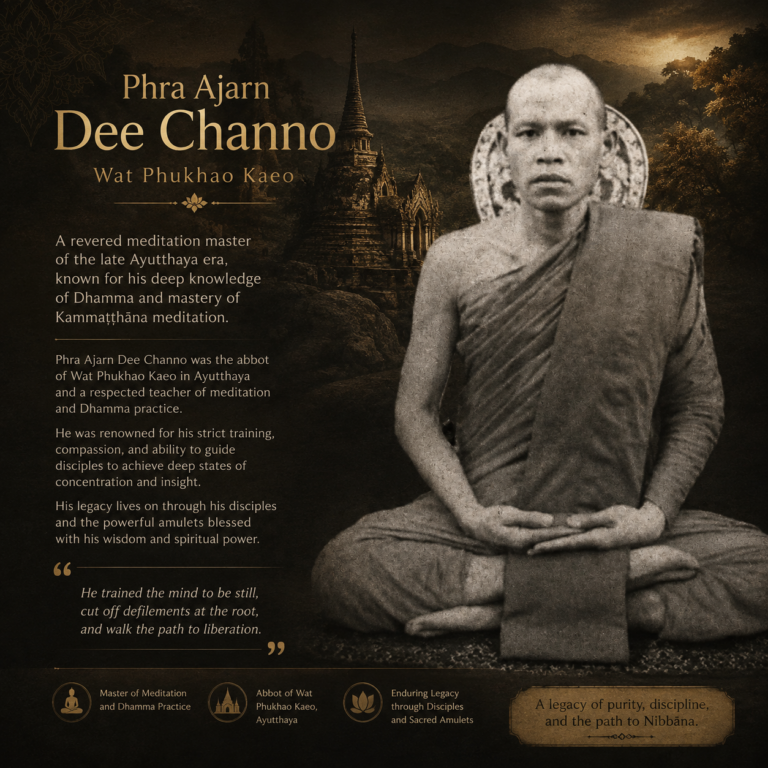
Phra Ajarn Dee Channo (พระอาจารย์ดี ฉนฺโน), also reverently known as Luang Phu Dee Channo (หลวงปู่ดี ฉันโน), was a highly venerated forest tradition monk of Wat Phukhao Kaeo (วัดภูเขาแก้ว), Amphoe Phibun Mangsahan (อำเภอพิบูลมังสาหาร), Ubon Ratchathani Province (จังหวัดอุบลราชธานี), northeastern Thailand. A direct disciple of the great meditation master Luang Phu Sao Kantasilo (หลวงปู่เสาร์ กันตสีโล), he passed away on 8 April BE 2502 (AD 1959) after 31 Rains Retreats, and is celebrated as one of Isan's foremost Buddhist saints. Read more ↓
Biography
Who Was Phra Ajarn Dee Channo?
Phra Ajarn Dee Channo (พระอาจารย์ดี ฉนฺโน), also reverently known as Luang Phu Dee Channo (หลวงปู่ดี ฉันโน), was a highly venerated forest tradition monk of Wat Phukhao Kaeo (วัดภูเขาแก้ว), Amphoe Phibun Mangsahan (อำเภอพิบูลมังสาหาร), Ubon Ratchathani Province (จังหวัดอุบลราชธานี), northeastern Thailand. A direct disciple of the great meditation master Luang Phu Sao Kantasilo (หลวงปู่เสาร์ กันตสีโล), he passed away on 8 April BE 2502 (AD 1959) after 31 Rains Retreats, and is celebrated as one of Isan’s foremost Buddhist saints.
Early Life and Ordination
Phra Ajarn Dee Channo (พระอาจารย์ดี ฉนฺโน) was born a native of Ubon Ratchathani Province (จังหวัดอุบลราชธานี) in the northeastern region of Thailand, popularly known as Isan (อีสาน). His exact birth date in the Buddhist Era is not widely documented in English sources, though records indicate he lived to the age of 66 years, 8 months, and 12 days at the time of his passing in BE 2502 (AD 1959), placing his approximate birth year around BE 2435 (AD 1892).
Before taking robes, Luang Phu Dee was a layman of considerable spiritual reputation. He had devoted himself to the study of esoteric and occult sciences — including sacred incantations (เวทมนตร์คาถา) and various forms of traditional mystical arts (คุณไสยศาสตร์) — acquiring a formidable reputation that inspired both awe and respect among those who knew him. Despite the fear he inspired, he was noted never to have used these powers to harm others or to create negative karma with any person. This remarkable restraint in lay life set the tone for the deeply ethical monk he would later become. His ordination year is not widely documented in English sources, though given his 31 completed Rains Retreats (พรรษา) at the time of passing, he is understood to have been ordained approximately in BE 2471 (AD 1928).
Spiritual Development and Practice
Following his ordination, Phra Ajarn Dee Channo (พระอาจารย์ดี ฉนฺโน) committed himself fully to the path of liberation, taking refuge under two of the most revered patriarch masters of the Thai forest tradition: Luang Phu Sao Kantasilo (หลวงปู่เสาร์ กันตสีโล) and Luang Phu Mun Bhuridatto (หลวงปู่มั่น ภูริทัตโต). Under their guidance, he received comprehensive instruction in the Middle Way (มัชฌิมาปฏิปทา) as taught by the Buddha, and dedicated himself to Vipassana meditation (วิปัสสนากรรมฐาน).
What distinguished Luang Phu Dee was the extraordinary foundation he brought to meditation practice. The mind-training he had undertaken as a layman — particularly his mastery of the Ten Kasina (กสิณ ๑๐), the ten elemental meditation objects used to develop deep concentration states (สมาธิ) — meant that the transition into formal Vipassana practice came with remarkable ease. His meditation deepened rapidly, and his mind was said to have risen to the highest levels of dhamma (ภูมิธรรม) with exceptional swiftness.
He frequently taught his disciples a core principle: “Meditation practice — mindfulness (สติ) and mind (จิต) — that is the true Buddho (พุทโธ). Buddho means the one who knows, the one who is awake, the one who is joyful. Without mindfulness, the mind cannot know, cannot awaken, cannot be joyful — it becomes only ignorance. Guard mindfulness and mind well, and wisdom in the dhamma will arise of itself.” His disciple Phra Ajarn Choti Aphakko (ท่านพระอาจารย์โชติ อาภัคโค) testified that Luang Phu Dee’s spiritual power was in no way inferior to that of the legendary Lao monk Samret Lun (สำเร็จลุน), a remarkable tribute from a direct witness.
Major Amulet Consecrations and Ceremonies
Detailed batch records — including specific Buddhist Era years, formal batch names, materials used, and ceremony documentation — for amulets associated with Phra Ajarn Dee Channo (พระอาจารย์ดี ฉนฺโน) of Wat Phukhao Kaeo (วัดภูเขาแก้ว) are not widely documented in English sources. Collectors and researchers seeking precise batch-level records are advised to consult Thai-language temple archives and established Thai amulet authentication communities.
Within Thai collector circles, amulets connected to Luang Phu Dee Channo are generally known to include sacred image types such as roop muean (รูปเหมือน) — portrait effigies of the monk himself — as well as phim (พิมพ์) pressed amulets consecrated through his powerful Kasina meditation focus. Given his exceptional mastery of the Fire Kasina (กสิณไฟ) — a power he reportedly used to physically incinerate spirit shrines during his missionary work — amulets associated with his energy are particularly prized among collectors who seek protection and the clearing of obstacles. Any Phra Ajarn Dee Channo amulet presented for sale should be accompanied by provenance documentation and, where possible, certification from a recognised Thai amulet authentication body.
Legacy and Temple Significance
Phra Ajarn Dee Channo (พระอาจารย์ดี ฉนฺโน) passed away on 8 April BE 2502 (AD 1959) at 5:30 in the morning, seated in a resting posture against a large bolster pillow — a passing so peaceful it appeared to onlookers as though he had simply leaned back to rest. He had lived for 66 years, 8 months, and 12 days, completing 31 Rains Retreats (พรรษา) in the robes.
His legacy in Ubon Ratchathani Province (จังหวัดอุบลราชธานี) — and particularly in Amphoe Phibun Mangsahan (อำเภอพิบูลมังสาหาร) — is profound. He is credited with leading a historic Dhamma missionary campaign alongside Luang Phu Sao (หลวงปู่เสาร์) and Luang Phu Mun (หลวงปู่มั่น) to transform the spiritual lives of Isan villagers, who at the time predominantly practised animist spirit worship (การนับถือผี) and were largely outside the formal Buddhist fold. Luang Phu Dee personally dismantled spirit shrines (ศาลผีปู่ตา) and guided entire communities toward the Three Jewels and the Five and Eight Precepts.
Today, devotees across Ubon Ratchathani remember him in the saying: “It is because of Luang Phu Dee that we know merit and demerit — he lit the golden lantern of the knowing heart.” Wat Phukhao Kaeo (วัดภูเขาแก้ว) remains a site of veneration in his memory, and his story is preserved in the oral and written traditions of the Thai forest lineage. Specific details regarding shrines, statues, or annual commemorative ceremonies held at the temple today are not widely documented in English sources.