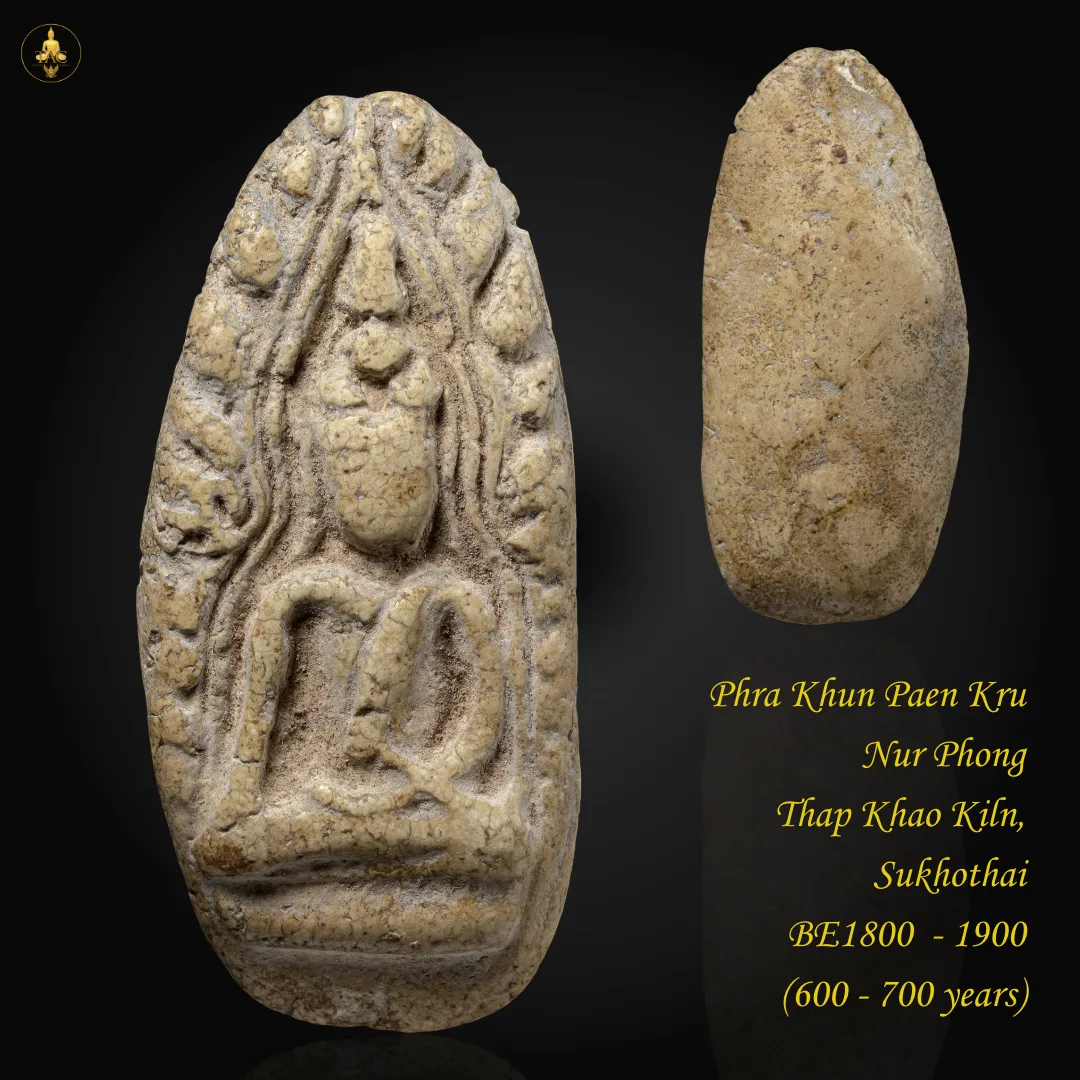
Phra Khun Paen Kru Nur Phong Thap Khao Kiln, Sukhothai BE1800 – 1900 (600 – 700 years)
$1,388.00
Phra Khun Paen Kru • Nur Phong
Estimated BE1800–1900 • Approximately 600–700 years old • Thap Khao Kiln, Sukhothai • Ancient Sukhothai kiln-votive lineage
Overview of the ancient Phra
Description
Phra Khun Paen Kru • Nur Phong
Estimated BE1800–1900 • Approximately 600–700 years old • Thap Khao Kiln, Sukhothai • Ancient Sukhothai kiln-votive lineage
Overview of the ancient Phra Khun Paen Kru in nur phong, associated with the old kiln tradition of Thap Khao, Sukhothai.
What This Piece Represents (Collector Lens)
Ancient Sukhothai-period amulets occupy a special place in Thai Buddhist material culture because they belong to a world long before modern temple batch naming, commercial issue structures, or contemporary certificate language. This Phra Khun Paen Kru from the Thap Khao kiln current is meaningful precisely because it appears rooted in that older sacred environment. Collectors are drawn to such pieces not for flashy surface sharpness, but for kiln-era character, old powder body, devotional compression, and the historical quietness that only very old amulets seem to carry. In hand, pieces like this often feel closer to archaeology than to ordinary collecting.
Amulet Information
Name: Phra Khun Paen Kru
Material: Nur Phong (ancient sacred powder body)
Estimated Period: BE1800–1900
Estimated Age: Approximately 600–700 years
Site / Origin: Thap Khao Kiln, Sukhothai
Province: Sukhothai
Monk: Not available
Lineage Note: Ancient kiln-associated votive amulet belonging to the broader Sukhothai sacred ceramics and powder-votive tradition.
SKU: TAC-Sukhothai-ThapKhao-PhraKhunPaenKru-001
Price:
SGD 1388
History & Lineage — Phra Khun Paen Kru (Thap Khao Kiln, Sukhothai)
The attribution to Thap Khao Kiln places this amulet within the historical orbit of Sukhothai, one of the most important early centers of Thai Buddhist art and sacred production. Kiln-associated sites in Sukhothai are studied not only for ceramics but also for the wider material world that surrounded temple life, devotional practice, and sacred image making. When an amulet is described as belonging to this current, it is usually approached as part of that older religious landscape rather than as a later named temple issue.
The use of the term phra kru suggests an old temple-kept or excavation-associated survival rather than an openly distributed modern amulet. In collector language, that matters because ancient pieces are often assessed through period style, powder structure, and site tradition more than through named consecrators. In this case, the estimated age of roughly 600–700 years frames the amulet as something from the late Sukhothai or early transitional world, a period deeply valued for its austere Buddhist visual language.
The Khun Paen identity in an ancient context should also be read carefully. Here it is best understood as a collector-type classification based on form rather than a modern romanticized Khun Paen market concept. Very old amulets often receive familiar type labels later so collectors can discuss and compare them, even when the original historical naming has not survived.
About the Material — Nur Phong Composition
Nur phong refers to a sacred powder-based body rather than a cast metal or straightforward fired clay object. In ancient amulet study, old powder amulets are especially prized because they preserve subtle evidence of historical making: compressed texture, mineral and organic inclusions, dryness of age, softened edges, and a body that feels built up rather than poured or struck. Collectors usually examine these details very closely because genuine old powder pieces rarely look overly uniform.
Compared with modern powder amulets, ancient nur phong bodies often show a deeper sense of maturity. The surface may appear worn but settled, with small voids, natural cracking, or areas of tonal variation that speak to long age rather than recent artificial distressing. These are the kinds of evidence cues that make ancient powder amulets both fascinating and difficult to study well.
- Ancient sacred powder body associated with early Thai votive production.
- Collectors often study compression, mineral inclusions, pore structure, and surface maturity.
- Old powder pieces are valued for organic age character rather than modern-style sharpness.
Design / Pim / Variant Notes
The triangular seated form allows collectors to place the piece broadly within the Khun Paen family, but its real importance lies in how old the visual language feels. The front is compact, direct, and devotional, with none of the ornate elaboration associated with much later market-oriented Khun Paen types. That simplicity is a strength. In ancient amulets, the power of the image often comes from proportion, stillness, and sacred compression rather than decorative complexity.
Front view showing the compact seated form, old powder body, and strong archaic visual character.
Back view showing the plain reverse body and the age-set structure expected of an ancient powder amulet.
Traditional Spiritual Attributes & Metaphysical Properties
Ancient phra kru amulets are often approached differently from later named monk issues. Devotees usually value them for old temple current, protective presence, continuity of merit, and the sacred calm that comes from a long devotional history. In the case of an ancient Khun Paen-form amulet, collectors may also read the image as one of composure, centeredness, and inward strength. These qualities are part of traditional Thai devotional understanding rather than measurable claims.
- Protection: Old temple amulets are often kept for quiet, enduring protective blessing.
- Stability: Ancient sacred powder pieces are commonly associated with groundedness and devotional continuity.
- Temple Current: The Sukhothai kiln lineage gives the piece a strong historical and spiritual presence for devotees and collectors alike.
Rarity & Collector Significance — Phra Khun Paen Kru Nur Phong
The importance of this amulet lies in age, survival, and context. Very old powder-based Thai amulets linked to early cultural centers such as Sukhothai are inherently finite, often fragile, and increasingly difficult to place correctly without careful study. A piece like this becomes especially meaningful when it retains a readable seated form, age-consistent powder body, and a visual language that feels truly old rather than merely distressed. For collectors who focus on early Thai Buddhist material culture, that combination makes it far more than just another amulet.
Conclusion
Phra Khun Paen Kru in nur phong from the Thap Khao kiln current represents an ancient layer of Thai Buddhist sacred art where powder, proportion, and devotional survival matter more than later commercial framing. Its estimated age, Sukhothai association, and archaic form give it strong significance for both collector and devotee. For students of Thai amulet history, it offers a compact but meaningful example of how early sacred objects preserve spiritual continuity through material, stillness, and time.
Reviews
There are no reviews yet.