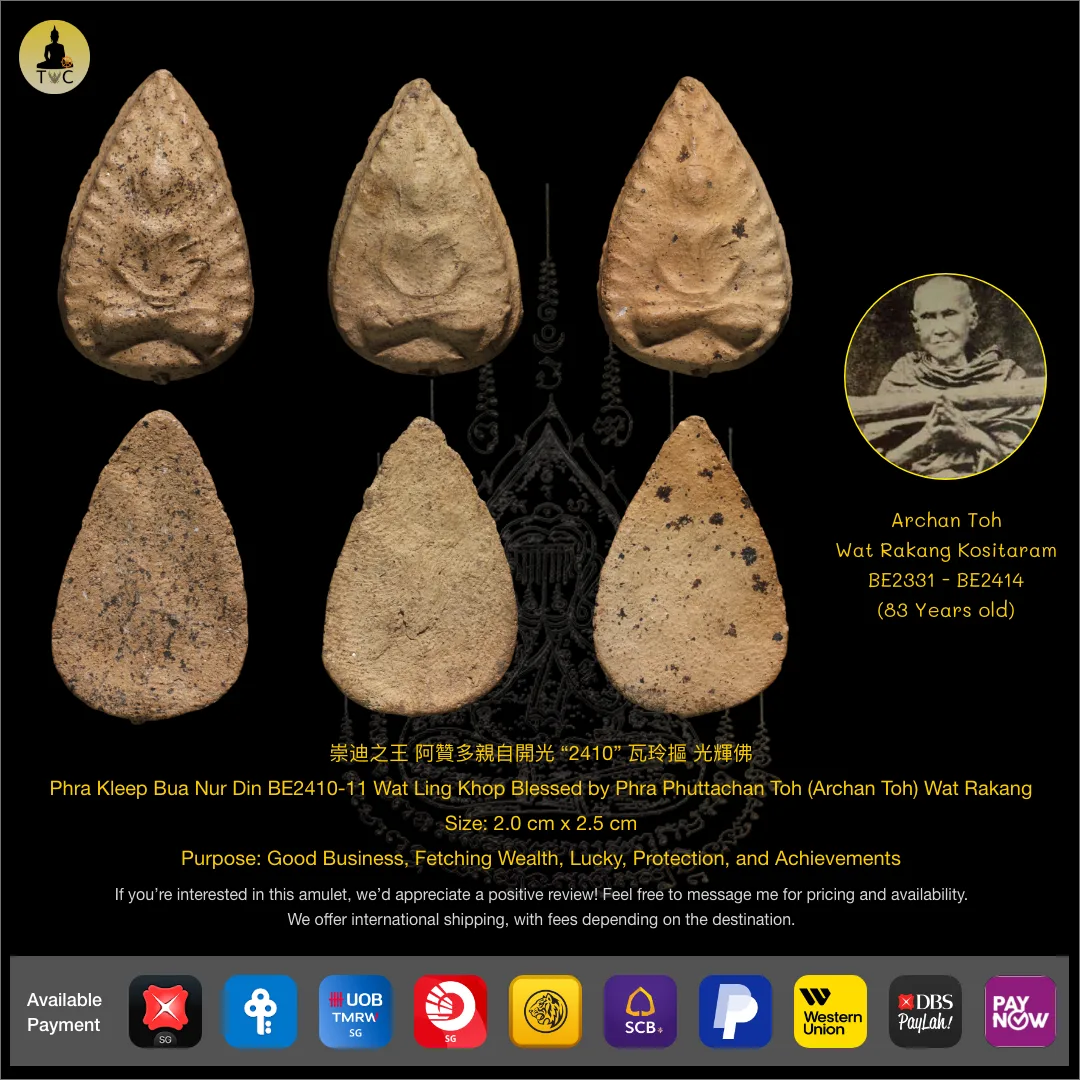
Phra Kleep Bua Nur Din BE2410-11 Wat Ling Khop Blessed by Phra Phuttachan Toh (Archan Toh) Wat Rakang
$268.00
Phra Kleep Bua Nur Din • BE2410–11
Wat Ling Khop • Blessed by Phra Phutthachan Toh (Somdej Toh) of Wat Rakang
Main overview of Phra Kleep Bua Nur Din BE2410–11, classic lotus-petal pim
Description
Phra Kleep Bua Nur Din • BE2410–11
Wat Ling Khop • Blessed by Phra Phutthachan Toh (Somdej Toh) of Wat Rakang
Main overview of Phra Kleep Bua Nur Din BE2410–11, classic lotus-petal pim from Wat Ling Khop, blessed by Somdej Toh.
Phra Kleep Bua (Lotus Petal) Nur Din BE2410–11 is one of the most respected early
kru clay votive tablets associated with the great master
Phra Phutthachan Toh (Somdej Toh) of Wat Rakang.
Created at Wat Ling Khop and later enshrined in a chedi, these lotus-petal shaped tablets
carry the refined aura of Somdej-era wicha — combining Metta Mahaniyom, strong protection and
support for serious Buddhist practice.
| Amulet Name | Phra Kleep Bua Nur Din BE2410–11 |
| Temple of Origin | Wat Ling Khop (closely linked to Wat Rakang lineage) |
| Presiding Master | Phra Phutthachan Toh (Somdej Toh) of Wat Rakang and senior Rattanakosin monks |
| Era / Year | Late King Rama IV period • BE2410–11 (~1867–1868 CE) |
| Material |
Nur Din — sacred baked clay blended with classic Somdej powders (Itthijay, Maharaj, Patamang, Trinisinghe), scripture ash, lotus petal fragments and blessed earth. |
| Pim / Form | Lotus petal (Kleep Bua) pim — small, curved petal shape designed for easy daily wear. |
| Spiritual Focus |
Metta Mahaniyom, Klaew Klad (evasion of danger), Kongkraphan (invulnerability), wealth & stable fortune, support for meditation and Dhamma practice. |
Historical Significance
Phra Kleep Bua BE2410–11 belongs to the early Rattanakosin tradition, created during the
reign of King Rama IV at Wat Ling Khop and empowered under the direct
blessing lineage of Somdej Toh. These tablets were made not just as personal amulets, but as
votive offerings — enshrined within the temple’s chedi to preserve the Dhamma and radiate blessings
to the surrounding community.
After many decades, the kru (reliquary) was opened and beautifully preserved lotus-petal tablets
were recovered. Because of their age, Somdej-level blessing and delicate form, authentic pieces are now
considered museum-grade artifacts in the Somdej-related family of amulets.
Front macro view — classic lotus petal profile with aged clay patina and soft Buddha features.
Reverse surface showing kru-style texture and natural ageing — an important reference point for authenticity.
Side profile — thin, petal-like curvature designed as a lightweight votive tablet.
Base and micro-texture, highlighting the baked clay matrix and age-appropriate wear.
Angled view capturing relief depth and the soft, worn edges typical of genuine kru pieces.
Macro close-up of the Buddha image and lotus aura, useful for studying original casting lines and pores.
Iconography & Design
The term “Kleep Bua” literally means “lotus petal”. The amulet takes the form of a
small petal, gently tapered at the top, symbolising the lotus rising above the mud towards enlightenment.
The Buddha is shown seated in meditation, radiating calm and stillness, reflecting Somdej Toh’s emphasis
on Vipassana and inner cultivation.
Many surviving examples display a soft, almost “melted” surface from long-term enshrinement in the chedi.
For collectors, this natural, uneven ageing — together with the fine Somdej-style facial
expression — is one of the key visual signatures of authentic pieces.
Materials & Wicha
The Nur Din mixture follows the classic Somdej school — finely ground sacred powders from old
Buddha images, Itthijay, Maharaj, Patamang, Trinisinghe, scripture ash from important temples,
lotus petals and blessed earth from holy sites. These ingredients are combined through repeated chanting
and hand-kneading, transforming simple clay into a ritual object charged with intention.
After molding and firing, the tablets were empowered again in multi-stage Putthapisek ceremonies.
The presence of Somdej Toh and senior Rattanakosin monks is what elevates this batch into
the ranks of classic Somdej-lineage votive tablets.
Spiritual Attributes & Intended Benefits
In Thai belief, Phra Kleep Bua BE2410–11 is renowned for a blend of:
- Metta Mahaniyom — enhancing kindness, likability and supportive relationships.
- Klaew Klad — evasion from accidents, danger and ill-intentioned harm.
- Kongkraphan Chatri — protective field that reinforces physical and spiritual safety.
- Wealth & Stability — gradual improvement in chok lap (luck) and business opportunities.
- Meditation Support — calming the mind, reminding the wearer of the Buddha’s path and Somdej Toh’s teachings.
Many long-term devotees regard this amulet as a “backbone piece” in their collection — something
worn not just for miracles, but as a daily reminder of faith, mindfulness and gratitude.
Rarity & Collector Significance
Because Phra Kleep Bua BE2410–11 was produced more than 150 years ago and enshrined as
a kru amulet, surviving examples in sharp condition are extremely scarce. Genuine pieces
from Wat Ling Khop with clean surfaces, good facial features and natural clay patina are highly prized and
often reserved in advanced collections.
For serious collectors of Somdej-lineage amulets, Phra Kleep Bua is considered an important
historical link — connecting the great master Somdej Toh, the broader Rattanakosin revival of Buddhist art,
and the living tradition of wearing clay votive tablets for protection and merit.
Related Articles
Reviews
There are no reviews yet.