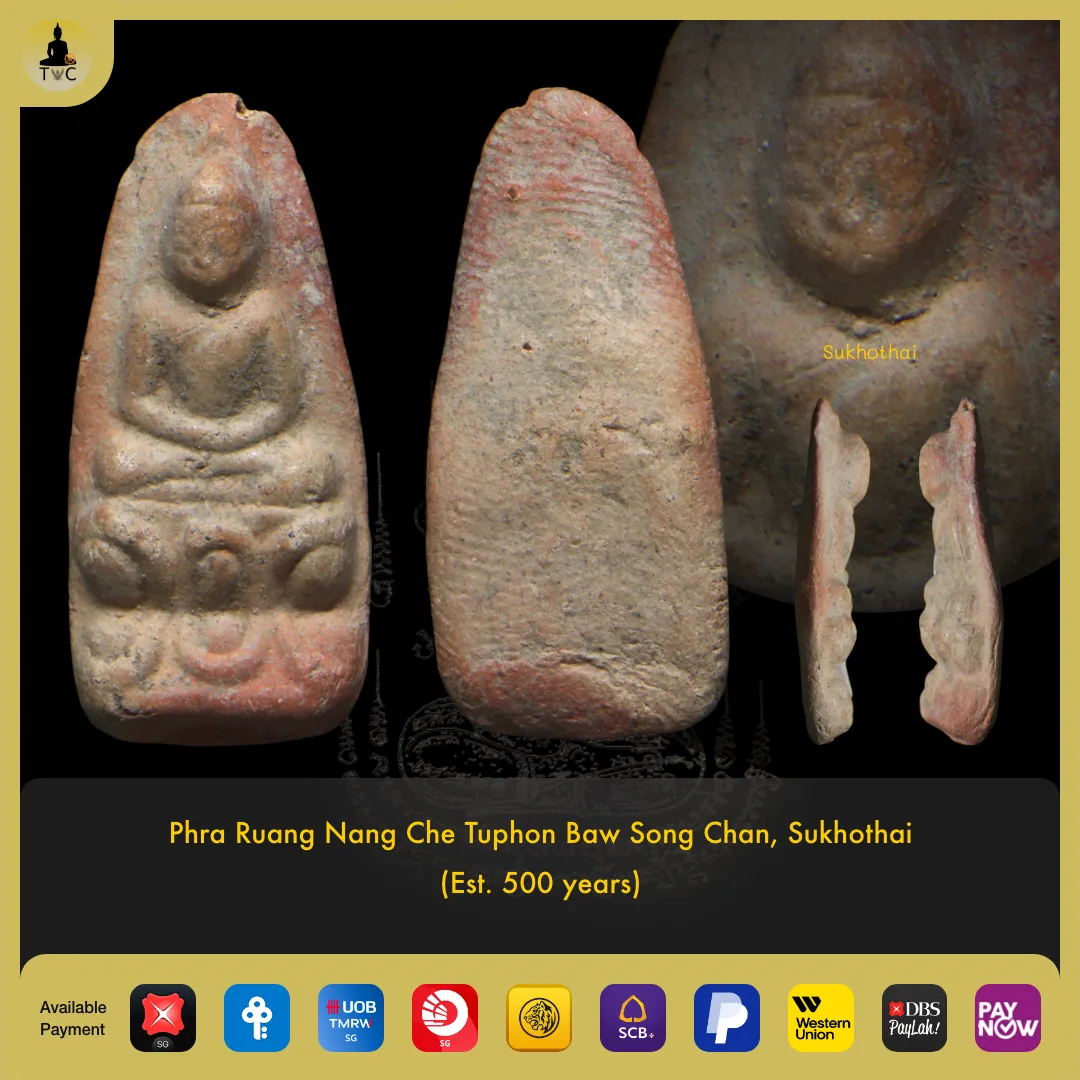
Phra Ruang Nang Che Tuphon Baw Song Chan Nur Din, Sukhothai (Est. 500 years)
$308.00
Phra Ruang Nang Che Tuphon Baw Song Chan • Nur Phong
Sukhothai Period (est. CE 15th–16th century) • Sukhothai Province • Ancient Kru votive tablet; Phra Ruang dynastic lineage • Double-base Baw Song Chan pim; est. 500 yea
Description
Phra Ruang Nang Che Tuphon Baw Song Chan • Nur Phong
Sukhothai Period (est. CE 15th–16th century) • Sukhothai Province • Ancient Kru votive tablet; Phra Ruang dynastic lineage • Double-base Baw Song Chan pim; est. 500 years
Overview: Phra Ruang Nang Che Tuphon Baw Song Chan (พระรวงนั่งเชตุภัณฑ์บัวสองชั้น) — Nur Phong (เนื้อผง) — Sukhothai period, est. 500 years — double-base votive tablet, Sukhothai province.
What This Piece Represents (Collector Lens)
Among ancient Thai amulets, the Phra Ruang Nang Che series occupies a rare and specifically situated position: it belongs to the Sukhothai school, the earliest fully documented tradition of Buddhist votive tablet production in Thailand, and carries the iconographic and material markers of a kingdom that placed Buddhist patronage at the centre of royal identity. Kru finds (กรุ — sealed underground chambers in temple foundations or within stupas) from the Sukhothai region have been documented by Thai Fine Arts Department surveys and by the collector community since the mid-20th century, and examples from intact Kru contexts represent some of the most historically significant ancient amulets in the Thai collecting canon. For the experienced collector, the distinguishing factors of a Sukhothai Phra Ruang example are its material integrity — the particular quality of aged Nur Phong from this era — and its iconographic specificity: the Nang Che posture (seated meditation), the Tuphon base decoration, and the Baw Song Chan (double lotus tier) all serve as classification markers that place the piece precisely within the Sukhothai stylistic vocabulary. Pieces of this age and type are encountered far less frequently in the open market than post-19th-century amulets, and they reward collectors who invest time in understanding Sukhothai visual grammar.
Amulet Information
Name: Phra Ruang Nang Che Tuphon Baw Song Chan (พระรวงนั่งเชตุภัณฑ์บัวสองชั้น)
Material: Nur Phong (เนื้อผง — sacred powder with Phong Bailan, relic dust, and herbal temple powders)
Year: Sukhothai period / est. CE 15th–16th century (approx. 500 years)
Temple: Sukhothai kingdom temple origin (specific temple not identified)
Province: Sukhothai
Monk: Not specified (ancient Kru find — no named individual consecrator documented)
Lineage Note: Phra Ruang dynastic lineage; Sukhothai school Nur Phong votive tablet; Kru-context ancient amulet; double-base Baw Song Chan pim with Nang Che meditative posture
SKU: TAC-Phra Ruang-NangCheTuphonBawSongChan-001
Price:
SGD 308
History & Lineage — Phra Ruang Nang Che Tuphon Baw Song Chan (Sukhothai)
The Phra Ruang amulet type takes its name from the Phra Ruang dynasty, the ruling lineage of the Sukhothai kingdom from its founding in the 13th century through its incorporation into the Ayutthaya sphere in the 15th–16th century. The Sukhothai kings were among the most active royal patrons of Theravada Buddhism in Southeast Asian history, commissioning extensive temple complexes, sponsoring assemblies of senior monks from Sri Lanka and neighbouring polities, and overseeing the production of Buddhist material culture — votive tablets among the most significant of these — as acts of royal merit-making (tham bun — ทำบุญ). Votive tablets from this period were produced in large quantities for enshrinement within stupa bases and ordination hall foundations (Kru — กรุ), where they accumulated over centuries until rediscovery during temple restoration work or deliberate excavation. Pieces recovered from intact Kru contexts carry a provenance story that links them directly to the original consecration environment — a connection that serious collectors and Thai Fine Arts Department specialists regard as materially significant for authentication purposes.
The specific form designated Nang Che Tuphon Baw Song Chan maps a precise iconographic vocabulary onto the piece. Nang Che (นั่งเช) refers to the seated posture of the principal Buddha figure in meditative absorption — a posture associated in Sukhothai Buddhist iconography with the inward-turned mind of deep samadhi (สมาธิ — concentration) and the generation of spiritual merit for those who venerate it. Tuphon (ตุภัณฑ์) describes the decorated base or throne element, a stylised architectural feature characteristic of Sukhothai-period tablet design that distinguishes this type from simpler, flat-base variants. Baw Song Chan (บัวสองชั้) — double lotus tier — refers specifically to the two-level lotus pedestal beneath the figure, a design element understood in the Sukhothai devotional context to represent the twin qualities of prajna (wisdom) and samadhi (concentration) that together constitute the foundation of the Buddhist path.
No individual monk or single temple has been identified as the specific consecrator of this example — a feature common to ancient Kru finds, where the producing institution may have ceased to function and documentary records from the period do not survive. The production context is understood through material and stylistic analysis: the Nur Phong composition, the hand-pressed mould technique, the surface patina profile, and the iconographic consistency with dated Sukhothai-school examples documented in Thai Fine Arts Department collections and published amulet encyclopaedias. The absence of a named monk is a factual characteristic of this class of amulet, not a deficiency — collectors who study the ancient amulet tradition understand that Kru-context pieces carry their authentication through material and visual evidence rather than named consecration chains.
About the Material — Nur Phong Composition
The Nur Phong (เนื้อผง — sacred powder material) of Sukhothai-period votive tablets differs meaningfully from the 19th–20th-century Somdej-lineage powders that dominate modern collecting. Sukhothai Nur Phong was formulated from locally available sacred materials: fine laterite-enriched soil from temple grounds, relic dust (athi — อัฐิ) derived from cremated monks or enshrined relics, and burnt scripture powder (Phong Bailan — ผงใบลาน) produced by incinerating palm-leaf manuscripts containing Pali texts. Herbal powders gathered from the temple precincts contributed aromatic and ritual dimensions to the compound. The resulting material was mixed with natural organic binders — commonly rice-starch paste or plant resins — and hand-pressed into mould forms, then left to cure and dry under controlled conditions before enshrinement or distribution. After five centuries of sealed Kru storage followed by ambient exposure, the surface character of authentic Sukhothai Nur Phong is unmistakable to the trained eye.
- Surface aging profile: Authentic Sukhothai Nur Phong exhibits deep, non-uniform patination — a muted grey-ochre or warm brown tone with micro-crazing — that results from centuries of sealed Kru humidity followed by exposure. This differs distinctly from the surface of reproductions, which typically show uniform colour and absence of genuine crazing depth.
- Phong Bailan (ผงใบลาน — burnt palm-leaf scripture powder): The incorporation of this ingredient is a distinctive marker of the Sukhothai-period production tradition, reflecting the monastic culture of manuscript Buddhism that characterised the kingdom’s religious life; its presence can sometimes be detected in the tablet’s surface grain structure.
- Hand-pressed mould character: The relief on Sukhothai votive tablets was produced by pressing the powder compound into carved stone or terracotta moulds by hand — a process that creates subtle asymmetries and compression variations absent from cast or machine-reproduced pieces, and which collectors treat as primary authentication reference points.
Design / Pim / Variant Notes
The pim (พิมพ์ — mould type) of the Nang Che Tuphon Baw Song Chan is among the more compositionally complex within the Sukhothai Phra Ruang family. The principal figure — the seated Buddha in Nang Che posture — is framed by the Tuphon architectural throne element and elevated on the two-tiered Baw Song Chan lotus pedestal, creating a vertically layered composition that conveys a sense of formal ceremonial placement. The overall silhouette is taller and more architecturally structured than simpler Sukhothai tablet types, reflecting the influence of Sri Lankan Theravada art — transmitted to Sukhothai through diplomatic and ecclesiastical contact — on local votive tablet design. The facial modelling of the Buddha figure follows the characteristic Sukhothai aesthetic: elongated features, a flame-like ushnisha (topknot), and an expression of deep inward calm. In well-preserved examples, the lotus petal layering of the double base retains visible relief definition; the degree of preservation at this detail point is a useful grading reference for condition assessment. Collectors should expect legitimate variation in relief sharpness and surface tone across specimens of the same pim, reflecting the hand-production process and individual Kru storage conditions.
Traditional Spiritual Attributes & Metaphysical Properties
In Thai amulet culture, the Phra Ruang type is associated with a broad and well-documented set of traditional attributes rooted in the Sukhothai kingdom’s royal Buddhist patronage. Devotees who venerate this class of ancient tablet typically approach it with intentions connected to personal protection, social harmony, and the cultivation of fortune — attributes understood to be embedded in the piece through the original royal merit-making ceremonies and the long accumulation of consecrated environment during Kru storage. The Nang Che meditative posture carries specific associations with mental clarity and spiritual guidance in the Thai devotional tradition, linking the piece additionally to the attribute of Buddha Nissayon (spiritual guidance and clarity). These are traditional attributions held within Thai Buddhist devotional culture, reflecting centuries of sincere practice around this amulet class rather than verified empirical claims.
- แคล้วคลาด (Klaew Klaad — Evasion of Danger & Protection): The primary protective attribute associated with the Phra Ruang lineage; devotees in Thailand, Singapore, and Malaysia traditionally regard ancient Sukhothai tablets as among the most powerful for this purpose, citing the depth of royal and monastic consecration that underpins the Kru-origin class.
- เมตตามหานิยม (Metta Mahaniyom — Charm & Loving-Kindness): The seated meditation posture and the double-lotus base are understood in Thai devotional practice to amplify metta radiation from the figure, making this pim type particularly associated with goodwill, social ease, and favourable regard from others.
- โชคลาภ (Chok Lap — Auspicious Fortune & Prosperity): Ancient Kru tablets of the Sukhothai school carry a traditional association with prosperity and opportune fortune in Thai collector and devotee communities; the Baw Song Chan (double lotus) base is specifically interpreted as a symbol of layered abundance in the popular devotional understanding of this pim type.
Rarity & Collector Significance — Phra Ruang Nang Che Tuphon Baw Song Chan
An estimated 500-year age horizon places this piece well beyond the range of modern-era amulets and into the category that Thai collectors designate as phra kru boran (พระกรุโบราณ — ancient sealed-chamber amulets). This classification carries specific weight in the collecting community: Kru finds of Sukhothai-period origin are among the most studied, documented, and contested categories in Thai amulet scholarship, and surviving examples in good condition are significantly less common than equivalent-age pieces from later Ayutthaya-period Krus. The Nang Che Tuphon Baw Song Chan pim is a recognised sub-type within the Sukhothai Phra Ruang family, and its combined iconographic elements — the Nang Che posture, Tuphon throne, and double-lotus base — make it a more compositionally complex and comparatively less common variant than simpler single-element Sukhothai tablets. Evidence cues that experienced collectors and specialists apply to assessment include: the depth and non-uniformity of surface patination, the micro-crazing pattern consistent with centuries of sealed humidity exposure, the quality of the Nur Phong grain under magnification, and the characteristic hand-press asymmetry of the relief. Collectors building a study collection of ancient Thai amulets typically regard a documented Sukhothai Phra Ruang example as a foundational reference piece for the pre-modern category.
Conclusion
The Phra Ruang Nang Che Tuphon Baw Song Chan is a materially and historically coherent example of Sukhothai-period Buddhist votive tablet production — a class of ancient amulet that embodies the royal patronage, monastic scholarship, and artistic refinement of the golden age of Thai Buddhism. Its Nur Phong composition, double-lotus base iconography, and Kru-context origin place it firmly within one of the most respected and studied categories in the Thai ancient amulet tradition. For collectors in Singapore, Malaysia, Taiwan, and Hong Kong who approach Thai amulets from a historical and material study perspective, a Sukhothai Phra Ruang of this pim type represents both a singular devotional object and a tangible connection to a period of Thai Buddhist culture that is five centuries removed from the present day.
Front face — Phra Ruang Nang Che Tuphon Baw Song Chan (พระรวงนั่งเชตุภัณฑ์บัวสองชั้น) — Nur Phong, Sukhothai period — seated Buddha on double-lotus base; Tuphon architectural throne element visible
Reverse face — natural Nur Phong (เนื้อผง) pressed surface — deep patination and micro-crazing consistent with Kru-context Sukhothai-era storage; approx. 500 years of ambient development
Side profile — tablet thickness and edge character — hand-pressed mould asymmetry visible; no mechanical seam; consistent with authentic Sukhothai Nur Phong production technique
Reviews
There are no reviews yet.