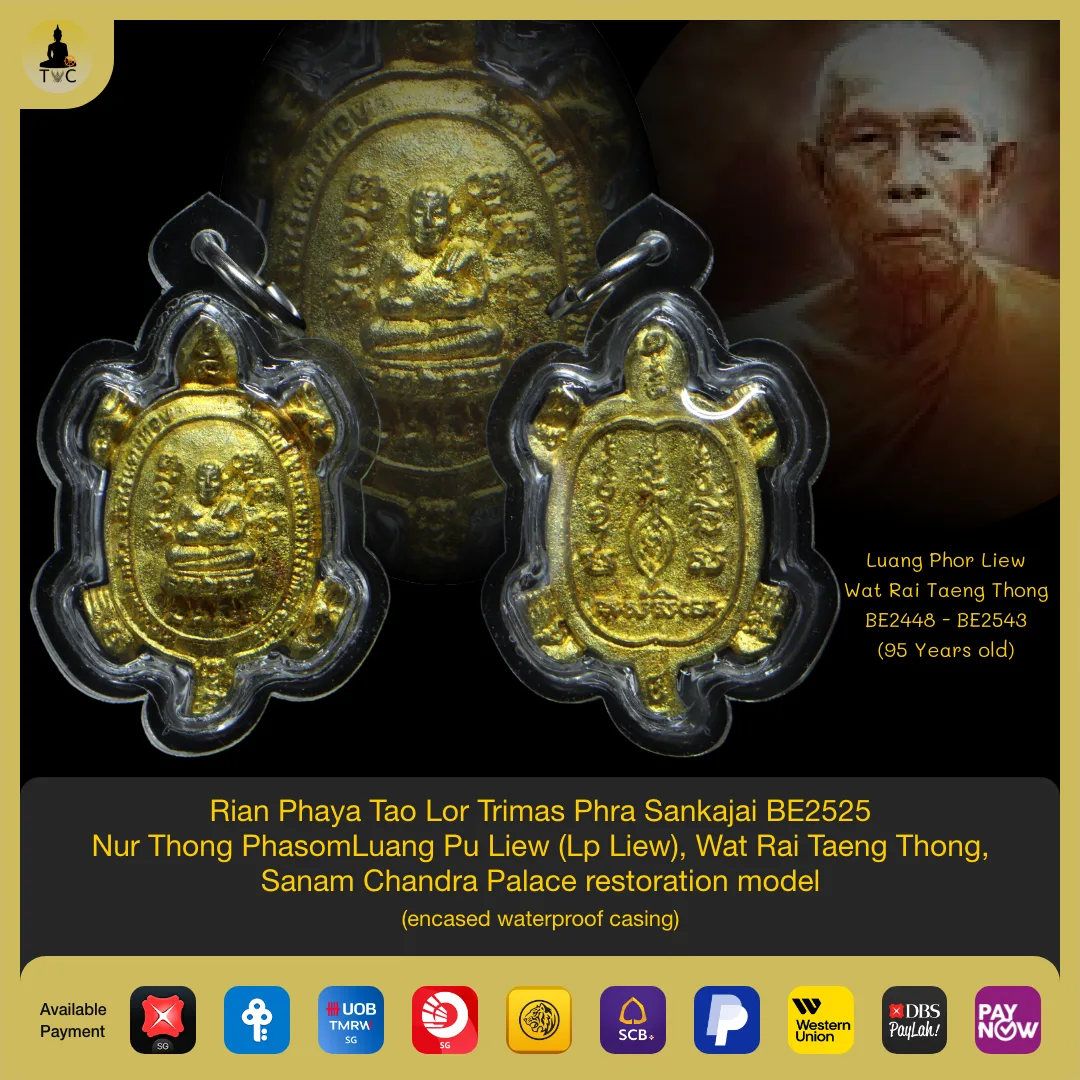
Rian Phaya Tao Lor Trimas Phra Sankajai BE2525 Luang Phor Liew, Wat Rai Taeng Thong
$168.00
Rian Phaya Tao Lor Trimas Phra Sankajai • Nur Thong Phasom
BE2525 / CE1982 • Wat Rai Taeng Thong, Nakhon Pathom • Consecrated by Luang Pu Liew Wajasit • Associated with the Sanam Chandra Palace restoration edition
Description
Rian Phaya Tao Lor Trimas Phra Sankajai • Nur Thong Phasom
BE2525 / CE1982 • Wat Rai Taeng Thong, Nakhon Pathom • Consecrated by Luang Pu Liew Wajasit • Associated with the Sanam Chandra Palace restoration edition
Presentation view of the BE2525 Sanam Chandra Palace restoration edition, showing Phra Sankajai seated on the sacred Phaya Tao Lor turtle.
What This Piece Represents (Collector Lens)
This medallion holds interest on several levels at once. It belongs to the turtle amulet tradition closely associated with Luang Pu Liew, yet it also departs from a plain turtle-only format by pairing Phaya Tao Lor with Phra Sankajai. That combination gives the piece both symbolic richness and strong devotional appeal. For collectors, the attraction lies in its large format, clearly stated charitable purpose, and Trimas blessing cycle. For devotees, it is valued as a calm and auspicious amulet that brings together wise contentment, steady prosperity, protection, and long-life symbolism in one balanced composition.
Amulet Information
Name: Rian Phaya Tao Lor Trimas Phra Sankajai
Material: Nur Thong Phasom (mixed sacred brass)
Year: BE2525 / CE1982
Temple: Wat Rai Taeng Thong, Nakhon Pathom
Province: Nakhon Pathom
Monk: Luang Pu Liew Wajasit
Edition: Sanam Chandra Palace Restoration Edition
Ritual Note: Trimas 3-month blessing cycle
Dimensions / Weight: 7.0 × 3.5 × 2.0 cm • 127.90 g
Lineage Note: A large-format Luang Pu Liew turtle-related medallion combining Phaya Tao symbolism with Phra Sankajai auspicious imagery.
SKU: TAC-LPLiew-RianPhayaTaoLor-Trimas-Sankajai-BE2525-001
Price:
SGD 168
History & Lineage — Rian Phaya Tao Lor Trimas Phra Sankajai (Wat Rai Taeng Thong, Nakhon Pathom)
Issued in BE2525 / CE1982 under Luang Pu Liew Wajasit of Wat Rai Taeng Thong, this medallion belongs to the period when his reputation in turtle-related sacred knowledge was already firmly established. Luang Pu Liew remains one of the most beloved names in the Thai turtle amulet tradition, and his works are consistently appreciated for their direct symbolism, calm strength, and long-standing devotional use.
This particular edition carries added historical interest because it was produced to support the restoration of Sanam Chandra Palace. That charitable purpose matters to collectors because it situates the piece within a clear benefaction narrative rather than a purely commercial release. In Thai amulet culture, editions connected to restoration, temple support, or heritage conservation often carry an added layer of meaning because the sacred object also becomes a record of communal patronage.
The image of Phra Sankajai seated upon Phaya Tao Lor creates a distinctive iconographic blend. The turtle is associated with stability, protection, longevity, and steady fortune, while Phra Sankajai represents wise contentment, auspicious abundance, and a prosperous state of mind. This pairing gives the amulet a particularly balanced character — not aggressive, but steady; not flashy, but enduring.
Contextual Insight
In Thai material culture, turtle symbolism is closely tied to ayuyuen, or longevity, as well as sheltered wealth that grows with patience rather than haste. Phra Sankajai, by contrast, represents fullness, good judgment, contentment, and auspicious success. When joined together in one medallion, the message becomes clear: prosperity should be stable, protected, and guided by wisdom.
The Trimas blessing cycle adds another important dimension. In amulet culture, a three-month empowerment period suggests repeated chanting and meditative reinforcement over time, rather than a single-event consecration. That longer devotional rhythm often makes such pieces especially appealing to devotees who value ritual depth.
Obverse view showing Phra Sankajai above the sacred turtle form, with strong relief and large-format presence.
Reverse view showing the back layout and period-correct structure of this large-format medallion.
About the Material — Nur Thong Phasom
The medallion is described as nur thong phasom, a mixed sacred brass composition that may include devotee-offered metals and yantra plates. In Thai amulet study, mixed-metal issues often carry special interest because they reflect both ritual intention and communal participation. Rather than being valued only for purity of one metal, they are appreciated for the sacred combination and the historical manner of production.
The stated lost-wax casting method, together with crisp relief and period-correct finishing details, supports the reading of this piece as a serious, well-made ritual medallion from its era. Its large size and substantial weight also give it strong physical presence, making it unlike smaller mass-issued temple coins.
- Mixed sacred brass composition with ritual and devotional material significance.
- Lost-wax casting with strong relief and large medallion format.
- Large dimensions and 127.90 g weight give the piece unusual visual and tactile presence.
Wat Rai Taeng Thong & Luang Pu Liew’s Turtle Wicha
Wat Rai Taeng Thong became deeply associated with Luang Pu Liew’s turtle-centered sacred knowledge, or wicha tao. That association is one of the reasons turtle amulets linked to him continue to enjoy strong devotional and collector demand. In Thai belief, the turtle does not simply signify long life; it also conveys protective shelter, measured progress, and wealth that accumulates with steadiness.
By combining this turtle symbolism with Phra Sankajai, the medallion offers a softer but highly auspicious tone. It suggests success through patience, contentment guided by wisdom, and prosperity protected by calm spiritual force rather than restless ambition.
Consecration & Ritual Character
The Trimas designation points to a three-month blessing period, a format especially appreciated in Thai amulet culture because it implies sustained empowerment through repeated chanting and meditation. Such a consecration rhythm often overlaps with important Buddhist devotional cycles and carries the sense that the amulet was reinforced across time rather than blessed in a single short ceremony.
For devotees, this makes the piece feel spiritually settled and complete. For collectors, it strengthens the documentary identity of the batch and helps distinguish it from more ordinary single-event releases.
Traditional Spiritual Attributes & Metaphysical Properties
According to Thai Buddhist belief, the union of Phaya Tao Lor and Phra Sankajai supports a broad but balanced range of auspicious qualities. The turtle contributes longevity, shelter, protection, and stable fortune. Phra Sankajai contributes wise abundance, contentment, and the ability to receive goodwill and favorable circumstances. These meanings are part of Thai devotional culture and should be understood as traditional beliefs rather than measurable guarantees.
- เมตตามหานิยม: Traditionally associated with social goodwill, likability, and smoother human relations.
- โชคลาภ: Linked with good fortune, business opportunity, and steady financial progress.
- แคล้วคลาด: Regarded as supportive of safety in travel and avoidance of danger.
- อายุยืน: The turtle symbolism is especially associated with longevity and stable life-force.
Rarity & Collector Significance — Rian Phaya Tao Lor Trimas Phra Sankajai BE2525
Within the broader Phaya Tao genre, this BE2525 Sanam Chandra Palace restoration edition stands out for its documented purpose, large format, and ritual identity. Those three factors matter because collectors increasingly value amulets that can be placed clearly within a charitable, historical, and ritual context. The substantial size also separates it from more common small-format medallions, giving it a stronger study and display presence.
When preserved with clear relief, natural period patina, and strong structural integrity, such examples are best understood as collector-grade temple medallions. Their appeal lies not only in rarity, but in how well they represent a specific devotional and material moment in Luang Pu Liew’s amulet tradition.
Conclusion
This medallion is an excellent example of how iconography, metallurgy, charitable purpose, and ritual chronology can align in a single Thai sacred object. The pairing of Phaya Tao Lor with Phra Sankajai gives it a clear symbolic identity, while the BE2525 Trimas blessing and Sanam Chandra Palace restoration context strengthen its long-term cultural and collector value. For devotees, it is a balanced amulet of protection, longevity, and steady fortune. For collectors, it is a well-defined Luang Pu Liew study piece with real character and historical placement.
For detailed documentation, provenance records, and acquisition information regarding this amulet, contact us via
WhatsApp.
Disclaimer: The information presented in this write-up is intended strictly for educational and reference purposes. It reflects traditional beliefs, historical context, and collector understanding, and should not be treated as definitive legal, commercial, or forensic proof of authenticity.
Reviews
There are no reviews yet.