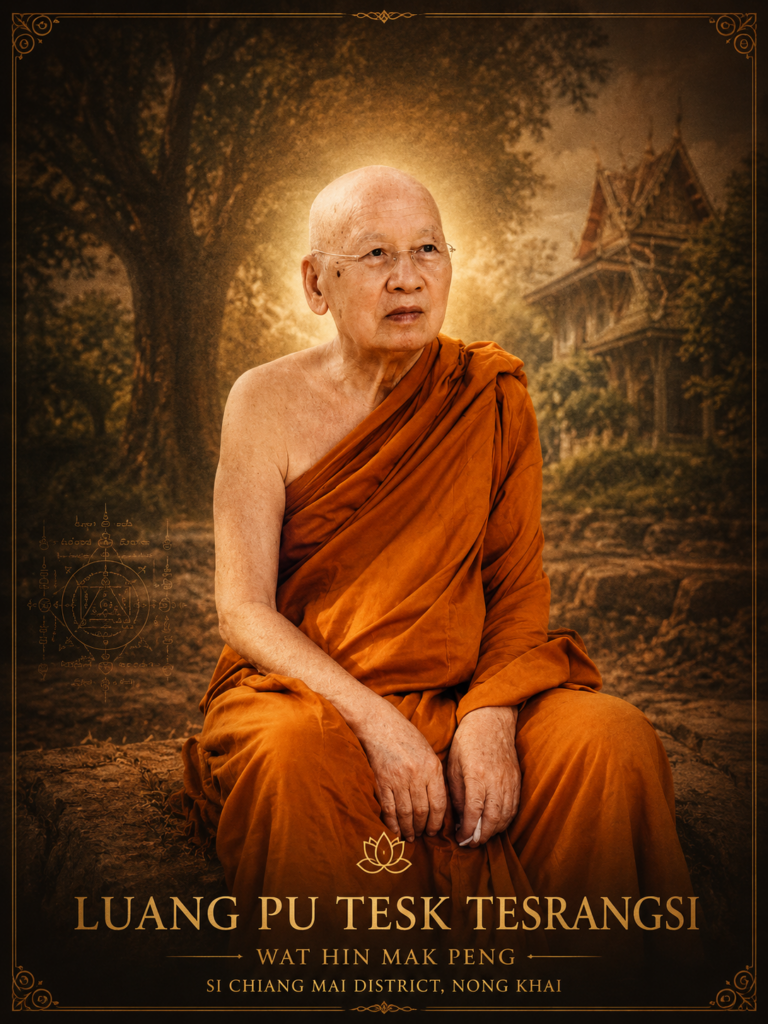
Luang Pu Tesk Tesrangsi, Wat Hin Mak Peng, Si Chiang Mai District, Nong Khai
Who Was Luang Pu Tesk Tesarangsri (หลวงปู่เทสก์ เทสรังสี)? Luang Pu Tesk Tesarangsri (หลวงปู่เทสก์ เทสรังสี), also written in some sources as Luang Pu Tesk Tesrangsi, was a highly respected forest monk of the Thai Buddhist tradition who was born on 26 April BE 2445 (AD 1902) and became closely associated with Wat Hin Mak Peng (วัดหินหมากเป้ง) ... Read more ↓
Biography
Who Was Luang Pu Tesk Tesarangsri (หลวงปู่เทสก์ เทสรังสี)?
Luang Pu Tesk Tesarangsri (หลวงปู่เทสก์ เทสรังสี), also written in some sources as Luang Pu Tesk Tesrangsi, was a highly respected forest monk of the Thai Buddhist tradition who was born on 26 April BE 2445 (AD 1902) and became closely associated with Wat Hin Mak Peng (วัดหินหมากเป้ง) in Nong Khai Province. He is remembered as a direct disciple within the lineage of Luang Pu Mun Bhuridatto (หลวงปู่มั่น ภูริทัตโต), a leading teacher of meditation, Dharma discipline, and monastic development in northeastern Thailand. In Thai amulet history, Luang Pu Tesk is most widely revered not for mass commercial amulet production but for his immense spiritual authority, strict moral conduct, and the devotional value later attached to commemorative amulets and sacred objects connected with his name, teachings, and temple.
Early Life and Ordination
Luang Pu Tesk Tesarangsri (หลวงปู่เทสก์ เทสรังสี) was born with the original name Tesk in a farming family in Ban Na Sida, Tambon Klang Yai, Amphoe Ban Phue, Udon Thani Province. His father was Mr. Utsah and his mother was Mrs. Krang. He was born on 26 April BE 2445 (AD 1902), in the Year of the Tiger. His early background was simple and rural, which is a common pattern among many revered monks of the Kammatthana or forest tradition in northeastern Thailand. That humble upbringing shaped his endurance, discipline, and closeness to the rhythm of nature, all of which later aligned deeply with meditation life.
At the age of 18, he had the opportunity to accompany Phra Ajarn Sing Khantayakamo (พระอาจารย์สิงห์ ขันตยาคโม) on a pilgrimage. This became a turning point in his spiritual life. He was ordained first as a novice monk at Wat Ban Keng Yai, with Phra Ajarn Lui (พระอาจารย์หลุย) as his preceptor. After entering novice life, he further studied Dharma at Wat Suthanaram and also at Wat Sri Thong in Ubon Ratchathani, building a stronger doctrinal and practical foundation before full ordination.
He later received full ordination on 16 May BE 2466 (AD 1923) at the ordination hall of Wat Suthanaram. His preceptor was Phra Maha Rat, and his karma-vachariya was Phra Maha Pin Panyapalo (พระมหาปิ่น ปัญญาพโล). From that point onward, he entered the monkhood fully and would remain ordained for 71 years, becoming one of the most venerated meditation masters of his generation.
Spiritual Development and Practice
The spiritual development of Luang Pu Tesk Tesarangsri (หลวงปู่เทสก์ เทสรังสี) is closely tied to the Thai forest meditation lineage. After his ordination, he continued travelling and practising with respected teachers, especially through pilgrimage and austere forest discipline. A major moment in his formation came when he had the chance to pay respects to Luang Pu Mun Bhuridatto (หลวงปู่มั่น ภูริทัตโต) at Ban Kho in Ban Phue District, Udon Thani. That meeting is remembered as something that greatly strengthened his determination, mind, and dedication to Dharma practice.
During the period when Luang Pu Mun was residing in northern Thailand, Luang Pu Tesk travelled with Ajahn Onsi to pay homage to the great master at Pa Miang, Doi Mae Pang, Chiang Mai. He also continued practice in the northern region, including the Muser area, and taught devotees in Lamphun before returning to the Northeast. This shows that his practice was not confined to one province or one monastery. He followed the classical forest pattern of wandering, meditation, discipline, seclusion, and teaching.
His lineage is strongly associated with the Kammatthana tradition, where meditation, mindfulness, renunciation, and direct insight into the nature of mind are central. In collector and devotee culture, Luang Pu Tesk is revered as a monk of great purity, calmness, and wisdom rather than as a figure built around miracle stories alone. His enduring reputation comes from Dharma talks, disciplined conduct, temple development, and his role as a respected teacher to monks, laypeople, and seekers from many backgrounds.
In BE 2492 (AD 1949), he visited Luang Pu Mun when the elder master was ill at Wat Ban Nong Phue in Phannanikhom District, Sakon Nakhon, and remained connected to that final period before Luang Pu Mun passed away. This further strengthened his place within the direct disciple lineage that many Thai Buddhist practitioners and amulet collectors value highly.
Major Amulet Consecrations and Ceremonies
For collectors, this is an important point to understand clearly: Luang Pu Tesk Tesarangsri (หลวงปู่เทสก์ เทสรังสี) is primarily remembered as a meditation master and Dharma teacher. Detailed batch-by-batch amulet records in English are not widely documented in the same way as monks whose fame is closely tied to high-volume amulet issuance. Because of that, serious collectors often approach Luang Pu Tesk material through temple provenance, Thai-language references, old photographs, temple publications, and trusted certification routes rather than relying only on simplified market lists.
What is broadly recognised in collector circles is that sacred objects associated with Luang Pu Tesk tend to fall into commemorative, devotional, or temple-issued categories linked to his long monastic career, his connection to Wat Hin Mak Peng (วัดหินหมากเป้ง), and later memorial observances. Many pieces are appreciated because of his status as a direct disciple in the Luang Pu Mun lineage and because devotees regard his blessings, teachings, and disciplined life as the true source of spiritual value.
- BE 2466 (AD 1923) onward, early monastic era: Not widely documented in English sources. There is no widely standardised English catalogue of early amulet batches directly attributed to Luang Pu Tesk from the beginning of his monkhood. Collectors should be cautious of broad marketplace claims that assign famous early issues to him without strong provenance.
- BE 2492 (AD 1949), final period of Luang Pu Mun lineage contact: This year is biographically significant because Luang Pu Tesk visited Luang Pu Mun during the latter’s illness. While this strengthens the spiritual importance of the lineage, specific amulet consecration details for this period are not widely documented in English sources. Pieces claimed from this era should be checked carefully for temple history and supporting evidence.
- BE 2493 to BE 2508 (AD 1950 to AD 1965), southern preaching period: Luang Pu Tesk spent the rains retreat in Phuket in BE 2493 (AD 1950) and continued spreading Dharma in Phuket, Phang Nga, and Krabi for about 15 years. Devotee culture often associates this period with sacred objects and commemorative items tied to his travelling and teaching influence, but detailed batch lists, materials, and ceremony records are not widely documented in English sources.
- Later residence period at Tham Kham Temple (วัดถ้ำขาม) and Wat Hin Mak Peng (วัดหินหมากเป้ง): Collectors most often encounter devotional images, commemorative medallions, monk coins, portraits, and memorial objects linked to these temples. Common materials in the Thai amulet market may include metal, bronze-toned alloys, alms-bowl metal blends, and occasionally sacred powder or mixed materials, but exact specifications depend on the issue and should be verified one piece at a time.
- BE 2537 (AD 1994), passing and memorial significance: Luang Pu Tesk passed away peacefully on 19 December BE 2537 (AD 1994) at around 10:00 PM, aged 93, after 71 years in monkhood. This year became one of the most historically important points for memorial issues, tribute medallions, and temple-related commemorative objects. For many collectors, pieces linked to the period surrounding his passing and royal funeral observances hold special devotional value.
- Royal cremation commemoratives at Wat Hin Mak Peng: His Majesty the King and Her Majesty the Queen granted royal permission for the bathing rite and bestowed a solid gold coffin, while the funeral was conducted under royal patronage. Because the royal cremation ceremony at Wat Hin Mak Peng was historically important, commemorative items related to this event are especially respected among devotees. Exact issue names and full mintage records are not widely documented in English sources, so Thai documentation and expert verification remain important.
From a collector significance standpoint, Luang Pu Tesk amulets are valued less for speculative hype and more for lineage, biography, temple importance, and the monk’s moral authority. In the Thai and Singapore collector market, pieces with clear temple provenance, old casing history, recognised certificates, or direct family ownership tend to attract more serious interest. A documented item from Wat Hin Mak Peng or a long-held memorial issue can carry meaningful devotional and collector appeal even if it is less publicised than the famous commercial batches of some other monks.
Legacy and Temple Significance
Luang Pu Tesk Tesarangsri (หลวงปู่เทสก์ เทสรังสี) left a deep legacy in Thai Buddhism through teaching, monastic leadership, and the establishment of religious sites that strengthened the Buddhist faith across many parts of northeastern Thailand. He was known as a monk of impeccable conduct and was revered by people from all social classes. This broad respect is important because it shows that his influence was not limited to village followers or temple regulars. He became a teacher whose Dharma reached educated laypeople, officials, householders, and serious practitioners alike.
Wat Hin Mak Peng (วัดหินหมากเป้ง) in Si Chiang Mai District, Nong Khai Province became one of the principal places associated with his later life and enduring memory. Situated along the Mekong River, the temple has long been regarded as a place suitable for meditation and reflection. The natural setting itself fits the forest monk ideal: quiet surroundings, contemplative atmosphere, and a strong sense of retreat from worldly distraction.
In his later years, Luang Pu Tesk also resided at Tham Kham Temple (วัดถ้ำขาม), another site connected with meditation life. He passed away there peacefully on 19 December BE 2537 (AD 1994). The royal honours granted after his passing elevated his public remembrance even further. The royal cremation at Wat Hin Mak Peng was not only a funeral rite but also a historic expression of national reverence for a monk whose life embodied Buddhist discipline and service.
Today, devotees continue to venerate Luang Pu Tesk through his teachings, biographies, temple visits, commemorative objects, portrait amulets, and annual acts of remembrance. For the amulet community, he represents a category of monk whose sacred value comes from lived practice, not from aggressive market visibility. That is why pieces associated with him are often treasured quietly and respectfully by collectors who value lineage and spiritual authenticity.
Frequently Asked Questions About Luang Pu Tesk Tesarangsri (หลวงปู่เทสก์ เทสรังสี) Amulets
What amulets did Luang Pu Tesk Tesarangsri (หลวงปู่เทสก์ เทสรังสี) create?
Detailed English records of all amulets directly created or blessed by Luang Pu Tesk are not widely documented in English sources. In the collector market, the most commonly encountered pieces are portrait medallions, commemorative monk coins, temple-issued devotional items, and memorial issues associated with Wat Hin Mak Peng (วัดหินหมากเป้ง), Tham Kham Temple (วัดถ้ำขาม), and later tribute periods after his passing in BE 2537 (AD 1994). Collectors generally focus on temple provenance, age, casing history, and certificate support rather than depending on broad commercial batch lists.
Which Luang Pu Tesk Tesarangsri (หลวงปู่เทสก์ เทสรังสี) amulet is considered the most powerful?
Among devotees, the most respected Luang Pu Tesk pieces are usually older portrait issues and memorial objects with credible links to Wat Hin Mak Peng or to important periods of his life and passing. Collector consensus does not revolve around one single universally dominant commercial batch in the way it does for some other famous amulet monks. Instead, pieces are prized for strong temple provenance, direct connection to his lineage under Luang Pu Mun, older documented ownership, and the monk’s reputation for strict morality and meditation attainment. In devotional culture, spiritual authority matters more than market hype.