Luang Pu Tesk Tesrangsi
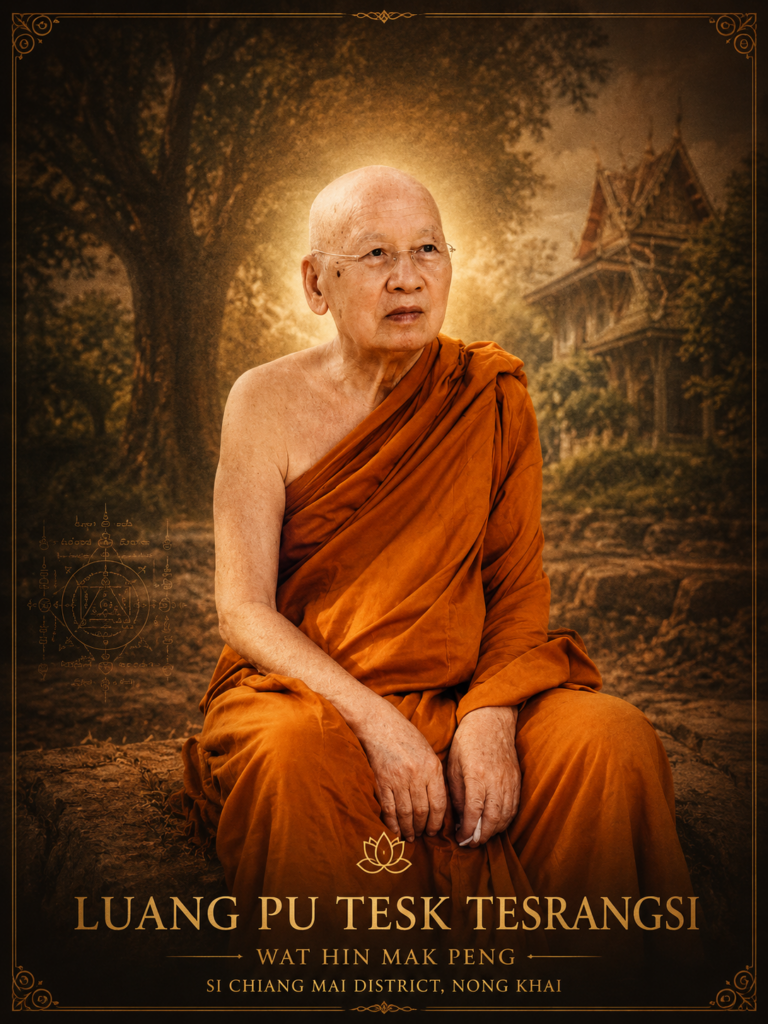
Luang Pu Tesk Tesrangsi (หลวงปู่เทสก์ เทสรังสี) was a highly revered Thai forest tradition master born in BE 2445 (AD 1902) in the northeastern region of Thailand, who served as the abbot of Wat Hin Mak Peng (วัดหินหมากเป้ง) in Si Chiang Mai District (อำเภอศรีเชียงใหม่), Nong Khai Province (จังหวัดหนองคาย), on the banks of the Mekong River bordering Laos. He was a direct disciple of the legendary Ajahn Mun Bhuridatto (อาจารย์มั่น ภูริทัตโต) and is considered one of the foremost meditation masters of the twentieth-century Thai forest tradition (กัมมัฏฐาน), renowned across Southeast Asia and the broader Buddhist world for his profound teachings on vipassana (วิปัสสนา) and his extraordinary moral purity. In Thai amulet collector culture spanning Singapore, Malaysia, Thailand, China, Taiwan, and Hong Kong, Luang Pu Tesk Tesrangsi is most celebrated for the sacred amulets consecrated under his authority at Wat Hin Mak Peng, which are regarded as embodiments of the deep spiritual power (พุทธคุณ) accumulated through decades of strict forest-monk discipline. Read more ↓
Biography
Who Was Luang Pu Tesk Tesrangsi?
Luang Pu Tesk Tesrangsi (หลวงปู่เทสก์ เทสรังสี) was a highly revered Thai forest tradition master born in BE 2445 (AD 1902) in the northeastern region of Thailand, who served as the abbot of Wat Hin Mak Peng (วัดหินหมากเป้ง) in Si Chiang Mai District (อำเภอศรีเชียงใหม่), Nong Khai Province (จังหวัดหนองคาย), on the banks of the Mekong River bordering Laos. He was a direct disciple of the legendary Ajahn Mun Bhuridatto (อาจารย์มั่น ภูริทัตโต) and is considered one of the foremost meditation masters of the twentieth-century Thai forest tradition (กัมมัฏฐาน), renowned across Southeast Asia and the broader Buddhist world for his profound teachings on vipassana (วิปัสสนา) and his extraordinary moral purity. In Thai amulet collector culture spanning Singapore, Malaysia, Thailand, China, Taiwan, and Hong Kong, Luang Pu Tesk Tesrangsi is most celebrated for the sacred amulets consecrated under his authority at Wat Hin Mak Peng, which are regarded as embodiments of the deep spiritual power (พุทธคุณ) accumulated through decades of strict forest-monk discipline.
Early Life and Ordination
Luang Pu Tesk Tesrangsi (หลวงปู่เทสก์ เทสรังสี) was born in BE 2445 (AD 1902) in the village of Ban Nong Sung (บ้านหนองสูง), in the northeastern Thai province of Nakhon Ratchasima (นครราชสีมา). His birth name and exact family background are not widely documented in English sources, though Thai biographical accounts describe a family of modest, devout Buddhist farmers typical of the rural Isan (อีสาน) region of that era.
He entered the monastic life at a young age, initially ordained as a novice (samanera, สามเณร) before receiving full Upasampada ordination (อุปสมบท) as a bhikkhu (ภิกษุ). The precise BE year of his full ordination is not widely documented in English sources, though Thai sources place it in the early BE 2460s (AD 1920s). From his earliest years as a monk, he demonstrated an unusual inclination toward the austere dhutanga (ธุดงค์) practices — the strict wandering ascetic disciplines that define the Thai forest tradition — choosing forest solitude over the relative comfort of village temple life, a commitment that would define his entire monastic career.
Spiritual Development and Practice
The defining moment of Luang Pu Tesk Tesrangsi’s spiritual life came when he became a devoted disciple of the great meditation master Ajahn Mun Bhuridatto (อาจารย์มั่น ภูริทัตโต), the revered patriarch of the Thai forest tradition (กัมมัฏฐาน). Under Ajahn Mun’s guidance, Luang Pu Tesk undertook rigorous training in both samatha (สมถะ) — the development of deep mental concentration and stillness — and vipassana (วิปัสสนา), the systematic contemplation of impermanence, suffering, and non-self that leads to liberation.
He is also documented to have studied under other senior disciples of Ajahn Mun’s lineage, embedding himself deeply within what scholars and devotees now recognise as the Kammatthana forest monk tradition of northeastern Thailand. Luang Pu Tesk was known for his exceptional clarity of Dhamma exposition, producing numerous written teachings and Dhamma talks that are still studied by monks and laypeople across Thailand today. His personal practice involved long periods of solitary retreat in forest settings, caves, and remote mountain areas throughout the Isan region and beyond. Devotees and collectors alike regard his decades of strict practice as the source of the exceptional spiritual potency (อานุภาพ) attributed to the amulets and sacred objects consecrated at Wat Hin Mak Peng during his abbotship.
Major Amulet Consecrations and Ceremonies
Luang Pu Tesk Tesrangsi was not primarily known as a prolific creator of amulets in the commercial sense; rather, his involvement in the consecration of sacred objects (วัตถุมงคล) was always deeply rooted in the monastery’s spiritual needs and the sincere requests of devoted laypeople and supporters of Wat Hin Mak Peng. This restraint is itself a point of great collector significance — objects bearing his blessing or consecration are comparatively scarce, lending them considerable prestige in the northeastern Thai amulet tradition.
Specific amulet batch records for Luang Pu Tesk Tesrangsi are not yet in the Thai Amulets Collection database, and comprehensive batch-by-batch documentation is not widely documented in English sources. The following outlines what is broadly known within Thai collector communities:
- Wat Hin Mak Peng Consecrated Items (General, circa BE 2500s–2530s / AD 1950s–1980s):
- Types: Medallions (เหรียญ), small clay tablets (พระผง), and monk-image amulets (เหรียญรูปเหมือน) produced in limited quantities for temple supporters and dhamma followers.
- Materials: Alpaca alloy (ทองแดง), brass (ทองเหลือง), and sacred powder composites (ผงพุทธคุณ) incorporating blessed herbs, old temple fragments, and consecrated earths sourced from the Mekong riverbank.
- Ceremony Details: Consecration ceremonies at Wat Hin Mak Peng were characteristically austere, conducted by Luang Pu Tesk and assembled senior forest monks with extended overnight chanting (สวดมนต์) and meditation-empowerment sessions (ปลุกเสก). The forest-monk atmosphere of these ceremonies — absent of commercial fanfare — is precisely what devotees and collectors cite as evidence of genuine spiritual potency.
- Collector Significance: Because Luang Pu Tesk’s primary identity was that of a meditation master and teacher rather than an amulet-creating monk, any certified object bearing provenance from Wat Hin Mak Peng during his abbotship is treated with exceptional reverence in collector circles across Thailand, Singapore, and Malaysia.
- Commemorative Medallions — Later Period (circa BE 2530s–2537 / AD 1987–1994):
- Types: Portrait medallions (เหรียญรูปเหมือน) featuring the image of Luang Pu Tesk in a seated meditation posture, produced as merit-making items for significant temple building projects and for the support of Wat Hin Mak Peng’s continuing development.
- Materials: Gilded brass, silver-toned alpaca, and occasionally pure silver editions for major donors.
- Ceremony Details: Not widely documented in English sources beyond their association with Wat Hin Mak Peng merit-making events.
- Collector Significance: Medallions from this period, particularly those blessed directly in the presence of Luang Pu Tesk before his passing in BE 2537 (AD 1994), are among the most sought-after objects by collectors who revere the forest-monk tradition.
Collectors and devotees are strongly advised to seek items accompanied by provenance documentation or certificates from recognised authentication bodies such as G-Pra (จีพระ) or the Samakom (สมาคมผู้นิยมพระเครื่องพระบูชาไทย), given the scarcity and collector demand for authentic pieces. Thai Amulets Collection will update this record as verified batch documentation becomes available.
Legacy and Temple Significance
Luang Pu Tesk Tesrangsi passed away in BE 2537 (AD 1994), leaving behind an extraordinary legacy that extends far beyond the northeastern Thai province of Nong Khai. He is revered throughout Thailand as one of the last great direct disciples of Ajahn Mun Bhuridatto, and his written Dhamma teachings continue to be widely published, distributed, and studied across the Thai-speaking Buddhist world.
Wat Hin Mak Peng (วัดหินหมากเป้ง) remains an active and deeply respected forest monastery today, drawing meditation practitioners, monks, and pilgrims from across Thailand and internationally. The temple’s location on the scenic Mekong River bank, with its characteristic rocky landscape, contributes to its atmosphere of natural tranquility and spiritual power. A shrine and statue of Luang Pu Tesk within the temple grounds serves as a focus of veneration, with devotees offering flowers, incense, and prayers in his memory throughout the year. Annual merit-making ceremonies (งานบุญประจำปี) at Wat Hin Mak Peng continue to honour his memory and attract both ordained monks and lay devotees who regard him as a figure of exceptional spiritual attainment (พระอรหันต์) within the living Thai Buddhist tradition.