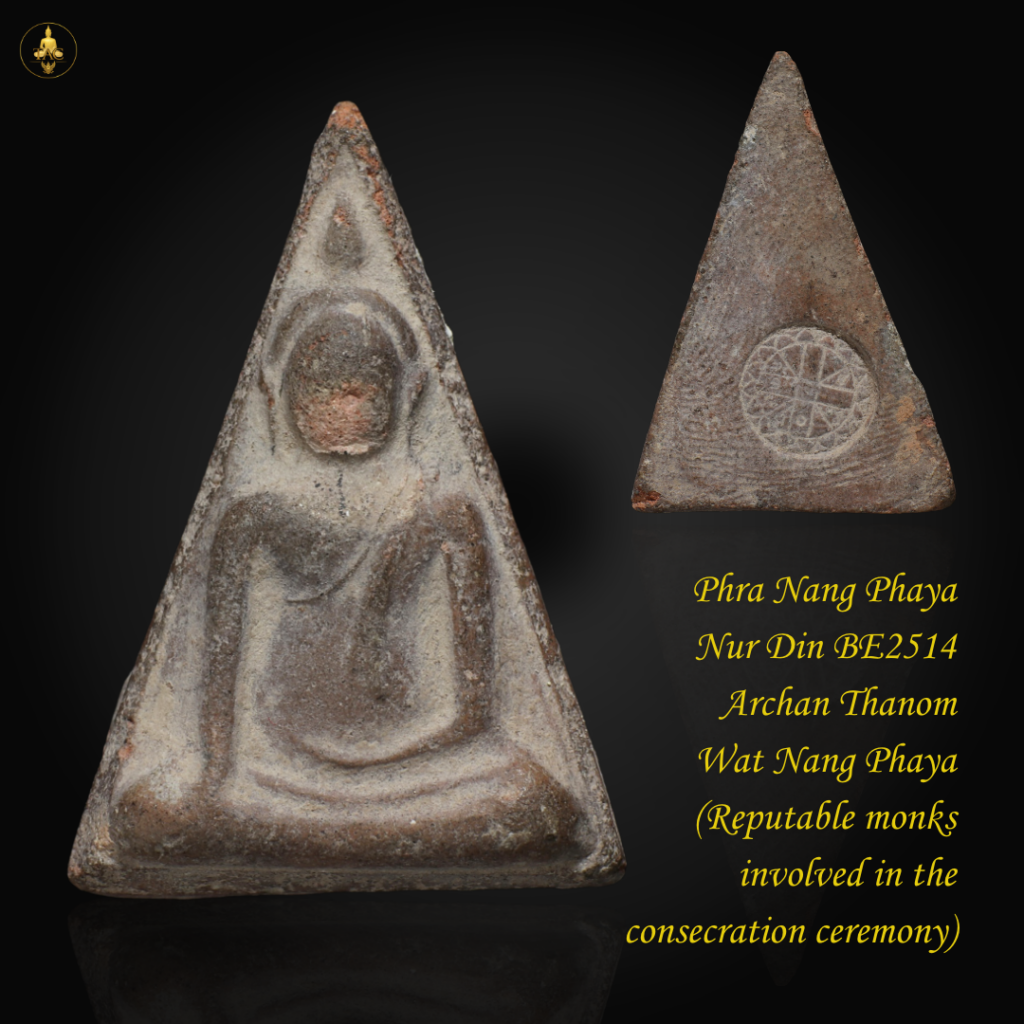
Phra Nang Phaya Nur Din BE2514 Archan Thanom Wat Nang Phaya (Reputable monks involved in the consecration ceremony)
| Type | Phra Nang Phaya |
| Monk | Phra Archan Thanom Khemajaro |
| Temple | Wat Nang Phaya |
| B.E. Year | 2514 |
| Material | Nur Din |
| Condition | Fair |
| SKU | TAC-PhraNangPhaya-AcThanom-001 |
Authentic Phra Nang Phaya Archan Thanom, Wat Nang Phaya BE 2514, Nur Din. Revered for protection & metta. Available from trusted Singapore dealer.
Phra Nang Phaya Archan Thanom — History and Significance
The Phra Nang Phaya Archan Thanom is one of the most respected vintage Thai amulets among collectors in Singapore, Malaysia, Hong Kong, and across Southeast Asia. Created at Wat Nang Phaya in Phitsanulok during BE 2514 (CE 1971), this batch is especially valued because it directly connects to the old Phra Nang Phaya lineage discovered within the temple grounds themselves.
Phra Ajarn Thanom Khemajaro, then abbot of Wat Nang Phaya, played a central role in preserving fragments of ancient Phra Nang Phaya amulets unearthed from the temple area during the Second World War period. Villagers who had taken shelter from wartime bombing within a banana grove inside the temple grounds discovered large quantities of old Phra Nang Phaya amulets among the ruins of a collapsed pagoda. Intact examples were kept by villagers and devotees, while broken fragments were largely left behind.
Recognising the historical and spiritual importance of these sacred remnants, Ajarn Thanom carefully collected the broken pieces and later ground them into sacred powder material for the creation of a new generation of Phra Nang Phaya BE 2514 amulets. For many collectors, this connection to the original ancient cache is one of the defining reasons why the batch remains highly respected within the wider Thai Buddhist amulet tradition.
The batch was also created for a meaningful temple purpose — to raise funds for the construction of the ubosot (main chapel) of Wat Nang Phaya. The auspicious project commencement date was Wednesday, 29 January BE 2512 (CE 1969) at 9:12 AM, following an officially granted royal auspicious timing from His Majesty the King. This royal connection further strengthened the ceremonial prestige associated with the batch.
Phra Nang Phaya and Wat Nang Phaya Heritage
The Phra Nang Phaya Wat Nang Phaya lineage occupies an important position within Thai amulet history. Wat Nang Phaya in Phitsanulok province has long been associated with one of the classic Benjapakee (เบญจภาคี) — the “Five Great Legendary Amulets” of Thailand.
Collectors widely regard the Phra Nang Phaya archetype as a symbol of metta mahaniyom (loving-kindness and social favour), elegance, and spiritual protection. The temple itself traces its heritage back to the Ayutthaya era, and over generations the name “Nang Phaya” became synonymous with highly desirable female-form Buddha amulets characterised by graceful triangular composition and refined sacred earth material.
The BE 2514 batch supervised by Ajarn Thanom was intentionally designed to continue this lineage using actual fragments from old Wat Nang Phaya amulets discovered within the temple grounds. Because of this, experienced collectors often view the batch as more than a commemorative reproduction. In Thai amulet culture, it is frequently regarded as a spiritually connected continuation of the ancient Wat Nang Phaya tradition itself.
The back of many amulets from this batch also bears an auspicious royal yantra-style inscription granted by His Majesty the King, although a smaller number were produced without the inscription. This feature has become one of the distinguishing characteristics referenced during authentication and collector evaluation.
Grand Maha Phutthapisek Consecration Ceremony of BE 2514
The grand Maha Phutthapisek (มหาพุทธาภิเษก) consecration ceremony for the Phra Nang Phaya Archan Thanom batch was held on Saturday, 30 January BE 2514 (CE 1971) inside the vihara of Wat Nang Phaya, Phitsanulok province. The ceremony followed ancient Thai Buddhist consecration traditions and was considered one of the major nationwide blessing ceremonies of its era.
Somdej Phra Wanarat (Pun Punnasiri), who later became the 17th Supreme Patriarch of the Rattanakosin period, also participated in blessing the batch, greatly elevating its historical significance among collectors and devotees.
The monastic side of the ceremony was presided over by Phra Ajarn Sai Sumano, while Phra Kru Wamthep Muni served as chief Brahmin officiant. The principal layperson representative was Lieutenant General Samran Paetayakun, Commander of the 3rd Army Region. During the sacred candle extinguishing ritual, the ceremonial candle was extinguished by Luang Phor Ngern of Wat Don Yai Hom.
A total of 108 renowned master monks from across Thailand participated in the consecration ceremony, including:
- Luang Phor Ngern of Wat Don Yai Hom, Nakhon Pathom
- Luang Pu Toh of Wat Pradu Chimphli, Thonburi
- Luang Pu Fan Ajaro of Wat Tham Kham, Sakon Nakhon
- Luang Phor Phang of Wat Udom Khongkha Khiri Khet, Khon Kaen
- Luang Pu Waen of Wat Doi Mae Pang, Chiang Mai
- Kruba Phromchak Sangwon of Wat Phra Phutthabat Tak Pha, Lamphun
- Luang Phor Thob of Wat Chang Phueak, Phetchabun
- Luang Phor Kasem Khemako of Susan Trilak Cemetery, Lampang
- Luang Phor Khom of Wat Phai Rong Wua, Suphan Buri
- Luang Phor Thir of Wat Pa Lelai, Suphan Buri
- Luang Phor Od of Wat Chan Sen, Nakhon Sawan
- Luang Phor Pae of Wat Phikun Thong, Sing Buri
Collectors today continue to reference this extensive list of participating monks as one of the strongest historical factors supporting the enduring popularity of the BE 2514 batch.
Nur Din Phra Nang Phaya — Composition and Craftsmanship
The Nur Din Phra Nang Phaya material from this batch carries exceptional collector importance because it incorporates powdered fragments of original ancient Phra Nang Phaya amulets recovered from Wat Nang Phaya itself. In Thai amulet culture, sacred old material (muan sarn) with direct historical lineage is considered highly meaningful both spiritually and historically.
The earth-based composition gives the amulet its characteristic matte texture and naturally aged appearance. Genuine examples from BE 2514 typically display fine granular surfaces, uneven natural compression, and subtle colour variations associated with old sacred clay material blended with ancient fragments.
Each amulet was individually hand-pressed rather than factory produced. Because of this, collectors often observe unique fingerprints, fingernail impressions, or slight pressure marks on the surfaces. The sides were manually trimmed using saw blades, resulting in visible edge-cutting marks that have become recognised authenticity indicators among experienced enthusiasts.
The mould itself was based on a traditional Phra Nang Phaya format replicating earlier temple-era designs, preserving the classic triangular silhouette associated with the Wat Nang Phaya lineage. For many serious collectors, these production characteristics provide important evidence cues separating authentic temple-made pieces from later commercial reproductions.
Spiritual Benefits of Phra Nang Phaya by Archan Thanom
Within Thai Buddhist amulet culture, the Phra Nang Phaya Archan Thanom is especially associated with metta mahaniyom (great loving-kindness and social attraction). Devotees often wear the amulet to encourage harmonious relationships, favourable interactions, and supportive connections in both personal and business life.
Because the batch incorporates material from ancient Wat Nang Phaya amulets together with a major nationwide consecration ceremony involving 108 respected monks, many collectors also regard it as a comprehensive all-round amulet suitable for daily wear.
- Metta Mahaniyom — Traditionally associated with charm, goodwill, compassion, and social support.
- Kong Grapan — Regarded in Thai amulet culture as supportive for spiritual protection and safety from harmful influences.
- Chok Lap — Associated with good fortune, smooth opportunities, and prosperity.
- Maha Sanaeh — Often connected with personal appeal, communication harmony, and relationship improvement.
Phra Nang Phaya BE 2514 — Authentication and Collector Value
The Phra Nang Phaya BE 2514 batch remains highly sought after because it occupies a unique middle ground between ancient lineage material and modern documented consecration history. While original Ayutthaya-period Phra Nang Phaya amulets from old caches command extremely high prices, the Ajarn Thanom batch is often viewed by collectors as a historically meaningful alternative that still retains genuine connection to the original temple material.
Authentication generally focuses on several evidence cues, including the Nur Din texture, natural ageing, hand-trimmed edges, royal inscription details, and characteristic mould features associated with the Wat Nang Phaya BE 2514 pressing. Minor imperfections such as fingerprints and saw-cut marks are usually regarded positively because they reflect the hand-made production process of the period.
Collectors also place strong emphasis on provenance due to the large number of reproductions circulating in the Thai amulet market. Pieces sourced from established dealers with documented lineage references remain especially desirable among collectors in Singapore and the broader Southeast Asian collecting community.
Today, the Phra Nang Phaya Archan Thanom continues to be appreciated not only for devotional reasons, but also for its historical relationship to one of Thailand’s most recognised Benjapakee amulet traditions and its remarkable nationwide consecration ceremony involving many of the country’s legendary master monks.
Attributes reflect Thai Buddhist devotional tradition and are not measurable claims.
![[SOLD] Phra Nang Phaya Nur Din BE2472 Luang Pu Toh (Lp Toh) Wat Pradoochimplee](https://tac-media.sgp1.digitaloceanspaces.com/2026/03/phra-nang-phaya-nur-din-be2472-luang-pu-toh-lp-toh-wat-pradoochimplee-150x150.webp)