Luang Phor Nong Wat Khlong Madan
Luang Phor Nong (หลวงพ่อนง) was a highly revered Buddhist monk based at Wat Khlong Madan (วัดคลองมะดัน) in Suphan Buri Province (จังหวัดสุพรรณบุรี), central Thailand, whose birth year is not widely documented in English sources. He is principally celebrated within Thai amulet collector communities across Southeast Asia and Greater China for the powerful sacred objects consecrated under his guidance at Wat Khlong Madan, a temple historically regarded as one of Suphan Buri's spiritually significant centres of Buddhist practice and amulet craftsmanship. Among devotees, Luang Phor Nong is venerated as a master practitioner of Wicha (วิชา) — the sacred esoteric knowledge applied during amulet consecration — and his name is closely associated with the broader tradition of Suphan Buri monks whose amulets carry a strong following among collectors in Singapore, Malaysia, Thailand, Hong Kong, Taiwan, and China. Read more ↓
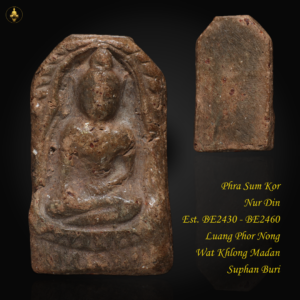
Amulets by Luang Phor Nong Wat Khlong Madan 1 total · 0 available
Biography
Who Was Luang Phor Nong?
Luang Phor Nong (หลวงพ่อนง) was a highly revered Buddhist monk based at Wat Khlong Madan (วัดคลองมะดัน) in Suphan Buri Province (จังหวัดสุพรรณบุรี), central Thailand, whose birth year is not widely documented in English sources. He is principally celebrated within Thai amulet collector communities across Southeast Asia and Greater China for the powerful sacred objects consecrated under his guidance at Wat Khlong Madan, a temple historically regarded as one of Suphan Buri’s spiritually significant centres of Buddhist practice and amulet craftsmanship. Among devotees, Luang Phor Nong is venerated as a master practitioner of Wicha (วิชา) — the sacred esoteric knowledge applied during amulet consecration — and his name is closely associated with the broader tradition of Suphan Buri monks whose amulets carry a strong following among collectors in Singapore, Malaysia, Thailand, Hong Kong, Taiwan, and China.
Early Life and Ordination
The specific details of Luang Phor Nong’s early life, including his lay name, family background, and the precise date of his birth in the Buddhist Era (พุทธศักราช), are not widely documented in English sources. What is preserved within Thai devotional and collector traditions is that he was associated with the central plains region of Thailand, where Suphan Buri Province (จังหวัดสุพรรณบุรี) has long served as fertile ground for the development of Buddhist monasticism and the production of sacred amulets with deep cultural significance.
Luang Phor Nong is understood to have undertaken his ordination (อุปสมบท) as a Theravada Buddhist monk in accordance with the Vinaya traditions upheld across Thai temples of the central region. Upon taking robes, he began his formal monastic education and spiritual training, eventually taking up residence at Wat Khlong Madan, where he would spend a significant portion of his monastic life and where his reputation as a teacher, meditation practitioner, and maker of consecrated objects would come to be firmly established. The precise year of his ordination is not widely documented in English sources.
Spiritual Development and Practice
Luang Phor Nong’s spiritual development is understood by devotees to have been shaped by the rich meditative and esoteric traditions native to Suphan Buri Province, a region that produced several of Thailand’s most celebrated amulet-making monks. Central Thailand’s monastic tradition typically integrates both Samatha (สมถะ) — the cultivation of mental stillness and concentration — and Vipassana (วิปัสสนา) — the development of deep insight into the nature of phenomena — as complementary pillars of practice.
The names of Luang Phor Nong’s primary teachers and the specific lineage (สายวิชา) through which he received his Wicha are not widely documented in English sources. However, within the collector community, monks of Wat Khlong Madan are broadly regarded as inheritors of central Thai Buddhist esoteric traditions, which place great emphasis on the empowerment of sacred objects through sustained meditation, the recitation of Kata (คาถา) — sacred verses — and the accumulation of spiritual merit (บุญ) over decades of disciplined practice. It is this depth of practice that devotees credit as the source of the protective and auspicious qualities attributed to amulets consecrated by Luang Phor Nong and monks of his generation and temple.
Major Amulet Consecrations and Ceremonies
Detailed batch records for Luang Phor Nong’s amulet consecrations — including specific Buddhist Era years, official batch names, and itemised material compositions — are not widely documented in English sources. Collectors and dealers working with Thai-language temple archives and specialist amulet publications (นิตยสารพระเครื่อง) will find the most accurate and complete batch-level documentation in those primary Thai sources.
Within the general collector tradition, Luang Phor Nong is associated with several categories of sacred object commonly produced by prominent monks of Suphan Buri and the central plains tradition. These include Phra Phim (พระพิมพ์) — pressed votive tablets in clay or mixed sacred powder (ผงพระ) — Roop Muean (รูปเหมือน) — likeness amulets bearing the monk’s image — and Rian (เหรียญ) — stamped or cast medallions in metal alloys such as copper (ทองแดง), brass (ทองเหลือง), and alpaca (ทองขาว). Any collector seeking to verify specific batch years, ceremonial details, or material compositions for a Luang Phor Nong piece is strongly advised to consult authenticated Thai-language temple records or to seek appraisal from a reputable Thai amulet certification body.
Legacy and Temple Significance
Luang Phor Nong’s lasting contribution to Thai Buddhist culture rests in his role as a teacher and consecrator of sacred objects at Wat Khlong Madan (วัดคลองมะดัน), a temple that occupies an honoured place within the spiritual landscape of Suphan Buri Province. Suphan Buri (สุพรรณบุรี) is itself one of Thailand’s most storied provinces in the context of amulet history, having produced generations of monks whose sacred objects are actively collected and venerated across the Thai-speaking world and throughout the broader Theravada Buddhist communities of Southeast Asia and Greater China.
Among devotees, Luang Phor Nong is remembered as a monk of sincere practice and deep compassion, qualities that Thai Buddhist culture holds to be essential prerequisites for the creation of efficacious amulets. The specific details of any shrines, memorial statues, or annual ceremonies held in his honour at Wat Khlong Madan are not widely documented in English sources, though it is customary for significant monks of Thai temples to be commemorated through continuing merit-making activities (ทำบุญ) at their home temple. Collectors who visit Wat Khlong Madan may find further information and venerative spaces dedicated to Luang Phor Nong within the temple grounds.