Benjapakee: The 5 Legendary Thai Sacred Amulets
Discover The Five Legendary "Benjapakee" Amulets — The Origin of Thailand's Most Revered Sacred Amulets — history, spiritual meaning, and collector value. Singapore's trusted Thai amulet resource.
The Five Legendary “Benjapakee” Amulets — The Origin of Thailand’s Most Revered Sacred Amulets — History and Significance
The Five Legendary “Benjapakee” Amulets — The Origin of Thailand’s Most Revered Sacred Amulets — represent the highest class of sacred Buddhist amulets ever recognised in Thai collecting culture. For collectors in Singapore, Malaysia, and across Southeast Asia, these five amulets stand as the ultimate benchmark of Thai amulet history, spiritual lineage, and sacred craftsmanship. Owning even a single authentic piece is considered both a blessing and a direct connection to Thailand’s living spiritual heritage.
The word “Benjapakee” is derived from two ancient terms: Benja, meaning five, and Pakee, meaning group or fellowship. Together, they name the five greatest legendary amulets ever formally recognised in Thai Buddhist tradition. Each amulet in the group represents a distinct kingdom, artistic era, and spiritual lineage from Thailand’s long sacred history.
Generations of serious collectors have spent entire lifetimes searching for these pieces. Some are so rare that simply seeing an authentic example in person is already considered a fortunate event. Their enduring status in the Thai amulet market is a testament to centuries of faith, royal patronage, and scholarly documentation.
Origins and Historical Context of The Five Legendary “Benjapakee” Amulets — The Origin of Thailand’s Most Revered Sacred Amulets
The formal classification of the Benjapakee was established around BE 2495 (AD 1952) through the dedicated scholarship of a legendary figure in Thai amulet history. Despite popular assumption, the grouping itself is not ancient — it is the product of rigorous modern academic study applied to genuinely ancient artefacts.
The scholar responsible was Colonel Prayoon Ploywimol, writing under the pen name “Triyampavai” — a man widely regarded by the collector community as the Grandmaster of the Thai Amulet World. He was the first person to systematically study, categorise, and document the standards of ancient Thai amulets using a structured analytical framework rather than superstition alone.
Colonel Prayoon evaluated each candidate amulet against six critical criteria: historical significance, rarity and survivability, sacred lineage and temple history, Buddhist artistic excellence, long-standing faith among devotees, and reputation for spiritual power passed down through generations. From this rigorous foundation, the legendary Benjapakee classification was born.
What makes the Benjapakee especially compelling is that together the five amulets form a near-complete timeline of Thailand’s sacred Buddhist heritage — spanning the Hariphunchai, Sukhothai, U-Thong, Ayutthaya, and Rattanakosin periods. Each piece represents a different artistic tradition, regional centre of faith, and monastic lineage. To learn more about the broader Thai Buddhist amulet tradition, the historical record is both deep and richly documented.
Key Events and Sacred Significance of The Five Legendary “Benjapakee” Amulets — The Origin of Thailand’s Most Revered Sacred Amulets
Each of the five Benjapakee amulets carries a distinct origin, material character, and spiritual purpose that collectors and devotees have venerated across multiple generations. The following profiles preserve the precise historical identity of each amulet as documented by Colonel Prayoon Ploywimol’s foundational scholarship.
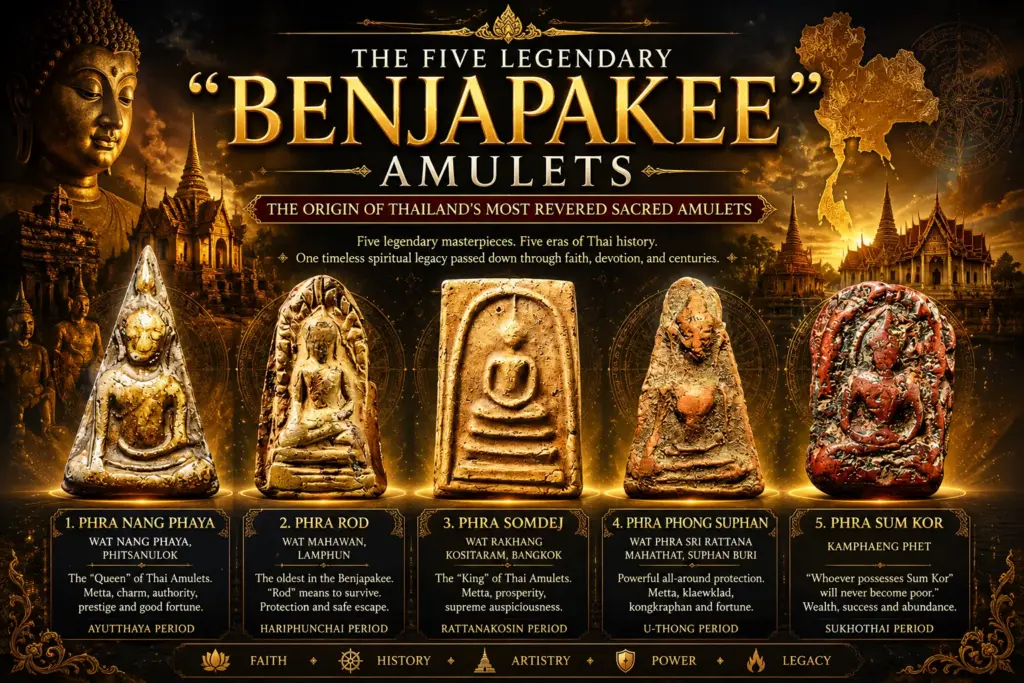
Phra Somdej Wat Rakhang Kositaram (Bangkok — Rattanakosin Period) is widely called the “King of Thai Amulets.” Created by the venerable Somdej Phra Phutthacharn Toh Phromrangsi, its simple rectangular powder form became the model for countless later amulets throughout Thailand. Collectors prize it for its deep association with metta mahaniyom — loving-kindness and popularity — as well as prosperity, peaceful living, and supreme auspiciousness. Authentic early-era pieces command extraordinary prices and are regarded almost as national treasures.
Phra Rod of Wat Mahawan (Lamphun Province — Hariphunchai Era) is the oldest among the Benjapakee group. Despite its small size, it is known for carrying exceptionally strong protective power across generations of devotees. The word Rod itself means “to survive” or “to escape danger,” and many old-school collectors and travellers carried Phra Rod as a personal protection amulet during uncertain times.
Phra Nang Phaya from Wat Nang Phaya (Phitsanulok — Ayutthaya Period) is known as the “Queen of Thai Amulets.” Created during the Ayutthaya period and connected by tradition to Queen Wisutkasat Mahathewi, its triangular form is one of the most beautiful in Thai Buddhist art. Collectors associate it with charm, authority, prestige, good fortune, and metta.
Phra Phong Suphan from Wat Phra Sri Rattana Mahathat (Suphan Buri — U-Thong Period) was discovered hidden inside temple crypt chambers many centuries after its creation. Its thick, powerful form immediately conveys strength to experienced collectors. It is respected as one of the strongest all-around protective amulets ever created — combining metta, klaewklad (safe escape), kongkraphan (protective power), and fortune in a single piece.
Phra Sum Kor (Kamphaeng Phet — Sukhothai Era) beautifully blends Sukhothai and Sri Lankan Buddhist artistic influence in its rounded, graceful Buddha form. It is considered one of the finest examples of ancient Thai sacred art. The famous saying collectors still repeat today captures its enduring reputation: “Whoever possesses Sum Kor will never become poor.” Generations of devotees associate this Sukhothai-era amulet with wealth, business success, opportunities, and abundance.
How to Identify and Authenticate The Five Legendary “Benjapakee” Amulets — The Origin of Thailand’s Most Revered Sacred Amulets
Authenticating a Benjapakee amulet is one of the greatest challenges in the Thai amulet Singapore collector market. Because these are among the most coveted pieces in all of Thai amulet history, they are also among the most frequently reproduced and misrepresented.
Experienced dealers assess multiple layers of evidence simultaneously — material composition, surface aging, artistic convention, and provenance documentation. No single factor is conclusive; authentic authentication requires all elements to align. The following key markers form the foundation of professional Benjapakee verification:
- Material and surface aging: Genuine pieces show natural patina, micro-cracking, and mineral absorption consistent with their declared age and burial or storage conditions.
- Iconographic precision: Each amulet type has strict artistic conventions — the rectangular form of Phra Somdej, the triangular profile of Phra Nang Phaya, and the rounded Buddha figure of Phra Sum Kor must conform to documented historical standards.
- Provenance and lineage documentation: Serious authentic pieces are typically accompanied by traceable collector history, temple certificates, or documented inheritance lines — especially critical for Phra Phong Suphan and Phra Rod.
- Expert community consensus: In the Thai amulet collector world, major pieces are assessed by panels of recognised veteran collectors and amulet association committees before being accepted as authentic.
- Physical weight and density: The feel of a genuine ancient pressed-powder or clay amulet differs distinctly from modern reproductions — experienced collectors develop this tactile knowledge over years of handling authentic Thai amulet pieces.
The Five Legendary “Benjapakee” Amulets — The Origin of Thailand’s Most Revered Sacred Amulets — Impact on Thai Amulet Tradition and Collector Value
The Benjapakee classification, established in BE 2495 by Colonel Prayoon Ploywimol, permanently shaped the standards and vocabulary of the entire authentic Thai amulet collecting world. Before his systematic work, amulet valuation was largely informal and inconsistent; after the Benjapakee framework, collectors had a shared canon against which all other amulets could be measured.
In today’s market across Singapore, Malaysia, Taiwan, Hong Kong, and mainland China, Benjapakee amulets occupy the absolute top tier of collector value. Authenticated pieces — particularly early Phra Somdej Wat Rakhang, Phra Nang Phaya from Phitsanulok, and Phra Sum Kor from Kamphaeng Phet — regularly achieve prices that rival fine art and historical artefacts at auction. Finding an authentic Phra Phong Suphan from Suphan Buri is considered exceptionally difficult even for well-connected dealers.
These amulets survived wars, kingdom collapses, hidden temple crypts, family inheritance lines, and centuries of devoted custodianship. That history of survival is itself part of their sacred and monetary value. The Benjapakee amulets are, in the truest sense, living pieces of Thailand’s spiritual and artistic heritage — and they remain the defining ambition of serious collectors across the region.
The Five Legendary “Benjapakee” Amulets — The Origin of Thailand’s Most Revered Sacred Amulets — Collector Guide for Singapore and Southeast Asia
For collectors in Singapore and across Southeast Asia entering the Benjapakee market, education is the single most important investment. The rarity and value of these pieces means that fakes and over-graded examples are common — and the cost of a mistake at this level can be significant. Working with an established, specialist Thai amulet Singapore dealer with documented expertise in ancient amulets is strongly recommended before any acquisition.
New collectors are advised to begin by studying each of the five types individually — understanding their distinct iconography, material history, and the specific temples and eras they represent. Building familiarity with the collector community through amulet associations in Thailand and certified dealers in Singapore and Malaysia provides the knowledge base and trusted networks that serious collectors rely on. The Benjapakee journey rewards patience, scholarship, and long-term commitment over impulse acquisition.
Frequently asked questions
The Benjapakee are the five amulets formally recognised as the greatest in Thai amulet history, spanning the Hariphunchai, Sukhothai, U-Thong, Ayutthaya, and Rattanakosin periods. The classification was established around BE 2495 (AD 1952) by Colonel Prayoon Ploywimol, writing under the pen name "Triyampavai," who assessed each amulet against criteria including historical significance, rarity, sacred lineage, and Buddhist artistic excellence. Together, the five amulets — Phra Somdej, Phra Rod, Phra Nang Phaya, Phra Phong Suphan, and Phra Sum Kor — form a timeline of Thailand's sacred Buddhist heritage across different kingdoms and artistic traditions. Each piece originated from a distinct regional centre of faith, from Lamphun in the north to Suphan Buri in the central plains. Their combined legacy defines the highest standard of Thai Buddhist amulet culture.
Authentic Benjapakee amulets are authenticated through a combination of material analysis, iconographic verification, surface aging assessment, and provenance documentation. Each of the five amulet types has strict artistic conventions — for example, the rectangular form of Phra Somdej Wat Rakhang Kositaram or the triangular profile of Phra Nang Phaya from Wat Nang Phaya in Phitsanulok — and deviations from these conventions are a primary red flag. Genuine ancient pieces display natural patina, mineral absorption, and aging characteristics consistent with centuries of storage or burial. Major authenticated pieces typically carry traceable collector lineage or temple certificates, and are reviewed by panels of veteran collectors and amulet association committees in Thailand. Because of their extraordinary rarity and value, professional authentication by a specialist dealer is essential before any Benjapakee acquisition.
Each Benjapakee amulet carries a distinct spiritual purpose rooted in its historical origin and the devotional traditions surrounding it. Phra Somdej Wat Rakhang Kositaram, created by Somdej Phra Phutthacharn Toh Phromrangsi, is associated with metta mahaniyom — loving-kindness, popularity, prosperity, and supreme auspiciousness. Phra Rod of Wat Mahawan in Lamphun, whose name means "to survive" or "to escape danger," is revered for personal protection and safe passage. Phra Nang Phaya from Phitsanulok, the "Queen of Thai Amulets" connected to Queen Wisutkasat Mahathewi, is known for charm, authority, prestige, and good fortune. Phra Phong Suphan from Suphan Buri combines metta, klaewklad (safe escape), kongkraphan (protective power), and fortune. Phra Sum Kor from Kamphaeng Phet, created during the Sukhothai era, carries the legendary association with wealth and abundance — expressed in the famous collector saying: "Whoever possesses Sum Kor will never become poor."