Chapter 01
How Thai amulets are actually worn
Which Wrist or Hand to Wear a Thai Amulet On? Before deciding which wrist, it helps to know that most Thai amulets aren't worn on the wrist at all. The traditional home for an amulet is a chain around the neck, with the piece resting over the chest — close to the heart, and easy to keep in a position of respect. Many Thais wear several pieces on one chain, each chosen for a different purpose such as protection, fortune or metta (if you're new to the subject, start with what a Thai amulet is). Wrist-worn pieces do exist — bracelet amulets, sacred cords and bangle-style charms — and they're perfectly traditional. But when people ask "which wrist?", the honest first answer is that the necklace is the classic choice, and the wrist is a secondary one for certain kinds of piece. Once you know that, the rest of the etiquette falls into place easily.Chapter 02
Left wrist or right? The honest answer
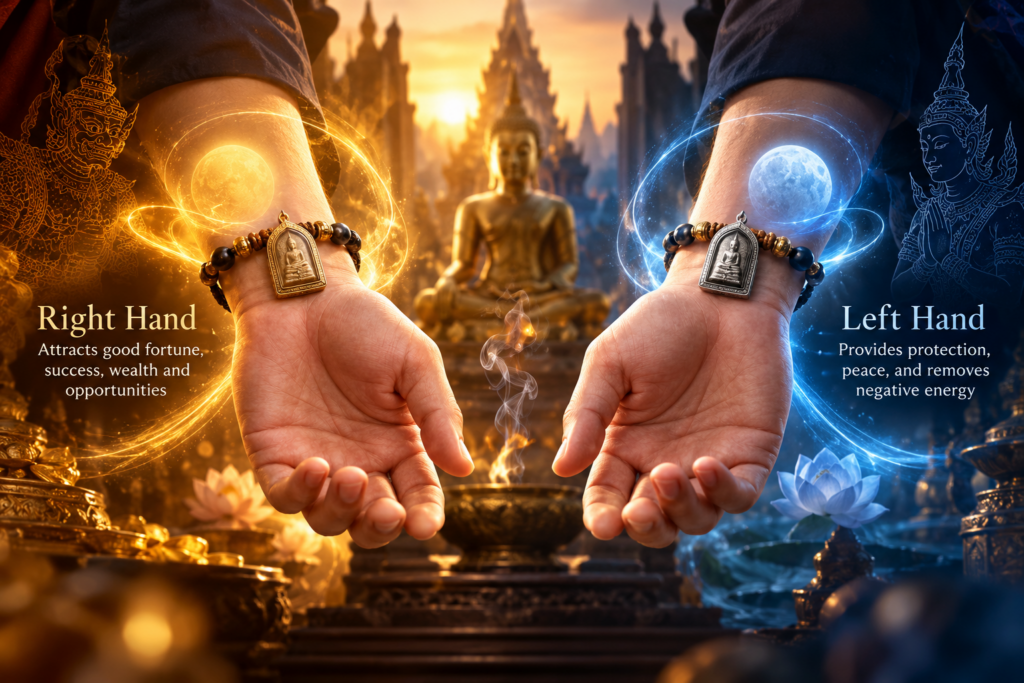
There is no single sacred rule that makes one wrist correct and the other wrong. If you wear a bracelet amulet or sacred cord, choose whichever wrist keeps the piece safe, comfortable and visible to you. Some people follow personal habits or family preference, and a right-handed person often finds a piece sits better on the left simply because it's out of the way — but that's practicality, not doctrine. What matters far more than the side is that the piece is treated with care: not knocked about, not left to dangle where it can snag, and not worn below the waist. If you keep those in mind, either wrist is entirely respectful.Chapter 03
The one rule that matters: keep it above the waist
The point collectors genuinely care about isn't left or right — it's height. A blessed piece should be worn above the waist, on the chest, upper arm or wrist, and never below. The reasoning is simple and respectful: what is sacred is kept in a high, honoured position on the body. For the same reason, Thais avoid letting an amulet trail to the floor, sit in a back pocket, or be placed carelessly on the ground. This single principle explains most amulet etiquette. Wear it high, keep it clean and protected, and handle it with a little reverence — that's the heart of wearing one well.Chapter 04
Wearing more than one — and the odd-number custom
It's common to wear several amulets together, and here tradition does offer guidance: the number of main amulets (phra — Buddha and monk pieces) worn on a chain is by custom kept odd — one, three, five, and so on. It's a long-standing preference rather than a strict law, but many collectors follow it. Importantly, that odd-number count applies only to the main amulets. Separate talismans — the khrueang rang class, such as takrut (rolled inscribed scrolls), loop om (small round pellet amulets) and singha (the sacred lion) — sit outside the count. You can add these freely without breaking the odd number, which is why you'll often see a chain carrying, say, three Buddha amulets alongside a takrut or two.Chapter 05
Bracelet amulets, sacred cords and casings
If you do wear a piece on the wrist, a few practical notes help. Bracelet-style amulets and sacred cords (such as a blessed sai sin) are worn on either wrist and are a comfortable everyday option. For any piece you wear daily — neck or wrist — a protective casing is the single best investment: it shields the amulet from sweat, moisture and knocks, which matters especially for old pressed-powder pieces that can chip or erode. Remove or protect metal and powder amulets before heavy exercise, swimming or the shower, where water and impact can harm them (our guide to caring for a Thai amulet goes into this in full).Chapter 06
Wearing your amulet with confidence
So — which wrist? Either, if you wear a bracelet piece; but most amulets are happiest on a chain over the chest. Keep it above the waist, protect it in a casing, and if you wear several, keep the main amulets to an odd number with your talismans added freely outside that count. None of this is complicated — it simply reflects the respect a blessed piece is given. When you're ready to find yours, browse our pieces and ask us about casings and chains any time.Chapter 07
Frequently Asked Questions
Which wrist should you wear a Thai amulet on?
There's no fixed sacred rule — either wrist is fine for a bracelet piece. Most Thai amulets are actually worn on a necklace over the chest rather than the wrist; when worn on the wrist, choose whichever keeps the piece safe and comfortable.Is it better to wear a Thai amulet as a necklace or bracelet?
A necklace is the traditional choice, resting the piece over the heart. Bracelet amulets and sacred cords are also common and respectful. Either way, keep the piece above the waist.Can you wear more than one Thai amulet at once?
Yes — and the tradition prefers an odd number: one, three, five. That count applies to the main Buddha and monk amulets (phra); talismans known as khrueang rang — takrut, loop om, singha — sit outside the count and can be added freely.Why do Thai amulets have to be worn above the waist?
Out of respect — a blessed piece is kept in a high, honoured position on the body. For the same reason, amulets aren't worn below the waist, left to trail on the ground, or kept in a back pocket.Can you wear a Thai amulet every day?
Yes, and most people do. For daily wear, use a protective casing and remove or shield the piece before swimming, the shower or heavy exercise to protect it from water and knocks.Dealer's Note — Thai Amulets Collection has sold and advised on Thai amulets f