Phra Kru Pim Na Khu (Giant Face) Nur Din Wat Takrai Ayutthaya BE2100-2200
| Type | Ancient |
| Temple | Wat Takrai |
| B.E. Year | 2100 |
| Material | Din |
| SKU | TAC-0332 |
Phra Kru Pim Na Khu (Giant Face) • Nur Din Year: BE2100-2200 • Wat Takrai, Ayutthaya • Ancient Ayutthaya-era votive lineage Overview of the ancient phra kru (excavated votive amulet)
Phra Kru Pim Na Khu (Giant Face) • Nur Din
Year: BE2100-2200 • Wat Takrai, Ayutthaya • Ancient Ayutthaya-era votive lineage
Overview of the ancient phra kru (excavated votive amulet) in nur din (earthen sacred clay), commonly identified by collectors as the “Giant Face” pim.
What This Piece Represents (Collector Lens)
In Thai amulet culture, old phra kru pieces are valued not only as sacred objects but also as surviving witnesses to earlier temple history. This Phra Kru Pim Na Khu, often called the “Giant Face” type, carries the visual force that collectors look for in Ayutthaya-period earthen amulets: a broad frontal presence, strongly simplified facial mass, and a body shaped more by devotional intention than later commercial refinement. Devotees often keep such pieces for quiet protection and continuity with the old temple current, while collectors typically study them for age-consistent surface, excavation character, and the way the clay body has matured over centuries.
Amulet Information
Name: Phra Kru Pim Na Khu (Giant Face)
Material: Nur Din (ancient sacred clay / earthen composition)
Year: BE2100 – 2200 • Estimated age 400–500 years
Temple: Wat Takrai, Ayutthaya
Province: Phra Nakhon Si Ayutthaya
Monk: Not available
Lineage Note: Ancient excavated-style votive amulet associated with Wat Takrai and the Ayutthaya-period phra kru tradition.
SKU: TAC-WatTakrai-PhraKruPimNaKhu-001
Price:
SGD 428
History & Lineage — Phra Kru Pim Na Khu (Giant Face) (Wat Takrai, Ayutthaya)
This amulet is presented as an old Wat Takrai piece estimated at roughly 400–500 years of age, which places it broadly within the historical world of Ayutthaya-era Buddhist material culture. In Thai amulet study, pieces described as phra kru are often understood as amulets preserved in temple crypts, old chedi deposits, or long-kept sacred caches before later discovery. That background matters because it shapes how collectors interpret the object: not as a modern issue, but as a surviving temple relic formed within an earlier devotional landscape.
The “Na Khu” or “Giant Face” identity refers to the visual prominence of the facial structure. Collectors usually apply such names as shorthand to distinguish one pim from another within a broader family of ancient clay votives. The form is not prized for ornamental finesse in the modern sense. Instead, it is appreciated for archaic directness, devotional compression, and the kind of simplified sacred image language that often appears in genuinely old earthen amulets.
Because no specific monk attribution is provided, the amulet is best framed through temple and period lineage rather than personal authorship. In practice, many very old Ayutthaya-period votives are studied through clay composition, iconographic family, excavation character, and temple association rather than named consecrators. That does not weaken their significance. In Thai amulet culture, age, temple current, and survival history are often precisely what make such pieces spiritually and academically compelling.
About the Material — Nur Din Composition
Nur din means an earth-based body, but in old Thai amulet study the term usually implies more than ordinary clay. Ancient votive pieces were often formed from selected soils, temple earth, fine mineral matter, and naturally binding elements, then pressed or molded into sacred forms. Over centuries, such bodies develop collector-visible evidence cues: dry mineral surfaces, settled pores, softened edges, micro-fissures, and tonal variation that are difficult to imitate convincingly. These are the kinds of traits collectors typically look for when assessing old earthen amulets from reputed temple sites.
- Ancient earthen body consistent with nur din votive production rather than modern machine-finished casting.
- Collectors typically study pore structure, dry clay maturity, and natural edge wear for age-consistent evidence cues.
- The surface character of old clay pieces often carries more importance than sharpness, because authentic age usually softens detail over time.
Design / Pim / Variant Notes
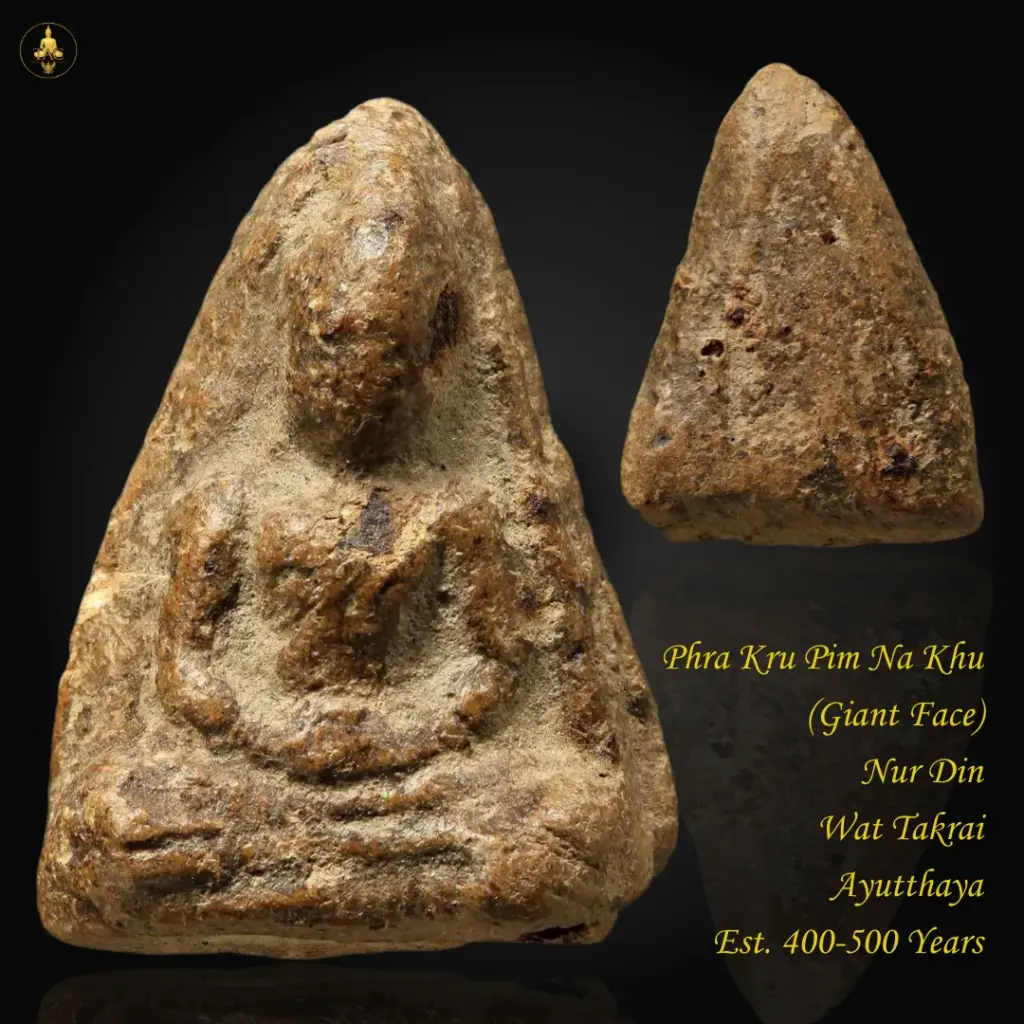
The “Giant Face” reading comes from the oversized and visually dominant frontal mass of the image. In Thai collector language, such names are practical tools for recognizing a specific pim, or mold family, especially when the exact ancient batch name has been lost to time. What matters here is the proportion: broad face, compressed sacred form, and an old-style visual economy that gives the amulet force without needing elaborate detail. That severity is often one of the reasons ancient votives feel so compelling in hand.
Front view showing the dominant facial plane and compact sacred composition that define the Na Khu identification.
Back view showing the plain reverse body and the aged earthen structure typical of old votive pieces.
Traditional Spiritual Attributes & Metaphysical Properties
In Thai amulet culture, ancient phra kru pieces are often approached with a different mindset from later named batches. Rather than focusing on a single advertised blessing, devotees often regard them as carrying old temple energy, quiet protection, and the stabilizing merit of long devotional continuity. The “Giant Face” form may also be read as a watchful presence, giving the amulet a strong guardian impression. These meanings are part of traditional belief and collector interpretation, not measurable claims.
- Protection: Devotees often keep old temple clay amulets for calm, enduring protective blessing.
- Stability: Ancient earthen votives are commonly associated with groundedness and continuity of merit.
- Temple Current: Collectors and devotees may value the piece for its connection to an old Wat Takrai sacred environment.
Rarity & Collector Significance — Phra Kru Pim Na Khu (Giant Face)
The significance of this amulet lies less in polished presentation and more in survival. Old Ayutthaya-associated clay pieces are valued because authentic examples are finite, often structurally fragile, and increasingly studied through subtle evidence rather than surface drama. A piece like this becomes important when it retains readable form, stable clay body, and an overall impression consistent with age. Collectors who focus on early Thai Buddhist material culture typically appreciate such amulets for exactly that reason: they remain close to the old temple world from which they emerged.
Conclusion
Phra Kru Pim Na Khu (Giant Face) in nur din from Wat Takrai represents an older layer of Thai amulet culture in which age, temple association, and devotional survival matter as much as visual finish. Its broad archaic face, earthen body, and Ayutthaya-era estimate give it clear identity for both collector and devotee. For students of Thai material culture, it offers a concise example of how ancient votive amulets carry meaning through form, clay, and continuity rather than through later commercial storytelling.
Attributes reflect Thai Buddhist devotional tradition and are not measurable claims.