Legend of Phra Rahu: The Thai Deity of Fortune, Protection and Wealth Transformation
Discover the Legend of Phra Rahu — ancient Hindu-Buddhist origins, astrological power, sacred amulets, and collector value for Singapore and Southeast Asia.
Legend of Phra Rahu — History and Significance
The Legend of Phra Rahu is one of the most compelling mythological narratives woven into Thai Buddhist tradition, drawing collectors in Singapore, Malaysia, Hong Kong, and across Greater China into its rich spiritual orbit. Rooted in ancient Hindu and Vedic cosmology, Phra Rahu represents the shadow forces of karma, fate, and ultimate transformation. For serious collectors of authentic Thai amulets, understanding this legend is essential to appreciating why Rahu amulets carry such powerful reverence and collector value.
Phra Rahu is classified as a shadow planet in both Indian and Thai astrology, exerting a dramatic influence over human fortune, sudden events, and karmic cycles. His mythology explains the very phenomenon of solar and lunar eclipses, making him one of the few deities in Thai cosmology directly tied to observable astronomical events.
Across Thailand, Rahu is worshipped not as an evil force, but as a karmic purifier — a deity who tests resilience and, when properly honoured, removes deep-seated misfortune and opens the path to sudden blessings.
Origins and Historical Context of the Legend of Phra Rahu
The Legend of Phra Rahu originates from the ancient Hindu myth of the Samudra Manthan — the Churning of the Cosmic Ocean — one of the most celebrated episodes in Vedic scripture. During this event, a great asura (demon) disguised himself as a god and infiltrated the divine assembly to drink the amrita, the nectar of immortality. His deception was discovered by the sun god Surya and the moon god Chandra, who alerted the great preserver Lord Vishnu.
Acting swiftly, Lord Vishnu severed the asura’s head with his divine discus, the Sudarshana Chakra. However, because the demon had already consumed a portion of the immortal nectar, his head could not die. This immortal head became known as Rahu, while the lifeless body transformed into Ketu — both recognised as shadow planets in Indian and Thai astrological systems.
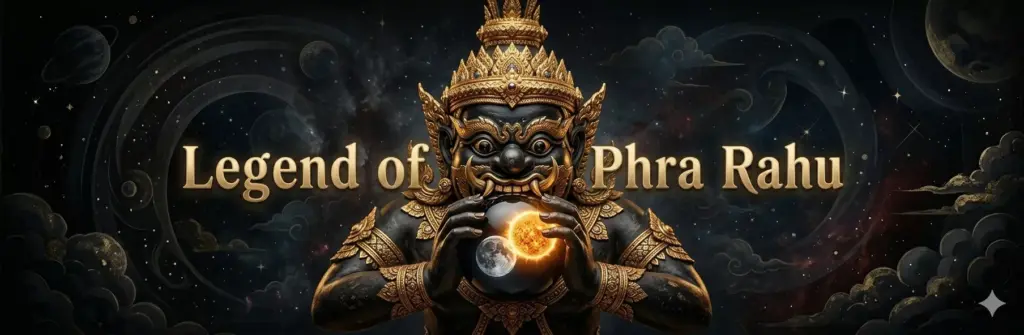
From that moment, Rahu eternally pursues Surya and Chandra across the heavens in revenge, periodically swallowing them whole. In Thai cosmological belief, each instance of Rahu swallowing the sun or moon is what causes solar and lunar eclipses, giving this ancient legend a direct and living presence in everyday astronomical observation. This mythological framework was seamlessly integrated into Thai Buddhist tradition as the faith absorbed and harmonised Brahmanical cosmology over centuries.
Phra Rahu’s worship became firmly established in Thailand through the famous Wat Srisathong in Nakhon Pathom, which stands today as the most celebrated temple for Rahu worship in the entire country. His iconography, rituals, and amulet traditions evolved over generations within the Thai Buddhist ceremonial framework, becoming a vital part of Thai amulet history.
Key Events and Sacred Significance of the Legend of Phra Rahu
In Thai cosmology, Phra Rahu is formally designated as the 8th celestial influence, known as Dao Rahu (ดาวราหู). He governs the House of Karma and is astrologically linked to sudden events, fame, scandal, fortune, spiritual temptation, and the powerful 18-year Rahu return cycle that profoundly affects a person’s destiny.
Phra Rahu is traditionally propitiated on Wednesday nights after 6 PM, on eclipse days (both solar and lunar), and on specific Rahu transit days designated by Thai astrologers. Offerings presented to him are distinctively black in colour — including black jelly, black coffee, black rice, and black beans — with eight types of black-coloured items symbolising the absorption and neutralisation of accumulated misfortune.
Rahu katha (sacred chants dedicated to Rahu) are recited during these rituals to invoke his protection and goodwill. Key temples associated with Rahu worship and amulet production include Wat Srisathong (Nakhon Pathom), Wat Sam Ngam (Nakhon Pathom) — which produces Phra Rahu amulets blessed by the highly respected Luang Phor Tae — as well as Wat Traimit (Bangkok), which hosts special Rahu chanting rituals, and Wat Bang Khan (Nakhon Si Thammarat), which has issued occasional Rahu-related releases.
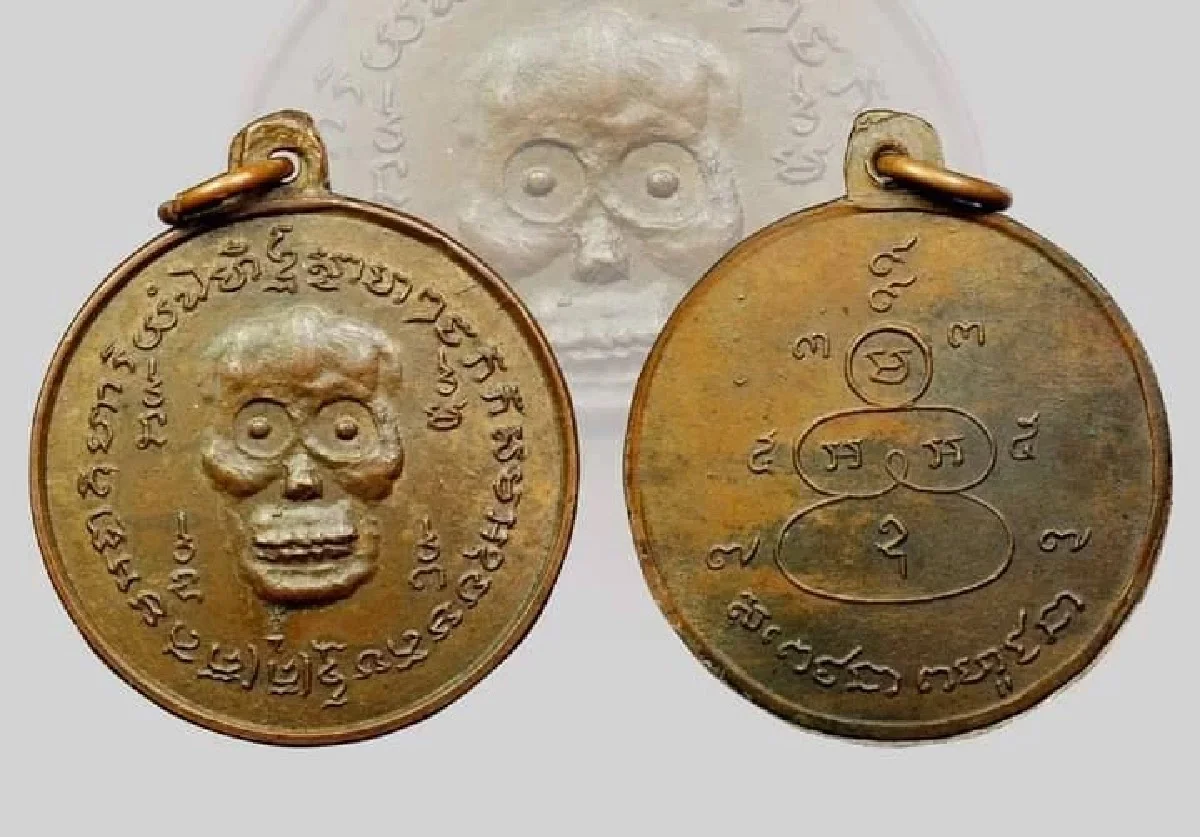
Phra Rahu amulets take several distinct forms, each carrying its own sacred function. The Rian Rahu is a medallion typically depicting Rahu in the act of swallowing the moon. The Takrut Rahu consists of metal scrolls inscribed with Rahu katha. Amulet images are also crafted in gemstone, black lacquer, and alpaca alloy, while the celebrated Rahu Omchan coins — depicting Rahu swallowing the moon — have been produced by temples including Wat Srisathong and Wat Sam Ngam, making these among the most sought-after pieces in Thai amulet history.
Impact on Thai Amulet Tradition and Collector Value
The Legend of Phra Rahu has left an indelible mark on the broader landscape of the Thai Buddhist amulet tradition, elevating Rahu amulets into a specialised and highly respected category sought by collectors across Thailand, Singapore, Malaysia, Taiwan, and mainland China. Unlike many amulet categories focused solely on wealth or protection, Rahu pieces carry a unique dual significance — they address both astrological misfortune and deep karmic obstacles simultaneously.
Collectors are particularly drawn to temple-certified pieces from Wat Srisathong and Wat Sam Ngam, where provenance, ceremonial blessing records, and the involvement of revered monks like Luang Phor Tae lend measurable authenticity and collector confidence. The rarity of properly consecrated Rahu Omchan coins and early Rian Rahu medallions means that genuine pieces continue to appreciate in collector markets across Southeast Asia and Greater China.
For those seeking an authentic Thai amulet with demonstrable spiritual pedigree and verifiable temple origins, Phra Rahu pieces represent one of the most meaningful acquisitions in any serious collection. Their value is reinforced by a living tradition of active worship, eclipse ceremonies, and ongoing amulet production from established temples.
Legend of Phra Rahu — Collector Guide for Singapore and Southeast Asia
For collectors in Thai amulet Singapore and across Southeast Asia, the Legend of Phra Rahu offers a compelling entry point into the astrological and karmic dimensions of Thai sacred arts. Rahu amulets are particularly popular among those experiencing misfortune attributed to unfavourable planetary alignments (ดวงตก), business downturns, legal challenges, threats from black magic or gossip, and significant karmic life transitions.
When assessing authenticity, collectors should verify the issuing temple, the presiding monk’s involvement in the consecration ceremony, and the material composition of the piece. Genuine Rahu amulets from reputable temples in the Nakhon Pathom region carry documented ceremonial histories and are distinguishable by their specific iconographic features — including the black-skinned, fanged depiction of Rahu swallowing the moon or sun, often surrounded by yantras and cosmic motifs.
Frequently asked questions
Legend of Phra Rahu is an important chapter in Thai Buddhist amulet tradition. This article explores its historical context, key figures, and lasting influence on the collector community.
Understanding the history behind Thai amulets deepens appreciation for their spiritual and cultural value. This knowledge helps collectors make more informed decisions.
Thai Amulets Collection offers an extensive knowledge base including monk biographies, temple guides, and historical articles. Visit our Learn section for more.